
Did Africans Sell Other Africans? Voluntary or Coerced? The Nature of African Agency in the Atlantic Slave Trade
Introduction
If some African rulers participated willingly in the Atlantic slave trade while others resisted it, how should their actions be understood? Were they exercising genuine freedom of choice, or were they responding to circumstances that increasingly left them with few viable alternatives? The question lies at the heart of one of the most enduring debates surrounding the Atlantic slave trade because it asks not simply who participated, but what degree of control African societies actually possessed over their own decisions within a rapidly expanding Atlantic system.
Answering this question requires moving beyond the false choice between portraying Africans either as passive victims or as entirely free actors. Across different regions and historical periods, African rulers, merchants, brokers, and communities exercised varying degrees of agency shaped by their political authority, geographical position, military strength, economic circumstances, and access to Atlantic commerce. Some possessed considerable room to negotiate and pursue their own interests. Others operated under mounting pressures created by rival states, commercial dependency, external demand, and growing insecurity. Examining the nature of that agency reveals a far more complex historical reality in which participation often reflected both choice and constraint operating simultaneously rather than independently.[1]
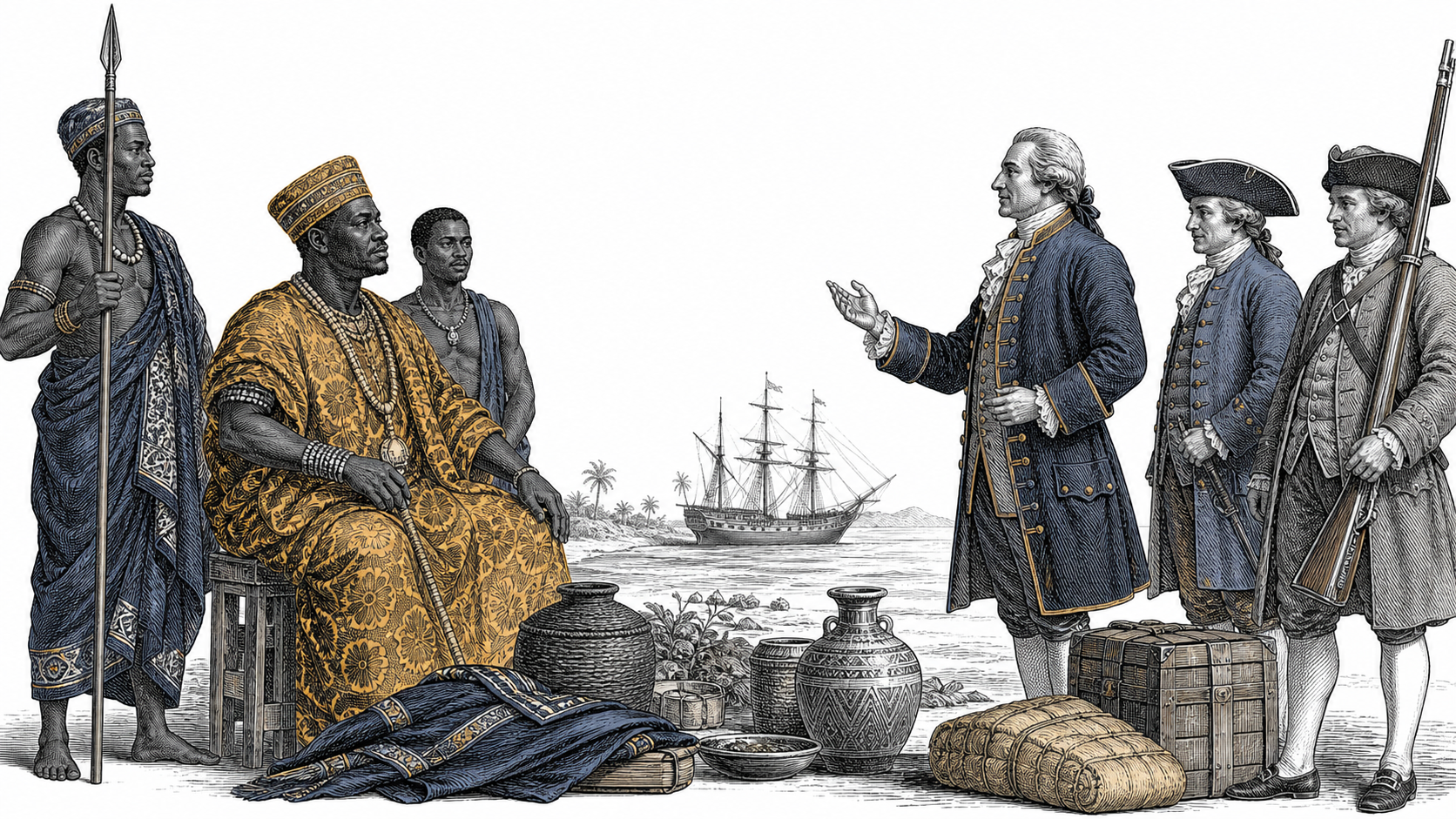
Editorial reconstruction of an eighteenth-century coastal negotiation between African political authorities and European maritime traders, illustrating the tension between bargaining power, commercial opportunity and military pressure in the Atlantic slave trade. Image: The African Foundry, 2026 (AI-assisted editorial illustration).
1. Defining African Agency
Before examining the actions of African societies during the Atlantic slave trade, it is necessary to clarify what historians mean by agency. Agency does not imply unlimited freedom or complete independence. Rather, it refers to the capacity of individuals, communities, or political leaders to make choices within the opportunities and constraints created by their historical circumstances.[2] Recognizing this distinction is essential because debates surrounding African participation in the slave trade have often confused the existence of choice with the existence of complete freedom.
Throughout the Atlantic era, African rulers and merchants made decisions about diplomacy, warfare, commerce, and political alliances. They negotiated with European traders, regulated access to coastal markets, and in many cases determined the conditions under which commerce could take place.[3] These actions demonstrate that African societies were not merely passive recipients of European decisions. They actively shaped important aspects of the trade and frequently pursued objectives that served their own political and economic interests.
Yet agency always operated within limits. The choices available to a powerful coastal kingdom differed significantly from those confronting an inland community vulnerable to slave raiding or a smaller state surrounded by stronger neighbors.[4] Likewise, the options available during the early stages of Atlantic commerce differed from those that existed after the trade had become deeply embedded within regional political and economic systems. Agency therefore varied considerably according to geography, political power, military capability, and historical context.
Understanding agency in this way allows us to move beyond simplistic interpretations of responsibility. It recognizes that African actors made meaningful decisions while also acknowledging that those decisions were shaped by pressures they neither created nor fully controlled. The historical question is therefore not whether Africans possessed agency, but how much agency different societies exercised under different circumstances and how those circumstances influenced the choices they ultimately made.
2. The Spectrum of Agency
Viewing African participation as either entirely voluntary or entirely coerced oversimplifies a much more complex historical reality. Rather than existing at opposite ends of a rigid divide, African agency during the Atlantic slave trade operated along a broad spectrum shaped by political authority, commercial position, military strength, and exposure to external pressures.[5] Different societies occupied different positions along that spectrum, and those positions often changed over time.
At one end were powerful coastal kingdoms, merchant elites, and commercial brokers who possessed considerable bargaining power. States such as Dahomey in present-day Benin, the Oyo Empire in present-day southwestern Nigeria, and influential merchant networks in the Bight of Biafra exercised significant control over access to European traders, negotiated prices, and frequently manipulated competition between rival European powers to secure more favorable commercial terms.[6] Their participation reflected substantial political agency even though it remained connected to wider Atlantic demand.
Further along the spectrum stood inland kingdoms and intermediary societies whose choices were increasingly constrained by regional competition and commercial pressures. While these groups retained political authority within their own territories, they often depended upon coastal trading networks, confronted militarized neighbors, or faced growing pressure to secure access to imported goods such as firearms and gunpowder.[7] Their participation cannot be understood simply as either voluntary or coerced because it reflected both strategic calculation and structural necessity.
At the opposite end were smaller communities, defeated populations, tributary societies, and individuals who possessed little meaningful agency within the wider system. Many became participants only after military defeat, judicial punishment, debt obligations, kidnapping, or direct capture by stronger groups.[8] Their experiences demonstrate that the capacity to choose diminished significantly as one moved away from centres of political and commercial power. For these communities, the Atlantic slave trade represented not an opportunity but an external force to which they were compelled to respond.
Recognizing this spectrum is essential because it reveals that African agency was never distributed equally across the continent. Political power, geographical location, military capability, and commercial influence profoundly shaped the choices available to different societies. Understanding those differences provides the foundation for examining how African agency operated within the broader structures of the Atlantic slave trade.
3. Coastal Power and Inland Vulnerability
The degree of agency exercised by African societies during the Atlantic slave trade was shaped not only by political authority but also by geography. Coastal kingdoms and merchant communities generally occupied a far stronger negotiating position than inland societies because they controlled the points through which European commerce entered the continent.[9] European merchants rarely penetrated deep into the African interior during the height of the Atlantic slave trade. Instead, they depended upon African rulers, merchants, and brokers to supply captives, creating commercial relationships in which coastal elites possessed considerable leverage over access to trade.
This geographical advantage allowed many coastal rulers to negotiate prices, regulate commercial access, and, in some cases, play competing European powers against one another to obtain more favorable terms.[10] The merchant houses of the Bight of Biafra in present-day southeastern Nigeria, the Efik traders of Old Calabar in present-day Cross River State, Nigeria, and powerful rulers along the Slave Coast all exercised varying degrees of influence over the conduct of Atlantic commerce. Their authority rested not upon European control but upon their command of coastal markets and their ability to regulate connections between Atlantic merchants and the African interior.[11]
The situation differed markedly for many inland societies. Communities located far from the coast rarely negotiated directly with European traders. Instead, they often relied upon chains of intermediaries through whom captives, goods, and information passed before reaching Atlantic markets.[12] This greater distance from the coast reduced their bargaining power while simultaneously increasing their vulnerability to slave raids, regional warfare, and commercial pressures generated elsewhere. For many inland populations, the Atlantic economy was experienced less as a negotiated partnership than as an expanding system whose consequences increasingly reached into their territories.
Geography therefore influenced not only commercial opportunity but also the nature of agency itself. Coastal elites frequently possessed greater freedom to shape the terms of exchange, whereas inland communities more often confronted circumstances largely determined by forces beyond their immediate control. Agency remained present in both settings, but it operated under markedly different conditions.
4. Strategic Participation
Among those African rulers and merchant elites who possessed relatively high levels of agency, participation in the slave trade was frequently strategic rather than accidental.[13] These leaders did not simply respond to European initiatives. They evaluated opportunities, negotiated commercial arrangements, managed political alliances, and sought to use Atlantic commerce to strengthen their own states.
The Kingdom of Dahomey provides one of the clearest examples. Having consolidated royal authority during the eighteenth century, Dahomey's rulers incorporated the slave trade into broader strategies of state-building, military expansion, and political centralization.[14] Captives acquired through warfare became an important source of commercial revenue, while imported goods strengthened royal authority and reinforced administrative institutions. Participation therefore reflected deliberate political calculations intended to enhance the kingdom's regional influence.
Comparable patterns appeared within the Asante Empire of present-day Ghana and the Oyo Empire of present-day southwestern Nigeria. Although neither state's economy depended exclusively upon slave exports, both recognized the strategic advantages offered by Atlantic commerce.[15] Imported firearms strengthened armies, luxury goods reinforced systems of patronage, and commercial revenues expanded opportunities for political consolidation. Participation was therefore closely linked to broader objectives of governance rather than simple commercial gain.
Merchant networks likewise exercised considerable initiative. The Aro commercial system in present-day southeastern Nigeria, together with merchant communities operating along the Bight of Biafra, developed sophisticated trading networks connecting inland markets with Atlantic ports.[16] These merchants organized transportation, negotiated exchanges, managed credit arrangements, and accumulated significant political influence through their commercial activities. Their actions demonstrate that important sectors of African society actively shaped the operation of the trade rather than merely responding to European demands.
Yet strategic participation should not be interpreted as evidence of unlimited freedom. Even the most powerful African states operated within a commercial system whose external demand, shipping networks, and plantation economies lay beyond their control. Their agency was substantial, but it remained exercised within an Atlantic economy increasingly driven by forces originating outside Africa.[17]
5. Structural Coercion
Recognizing the strategic choices made by some African actors should not obscure the structural pressures that increasingly narrowed those choices over time. As the Atlantic slave trade expanded, participation became embedded within political, military, and economic systems that made withdrawal progressively more difficult.[18]
One of the most significant sources of pressure emerged through military competition. As neighboring states acquired firearms and strengthened their armies through participation in Atlantic commerce, rulers who attempted to remain outside the trade risked falling behind militarily.[19] Access to imported weapons became closely associated with state security, creating incentives that extended beyond immediate commercial profit. Participation increasingly appeared not simply as an opportunity but as a means of preserving political independence within an increasingly competitive regional environment.
Economic dependency reinforced these pressures. European manufactured goods—including firearms, textiles, metal products, alcohol, and luxury commodities—became deeply integrated into the political economies of many African states.[20] As Walter Rodney and Joseph Inikori have argued, this growing dependence gradually altered patterns of production and exchange, making imported goods increasingly difficult to replace through local manufacture alone.[21] Maintaining access to those commodities often required continued participation in Atlantic commerce, further narrowing the practical options available to many political leaders.
The structure of Atlantic commerce itself also constrained African agency. While African rulers negotiated prices and controlled access to local markets, the overall demand for captives, the availability of European shipping, and the destination of enslaved Africans were determined largely outside the continent.[22] European merchants did not simply purchase captives; they operated within commercial systems backed by expanding imperial economies whose demand for labor remained both external and relentless. African negotiators therefore exercised agency within a market whose fundamental direction they did not control.
These pressures did not eliminate African choice, but they significantly influenced the range of choices available. Some rulers continued to restrict participation despite mounting costs. Others concluded that continued engagement offered the most realistic means of protecting their states from stronger rivals. Still others found themselves drawn into the trade through circumstances created by regional warfare, commercial dependency, or political insecurity.[23] Understanding these different experiences is essential because they reveal that African agency operated within increasingly constraining structures rather than in conditions of unrestricted freedom.
By the late eighteenth century, the question confronting many rulers was no longer simply whether to participate in the slave trade. It was whether their states could afford not to participate while neighboring rivals continued to acquire wealth, firearms, and political advantages from the same system. It is within this narrowing space between strategic choice and structural pressure that the true nature of African agency must be understood.
6. Knowledge, Misunderstanding, and the Limits of Choice
Understanding the nature of African agency also requires examining what different participants knew about the system into which captives were being sold. The degree of responsibility exercised by rulers, merchants, and intermediaries cannot be separated from the information available to them, nor from how that knowledge evolved over time.[24]
During the early centuries of Atlantic commerce, many African rulers encountered European traders through relationships already shaped by earlier exchanges involving gold, ivory, pepper, and other commodities.[25] Although forms of slavery had long existed within many African societies, they differed significantly from the hereditary racial chattel slavery that developed across the plantations of the Americas. In many African systems, enslaved persons could marry, acquire property, become integrated into their owners' households, or in some societies eventually secure their freedom.[26] While these systems were themselves coercive and often harsh, they differed fundamentally from the permanent, racialized, and hereditary institution emerging across the Atlantic world.
For this reason, a number of historians argue that many early African participants did not initially appreciate the full character of New World plantation slavery.[27] They understood that captives were being sold overseas, but many had little direct knowledge of the conditions awaiting them or of the scale upon which Atlantic plantation economies would eventually depend upon enslaved labor. The distance separating African markets from American plantations limited opportunities to observe what became of those who disappeared across the ocean.
Over time, however, that knowledge became increasingly difficult to ignore. Returning sailors, merchants, missionaries, diplomatic correspondence, and rulers such as Afonso I of Kongo all contributed to growing awareness that the trade was producing profound demographic, political, and social consequences.[28] By the eighteenth century, many political leaders had witnessed the depopulation of neighboring regions, the escalation of slave raiding, and the increasing instability generated by the commerce itself. Their decisions therefore occurred within a context of far greater historical experience than had existed during the earliest phases of the trade.
Yet increased knowledge did not necessarily produce greater freedom of action. By the time many rulers fully recognized the long-term consequences of the trade, their states had often become deeply integrated into Atlantic commercial systems.[29] Political alliances depended upon imported goods. Military security increasingly relied upon access to firearms. Merchant networks derived substantial revenues from Atlantic commerce, while neighboring rivals continued to strengthen themselves through participation. For many rulers, the choice no longer lay between entering or avoiding the slave trade. Rather, it lay between remaining within an increasingly destructive system or confronting political, economic, and military consequences that threatened the survival of their own states.
Knowledge therefore altered the moral and political dimensions of agency without necessarily expanding the practical options available to those exercising it. Understanding this distinction helps explain why awareness of the trade's destructive consequences did not automatically result in widespread withdrawal from participation.
7. Responsibility Without Simplification
The question of African agency has often been framed as though historians must choose between two opposing explanations. One portrays Africans primarily as victims overwhelmed by European expansion. The other presents African rulers and merchants as fully independent actors who willingly supplied captives to Atlantic markets. Neither interpretation adequately reflects the historical evidence.[30]
The Atlantic slave trade emerged through the interaction of African, European, and American systems whose contributions were neither identical nor interchangeable. European demand, maritime technology, commercial capital, plantation economies, and imperial expansion created and sustained the transatlantic market into which millions of Africans were sold.[31] At the same time, many African rulers, merchants, and intermediaries exercised meaningful agency by negotiating with European traders, organizing commercial networks, conducting wars that produced captives, and participating in systems that supplied Atlantic markets.[32] Both dimensions formed essential components of the historical process.
Recognizing African agency therefore does not diminish European responsibility for creating, expanding, and profiting from a global system of racial chattel slavery. Equally, acknowledging Europe's central role does not erase the decisions made by African actors who participated in that system under varying historical circumstances.[33] The evidence instead points toward a more complex reality in which agency existed but was distributed unevenly, constrained by geography, political power, commercial dependency, regional competition, and the changing dynamics of Atlantic commerce.
Perhaps the most important conclusion emerging from this discussion is that African participation cannot be understood through a single explanation. Some rulers exercised considerable strategic choice. Others confronted narrowing options shaped by military pressures, commercial dependence, and the actions of neighboring states. Many ordinary communities possessed little meaningful agency at all, becoming victims of systems over which they exercised almost no control.[34] The nature of African agency therefore varied not only from one society to another but also across different periods of the trade itself.
In conclusion, asking whether Africans voluntarily sold fellow Africans ultimately presents the wrong historical question. The more revealing question is how different African societies exercised differing degrees of agency within an Atlantic system that became progressively more powerful, more interconnected, and more difficult to escape. Some participated strategically, some resisted, many were coerced by circumstances beyond their control, and countless others became the victims of decisions made by stronger actors around them. Appreciating these distinctions neither absolves nor condemns entire societies. Instead, it restores the complexity that history demands and provides a more balanced understanding of one of the most consequential episodes in Africa's past.[35]
End Notes:
[1] John K. Thornton, Africa and Africans in the Making of the Atlantic World, 1400–1800, 2nd ed. (Cambridge: Cambridge University Press, 1998), pp. 92–116; Paul E. Lovejoy, Transformations in Slavery: A History of Slavery in Africa, 3rd ed. (Cambridge: Cambridge University Press, 2012), pp. 108–121.
[2] Thornton, Africa and Africans in the Making of the Atlantic World, pp. 92–100.
[3] Thornton, Africa and Africans in the Making of the Atlantic World, pp. 100–104; Robin Law, The Slave Coast of West Africa 1550–1750: The Impact of the Atlantic Slave Trade on an African Society (Oxford: Clarendon Press, 1991), pp. 205–214.
[4] Joseph C. Miller, Way of Death: Merchant Capitalism and the Angolan Slave Trade, 1730–1830 (Madison: University of Wisconsin Press, 1988), pp. 97–115.
[5] Paul E. Lovejoy, Transformations in Slavery, pp. 108–121.
[6] G. Ugo Nwokeji, The Slave Trade and Culture in the Bight of Biafra: An African Society in the Atlantic World (Cambridge: Cambridge University Press, 2010), pp. 112–145; Robin Law, The Slave Coast of West Africa 1550–1750, pp. 205–220.
[7] Joseph E. Inikori, Africans and the Industrial Revolution in England: A Study in International Trade and Economic Development (Cambridge: Cambridge University Press, 2002), pp. 181–196; Miller, Way of Death, pp. 115–130.
[8] Lovejoy, Transformations in Slavery, pp. 60–85; Thornton, Africa and Africans in the Making of the Atlantic World, pp. 104–110.
[9] John K. Thornton, Africa and Africans in the Making of the Atlantic World, 1400–1800, 2nd ed. (Cambridge: Cambridge University Press, 1998), pp. 92–104.
[10] Thornton, Africa and Africans in the Making of the Atlantic World, pp. 100–104.
[11] G. Ugo Nwokeji, The Slave Trade and Culture in the Bight of Biafra: An African Society in the Atlantic World (Cambridge: Cambridge University Press, 2010), pp. 112–145; Robin Law, The Slave Coast of West Africa 1550–1750: The Impact of the Atlantic Slave Trade on an African Society (Oxford: Clarendon Press, 1991), pp. 205–220.
[12] Joseph C. Miller, Way of Death: Merchant Capitalism and the Angolan Slave Trade, 1730–1830 (Madison: University of Wisconsin Press, 1988), pp. 97–130.
[13] Paul E. Lovejoy, Transformations in Slavery: A History of Slavery in Africa, 3rd ed. (Cambridge: Cambridge University Press, 2012), pp. 85–108.
[14] Robin Law, The Slave Coast of West Africa 1550–1750, pp. 76–98.
[15] Ivor Wilks, Asante in the Nineteenth Century: The Structure and Evolution of a Political Order (Cambridge: Cambridge University Press, 1975), pp. 180–200; Robin Law, The Oyo Empire c.1600–1836: A West African Imperialism in the Era of the Atlantic Slave Trade (Oxford: Oxford University Press, 1977), pp. 144–158.
[16] G. Ugo Nwokeji, The Slave Trade and Culture in the Bight of Biafra, pp. 132–155.
[17] Thornton, Africa and Africans in the Making of the Atlantic World, pp. 104–110.
[18] Lovejoy, Transformations in Slavery, pp. 108–121.
[19] Thornton, Africa and Africans in the Making of the Atlantic World, pp. 97–104.
[20] Walter Rodney, How Europe Underdeveloped Africa (London: Bogle-L'Ouverture Publications, 1972), pp. 117–130.
[21] Joseph E. Inikori, Africans and the Industrial Revolution in England: A Study in International Trade and Economic Development (Cambridge: Cambridge University Press, 2002), pp. 181–196; Rodney, How Europe Underdeveloped Africa, pp. 117–130.
[22] Joseph C. Miller, Way of Death, pp. 130–145.
[23] Lovejoy, Transformations in Slavery, pp. 115–121.
[24] Paul E. Lovejoy, Transformations in Slavery: A History of Slavery in Africa, 3rd ed. (Cambridge: Cambridge University Press, 2012), pp. 121–130.
[25] John K. Thornton, Africa and Africans in the Making of the Atlantic World, 1400–1800, 2nd ed. (Cambridge: Cambridge University Press, 1998), pp. 43–60.
[26] Orlando Patterson, Slavery and Social Death: A Comparative Study (Cambridge, MA: Harvard University Press, 1982), pp. 5–13; Paul E. Lovejoy, Transformations in Slavery, pp. 1–25.
[27] Lovejoy, Transformations in Slavery, pp. 25–38; Thornton, Africa and Africans in the Making of the Atlantic World, pp. 60–70.
[28] Linda M. Heywood and John K. Thornton, Central Africans, Atlantic Creoles, and the Foundation of the Americas, 1585–1660 (Cambridge: Cambridge University Press, 2007), pp. 34–43; John K. Thornton, Africa and Africans in the Making of the Atlantic World, pp. 110–116.
[29] Joseph E. Inikori, Africans and the Industrial Revolution in England: A Study in International Trade and Economic Development (Cambridge: Cambridge University Press, 2002), pp. 181–196; Walter Rodney, How Europe Underdeveloped Africa (London: Bogle-L'Ouverture Publications, 1972), pp. 117–130.
[30] Thornton, Africa and Africans in the Making of the Atlantic World, pp. 92–116; Lovejoy, Transformations in Slavery, pp. 108–130.
[31] David Eltis and David Richardson, Atlas of the Transatlantic Slave Trade (New Haven: Yale University Press, 2010), pp. 15–23; Joseph C. Miller, Way of Death: Merchant Capitalism and the Angolan Slave Trade, 1730–1830 (Madison: University of Wisconsin Press, 1988), pp. 97–145.
[32] Robin Law, The Slave Coast of West Africa 1550–1750: The Impact of the Atlantic Slave Trade on an African Society (Oxford: Clarendon Press, 1991), pp. 205–220; G. Ugo Nwokeji, The Slave Trade and Culture in the Bight of Biafra: An African Society in the Atlantic World (Cambridge: Cambridge University Press, 2010), pp. 132–155.
[33] Joseph E. Inikori, Africans and the Industrial Revolution in England, pp. 181–196; Thornton, Africa and Africans in the Making of the Atlantic World, pp. 110–116.
[34] Lovejoy, Transformations in Slavery, pp. 121–130; Patrick Manning, Slavery and African Life: Occidental, Oriental, and African Slave Trades (Cambridge: Cambridge University Press, 1990), pp. 122–130.
[35] Thornton, Africa and Africans in the Making of the Atlantic World, pp. 110–116; Lovejoy, Transformations in Slavery, pp. 121–130.
Bibliography.
Eltis, David, and David Richardson. Atlas of the Transatlantic Slave Trade. New Haven: Yale University Press, 2010.
Heywood, Linda M., and John K. Thornton. Central Africans, Atlantic Creoles, and the Foundation of the Americas, 1585–1660. Cambridge: Cambridge University Press, 2007.
Inikori, Joseph E. Africans and the Industrial Revolution in England: A Study in International Trade and Economic Development. Cambridge: Cambridge University Press, 2002.
Law, Robin. The Oyo Empire c.1600–1836: A West African Imperialism in the Era of the Atlantic Slave Trade. Oxford: Oxford University Press, 1977.
Law, Robin. The Slave Coast of West Africa 1550–1750: The Impact of the Atlantic Slave Trade on an African Society. Oxford: Clarendon Press, 1991.
Lovejoy, Paul E. Transformations in Slavery: A History of Slavery in Africa. 3rd ed. Cambridge: Cambridge University Press, 2012.
Manning, Patrick. Slavery and African Life: Occidental, Oriental, and African Slave Trades. Cambridge: Cambridge University Press, 1990.
Miller, Joseph C. Way of Death: Merchant Capitalism and the Angolan Slave Trade, 1730–1830. Madison: University of Wisconsin Press, 1988.
Nwokeji, G. Ugo. The Slave Trade and Culture in the Bight of Biafra: An African Society in the Atlantic World. Cambridge: Cambridge University Press, 2010.
Patterson, Orlando. Slavery and Social Death: A Comparative Study. Cambridge, MA: Harvard University Press, 1982.
Rodney, Walter. How Europe Underdeveloped Africa. London: Bogle-L'Ouverture Publications, 1972.
Thornton, John K. Africa and Africans in the Making of the Atlantic World, 1400–1800. 2nd ed. Cambridge: Cambridge University Press, 1998.
Wilks, Ivor. Asante in the Nineteenth Century: The Structure and Evolution of a Political Order. Cambridge: Cambridge University Press, 1975.
Research by: Atwiine Emmer
Paper by: Ezron Kaijuka
