
Did Africans Sell Other Africans? The African Kings, Merchants, and Kingdoms Behind the Slave Trade
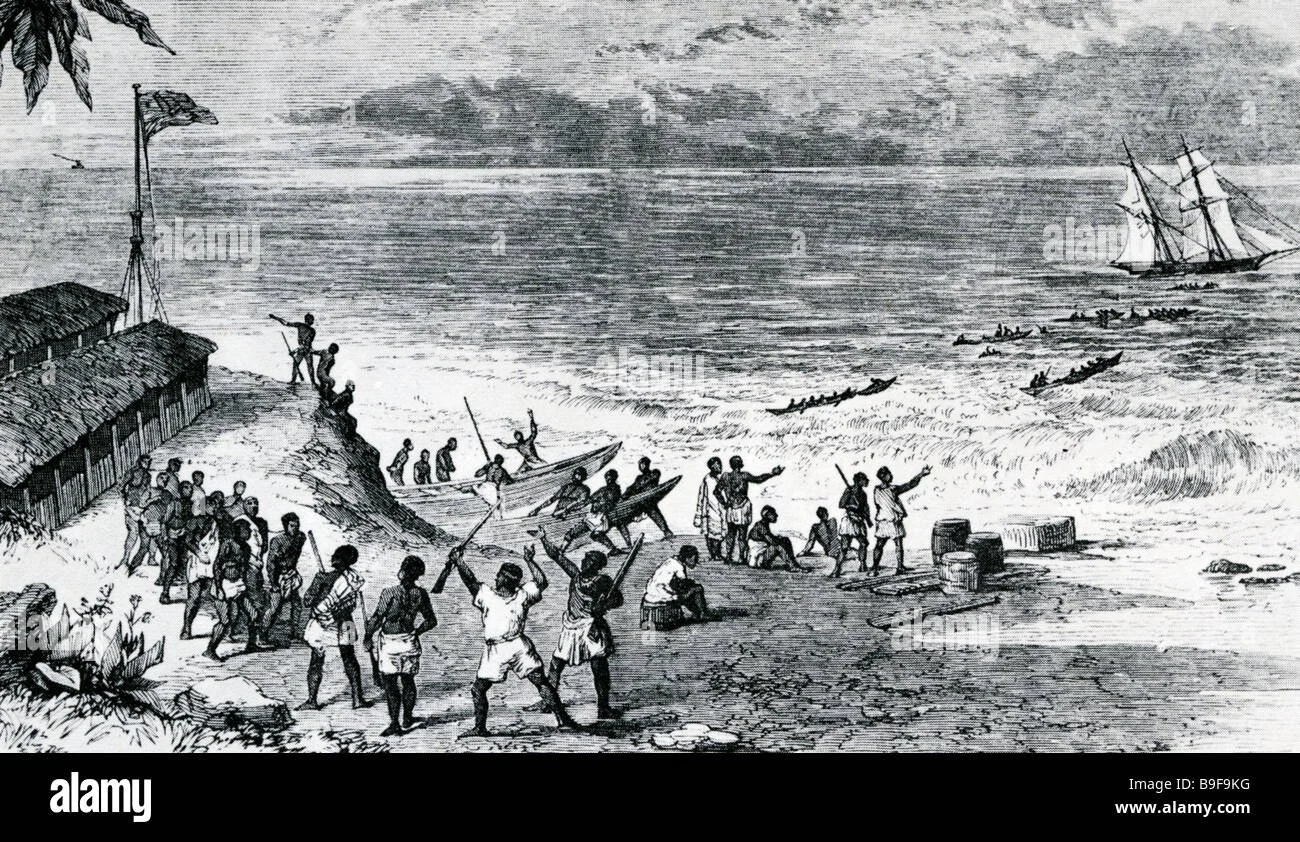
A 19th-century illustration depicting a scene on the West African coast, with European ships anchored offshore and African merchants and captives on the beach.
Confronting a Difficult Question.
Few questions in the history of the Atlantic slave trade provoke as much discomfort and controversy as this one: if millions of Africans were transported across the Atlantic as slaves, who supplied them? Some encounter this question for the first time as a troubling historical puzzle, while others know it as one of the most debated issues in African history. For some, the answer appears to confirm African complicity in one of history’s greatest human tragedies. For others, it oversimplifies a complex historical reality and shifts attention away from the European merchants, financiers, and slave-owning societies that drove the demand for enslaved labor across the Atlantic. Yet beneath the controversy lies a more important historical question: who supplied the millions of captives who eventually entered the transatlantic slave trade, and under what circumstances did they do so?
Answering this question requires abandoning the notion of a single, unified Africa acting with a common purpose. Between the fifteenth and nineteenth centuries, the continent consisted of hundreds of kingdoms, chiefdoms, city-states, and trading networks, each pursuing its own political, military, and economic interests. Some states and commercial groups became deeply involved in supplying captives to Atlantic markets. Others sought to restrict their participation, resisted the trade, or suffered from the instability and violence it generated. The history of African involvement in the slave trade is therefore not a story of collective responsibility, but of specific institutions, political authorities, and commercial actors making decisions within a rapidly expanding Atlantic economy.
The Atlantic slave trade did not begin on the decks of European ships. Long before captives reached the coast, they passed through the hands of kings, merchants, brokers, and trading networks that linked inland communities to the Atlantic world. Along thousands of miles of coastline, European traders depended on African intermediaries who controlled access to markets, organized exchanges, and determined who could participate in the trade.
Some of the most powerful states in West and Central Africa became deeply involved in this commerce. Kingdoms such as Dahomey, Oyo, Asante, and Kongo, alongside influential trading networks like the Aro, Fante, and Efik, occupied key positions between the interior and the coast. Through diplomacy, warfare, commerce, and political influence, they helped shape the movement of captives from African societies to waiting ships. Understanding who these intermediaries were, how they operated, and what they knew about the trade opens a window into the African side of a vast and complex system.
Their involvement does not diminish the central role played by European powers, nor does it reduce Africa to a passive backdrop in the story. Instead, it reveals a world of competing interests, shifting alliances, commercial ambitions, and political calculations. Within that world, external demand from across the Atlantic intersected with local realities, drawing particular rulers, merchants, and trading networks into one of the largest forced migrations in human history.
1. The African Intermediaries: The Human Bridge Between the Interior and the Atlantic
The transatlantic slave trade did not operate through direct European access to the African interior. Although European ships anchored along the Atlantic coast in growing numbers from the fifteenth century onward, the vast majority of European traders rarely ventured far beyond their coastal forts and trading stations. Disease, unfamiliar terrain, political restrictions imposed by African rulers, and the absence of established inland networks made such penetration both dangerous and impractical.[1] Instead, the trade depended upon a complex system of African intermediaries who connected the continent's interior to the Atlantic marketplace.[2]
These intermediaries were not a single group of people acting with a common purpose. Rather, they formed a layered network of rulers, military leaders, merchants, brokers, caravan organizers, local authorities, and coastal trading communities. Each occupied a different position within the chain that carried captives from inland societies to European ships waiting offshore.[3] Some captured prisoners through warfare. Others organized their transport across vast distances. Others negotiated prices with European merchants and controlled access to coastal markets. Together, they formed the human bridge that sustained one of the largest forced migrations in history.
Understanding this network is essential because it reveals that the supply of captives was not the work of a handful of powerful kingdoms alone. It depended upon interconnected political, commercial, and military structures that stretched across large regions of West and Central Africa.[4] The story of African intermediaries is therefore not merely a story about who participated in the trade, but about how an entire system emerged that linked local conflicts and political ambitions to the expanding demands of the Atlantic world.
1.1 The Chain from the Interior to the Coast
The journey from captivity to the Atlantic coast was rarely direct. Before an individual ever encountered a European slave trader, they often passed through several layers of African-controlled networks. Historians of the Atlantic slave trade have shown that captives were typically moved through a series of regional markets, staging points, and commercial corridors before reaching the coast.[5] In many cases, the people who captured them were not the same people who ultimately sold them.
The process frequently began in the interior. Warfare between neighboring states, military expansion, frontier raids, judicial punishment, and political upheaval generated a steady flow of captives.[6] Once captured, individuals were often marched to local markets where they could be exchanged, redistributed, or incorporated into wider trading systems. From there, merchants and brokers organized their movement toward larger commercial centers connected to Atlantic ports.
This system varied across regions but followed a broadly similar pattern. In the Gold Coast hinterland (located in present-day Ghana), captives moved through networks controlled by powerful states and commercial communities before arriving at ports such as Elmina and Cape Coast.[7] In the Bight of Biafra (located along the coast of present-day southeastern Nigeria, Cameroon, Equatorial Guinea, and northern Gabon), merchant networks linked inland societies to coastal markets through a complex web of brokers and middlemen.[8] In West Central Africa, long-established commercial routes connected inland populations to ports supplying Portuguese traders operating from Angola and the Congo coast.[9]
The significance of this system lay in the fact that it distributed responsibility across multiple actors. By the time a captive reached the coast, numerous individuals and institutions may have already profited from their movement. Military leaders acquired prisoners through war. Merchants earned income through transport and exchange. Local authorities collected duties and taxes. Coastal brokers negotiated final sales. Each stage added value to a human commodity whose price increased as it approached the Atlantic market.[10]
Consequently, the transatlantic slave trade should not be imagined as a simple transaction between European buyers and African sellers. It functioned instead as a vast commercial chain that depended upon African-controlled networks operating far beyond the sight of the European ships anchored along the coast.
1.2 Kings, States, and Royal Authority
Because the movement of captives required security, organization, and political authority, some of the most influential intermediaries were African states themselves. Powerful kingdoms often possessed the military capacity to acquire captives, the administrative structures to regulate trade, and the political authority necessary to control commercial routes.[11] As Atlantic demand expanded, several states increasingly integrated slave exports into their political and economic systems.
Among the most prominent examples was the Kingdom of Dahomey, a former West African kingdom located in the area of present-day Benin. During the eighteenth and nineteenth centuries, Dahomey's rulers transformed the kingdom into one of the most militarized states in West Africa. Military campaigns generated captives who could be incorporated into the kingdom, sacrificed during royal ceremonies, or sold into the Atlantic trade.[12] Over time, slave exports became closely connected to royal revenue and state power, creating powerful incentives for continued participation.
A similar pattern emerged within the Asante Empire, centered in what is now southern and central Ghana in West Africa. Although Asante's economy rested upon a broader foundation that included gold production, tribute, agriculture, and regional commerce, military expansion also produced significant numbers of captives.[13] These captives formed part of a wider political system through which conquered territories supplied labor, tribute, and human resources to the state. The exchange of captives for firearms and other imported goods further strengthened Asante's military position, creating a relationship between warfare and commerce that reinforced state power.[14]
The Oyo Empire, located primarily in what is now southwestern Nigeria and extending into parts of present-day Benin, likewise illustrates how political authority could become intertwined with the trade. Benefiting from a powerful cavalry and extensive regional influence, Oyo conducted military campaigns that produced captives who entered commercial networks leading to Atlantic ports.[15] While Oyo did not organize its entire political economy around slave exports, participation in the trade nonetheless became one component of its broader strategy for maintaining regional dominance.
The Kingdom of Kongo, which encompassed territories in present-day northern Angola, the Republic of the Congo, the western Democratic Republic of the Congo, and the enclave of Cabinda, demonstrates a different trajectory. Initially, Kongo's relationship with Portugal focused on diplomacy, Christianity, and commerce in goods such as copper, ivory, and textiles.[16] However, growing Portuguese demand for enslaved labor gradually altered the relationship. Internal conflicts, corruption, and unauthorized slave trading increasingly destabilized the kingdom, transforming parts of Kongo into major sources of captives despite efforts by rulers such as Afonso I (reigned c. 1509–1543) to limit abuses.[17]
These examples reveal that African states participated in the trade for different reasons and to different degrees. Yet they also highlight a broader pattern. Political authority provided the framework within which large-scale slave trading could operate. Armies generated captives, governments regulated commerce, and rulers controlled access to trade routes. As a result, state power became one of the most important mechanisms linking the African interior to the Atlantic slave trade.
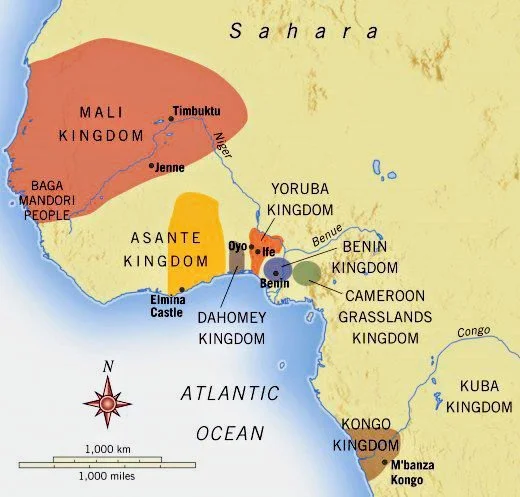
A map of West Africa from the 17th-18th centuries, highlighting the kingdoms of Dahomey, Asante, Oyo, and Kongo, along with major slave-trading ports.
1.3 Merchants, Brokers, and Commercial Networks
While kings and states provided political authority, they rarely managed the day-to-day movement of captives themselves. That responsibility often fell to merchants, brokers, caravan organizers, and commercial networks that connected distant regions of Africa to the Atlantic coast.[18] If rulers created the conditions that made large-scale slave trading possible, merchants transformed those conditions into a functioning commercial enterprise.
Across much of West and Central Africa, long before the arrival of Europeans, merchants had already established extensive trading networks that moved goods such as gold, kola nuts, salt, ivory, textiles, and metal products between regions.[19] The expansion of the Atlantic slave trade did not create these commercial systems from nothing. Rather, it inserted a new and increasingly profitable commodity into pre-existing networks. As demand for captives grew, many merchants adapted their activities accordingly, using established routes and commercial relationships to move enslaved people alongside other goods.[20]
One of the clearest examples emerged in the Bight of Biafra, located along the coast of present-day southeastern Nigeria and parts of Cameroon. Here, the Aro commercial network, a trading and political alliance centered on the Aro people of present-day southeastern Nigeria and linked to allied Igbo communities and merchant settlements known as Aro colonies, developed into one of the most influential trading systems in the region.[21] The network emerged between the seventeenth and eighteenth centuries as Aro merchants expanded their influence through long-distance trade, strategic alliances, and the religious authority of the Ibini Ukpabi (Long Juju) oracle, which helped legitimize their commercial activities and resolve disputes across a wide geographic area. Operating through a combination of religious authority, commercial partnerships, and political alliances, Aro merchants established connections that stretched deep into the interior. These networks allowed them to facilitate the movement of captives from inland communities to coastal markets where European traders awaited shipment.[22]
Similar patterns appeared elsewhere. Throughout the Gold Coast (present-day Ghana), merchants acted as intermediaries between inland producers and coastal trading centers.[23] In West Central Africa, commercial agents organized the transportation of captives from interior markets to ports in present-day Angola and the Democratic Republic of the Congo.[24] In many cases, multiple brokers handled a captive before that individual reached the coast, with each intermediary taking a profit from the transaction.
The importance of these commercial actors is often overlooked because public discussions of the slave trade tend to focus on kings and wars. Yet the trade could not have functioned without merchants willing to finance expeditions, organize transportation, negotiate exchanges, and absorb the risks associated with long-distance commerce.[25] Their activities transformed the capture of individuals into a sustained commercial system capable of supplying hundreds of thousands of captives across vast geographic distances.
1.4 Coastal Middlemen and Atlantic Gatekeepers
As captives approached the Atlantic coast, another group of intermediaries assumed increasing importance. These were the coastal brokers, merchant families, and trading communities that controlled access to European ships.[26] Although European forts and trading stations dotted parts of the coastline, European merchants remained heavily dependent upon African coastal societies for supplies, protection, local knowledge, and commercial access.
Among the most influential were the Fante, an Akan-speaking people of the Gold Coast (present-day Ghana) organized through a network of coastal towns and merchant elites, and the Efik, a Cross River people centered in trading settlements such as Old Calabar in present-day southeastern Nigeria.[27] These groups included prominent merchant families, local chiefs, brokers, interpreters, and commercial agents who played key roles in facilitating trade between the African interior and European merchants. Situated between inland suppliers and European buyers, these communities occupied a strategic position that allowed them to profit enormously from Atlantic commerce. They negotiated prices, managed warehouses, arranged credit, interpreted between different languages, and regulated commercial exchanges.[28]
Their influence stemmed not simply from geography but from their ability to control access. European traders could not simply bypass these communities and trade directly with inland suppliers. Coastal authorities frequently regulated who could trade, where trade could occur, and under what conditions transactions would take place.[29] As a result, African coastal elites often possessed considerable bargaining power despite the growing presence of European commercial interests.
The Efik merchant houses of Old Calabar, located in present-day Nigeria, provide a particularly revealing example. By the eighteenth century, prominent Efik trading families had developed sophisticated commercial relationships with British merchants, managing extensive trading operations that linked inland suppliers to Atlantic markets.[30] Similarly, Fante merchants leveraged their position along the Gold Coast to dominate exchanges between inland states and European trading forts.[31]
These coastal intermediaries therefore served as the final African link in the chain. By the time captives reached their hands, they had already passed through multiple layers of African-controlled networks. Coastal brokers then transformed those captives into Atlantic cargo, negotiating the final transactions that connected African supply systems to European demand.
1.5 Why Did They Participate?
Understanding who participated in the trade is only part of the story. Equally important is understanding why participation became so widespread. The answer cannot be reduced to greed alone. African intermediaries operated within political, military, and economic environments that created powerful incentives for involvement.[32]
For rulers, the trade offered access to wealth on a scale that few other commercial activities could match. European merchants brought firearms, gunpowder, textiles, alcohol, metal goods, and luxury products that enhanced royal prestige and strengthened political authority.[33] These imports were not merely symbols of status. In many regions, they became tools of statecraft, allowing rulers to reward supporters, consolidate alliances, and maintain military superiority over rivals.
The acquisition of firearms proved particularly significant. As more states gained access to European weapons, military competition intensified. Kingdoms that participated in the trade often acquired firearms that strengthened their armies, while neighboring states that lacked similar access risked military disadvantage.[34] This created a cycle in which participation became increasingly tied to survival. Refusing to engage in the trade could leave a state vulnerable to better-armed competitors who continued to acquire weapons through slave exports.
Political considerations reinforced these pressures. Captives acquired through warfare could be converted into revenue, while the sale of rival populations weakened potential enemies and strengthened the victorious state.[35] In this way, slave trading became intertwined with broader processes of state formation, territorial expansion, and political competition.
Merchants faced a different set of incentives. For them, the trade represented an opportunity to profit from a rapidly expanding Atlantic economy.[36] As demand for enslaved labor grew in the Americas, the value of captives increased, creating lucrative opportunities for those positioned within commercial networks. Many merchants simply adapted existing trading systems to accommodate a commodity that generated unprecedented returns.
Yet participation was not always entirely voluntary. In some regions, communities found themselves caught within a system that increasingly rewarded involvement and punished resistance.[37] States that refused to participate sometimes faced raids from neighbors who did. Merchants who withdrew from the trade risked losing access to profitable markets. Political leaders confronted difficult choices between moral objections and concerns for their own security and survival.
Consequently, the growth of African participation in the slave trade cannot be explained by a single motive. Wealth, military power, political competition, commercial opportunity, and structural pressures all combined to draw different actors into the system. The result was a network of participation that expanded far beyond any single kingdom, ruler, or merchant group.
1.6 Knowledge, Complicity, and Historical Responsibility
The final and perhaps most difficult question concerns knowledge. To what extent did African intermediaries understand the fate awaiting the people they sold?
During the early stages of Atlantic commerce, many African rulers and merchants possessed only limited knowledge of conditions across the ocean.[38] Slavery existed in numerous African societies long before the Atlantic trade, but it generally differed from the racialized chattel slavery that emerged in the Americas. Captives could often be incorporated into households, serve as laborers, or eventually obtain freedom. Consequently, many early participants appear to have understood slavery through their own social and cultural experiences rather than through the realities of plantation labor in the New World.[39]
Over time, however, information spread. As the trade expanded and endured for centuries, increasing numbers of African rulers, merchants, and coastal elites became aware that captives were being transported permanently across the Atlantic and subjected to extremely harsh conditions.[40] Evidence of this growing awareness can be found in the correspondence of King Afonso I of Kongo, who repeatedly complained to the Portuguese Crown about the destructive effects of the trade on his kingdom.[41] His letters reveal an increasing recognition that the demand for captives was undermining political stability, encouraging corruption, and threatening the very foundations of Kongo society.
Yet greater awareness did not necessarily lead to withdrawal from the trade. For some rulers and merchants, the economic and political benefits remained too significant to abandon.[42] Others believed they lacked the capacity to extricate themselves from a system that had become deeply embedded within regional politics and commerce. As a result, participation often continued even as understanding of the trade's consequences expanded.
This reality makes the question of responsibility particularly complex. African intermediaries were neither passive victims nor the primary architects of the Atlantic slave trade. European merchants, plantation owners, investors, and states generated the demand, provided the capital, and created the vast plantation economies that consumed enslaved labor.[43] At the same time, African rulers, merchants, and brokers supplied many of the captives who entered that system and, in numerous cases, profited from doing so.[44]
Recognizing these overlapping realities is essential because it moves the discussion beyond simplistic narratives of blame. The history of African intermediaries reveals a world shaped by competing interests, unequal power relationships, commercial incentives, political calculations, and evolving understandings of slavery itself. It is within this complex landscape that the question of African participation must be understood.
In a nutshell, the captives who entered the Atlantic slave trade did not move directly from African villages to European ships. Between those two points stood an extensive network of rulers, military leaders, merchants, brokers, caravan organizers, and coastal intermediaries whose decisions shaped the movement of millions of people toward the Atlantic. Their participation varied across regions and over time, but together they formed the human infrastructure upon which the trade depended.
Understanding their role neither transfers responsibility for the slave trade away from Europe nor absolves those African actors who participated in it. Rather, it reveals the complex political and commercial systems that connected the African interior to the Atlantic world. It also provides the foundation for the next question in this discussion: if African intermediaries exercised agency within the trade, to what extent were their choices truly voluntary, and to what extent were they shaped by forces beyond their control?
End Notes.
[1] John K. Thornton, Africa and Africans in the Making of the Atlantic World, 1400–1800, 2nd ed. (Cambridge: Cambridge University Press, 1998), pp. 43–49.
[2] Thornton, Africa and Africans in the Making of the Atlantic World, pp. 74–76.
[3] Paul E. Lovejoy, Transformations in Slavery: A History of Slavery in Africa, 3rd ed. (Cambridge: Cambridge University Press, 2012), pp. 60–67.
[4] Joseph C. Miller, Way of Death: Merchant Capitalism and the Angolan Slave Trade, 1730–1830 (Madison: University of Wisconsin Press, 1988), pp. 31–38.
[5] Lovejoy, Transformations in Slavery, pp. 64–69.
[6] Lovejoy, Transformations in Slavery, pp. 85–92.
[7] Ivor Wilks, Asante in the Nineteenth Century (Cambridge: Cambridge University Press, 1975), pp. 180–185.
[8] G. Ugo Nwokeji, The Slave Trade and Culture in the Bight of Biafra (Cambridge: Cambridge University Press, 2010), pp. 112–120.
[9] Joseph C. Miller, Way of Death, pp. 97–105.
[10] Thornton, Africa and Africans in the Making of the Atlantic World, pp. 84–87.
[11] Thornton, Africa and Africans in the Making of the Atlantic World, pp. 92–95.
[12] Robin Law, The Slave Coast of West Africa 1550–1750 (Oxford: Clarendon Press, 1991), pp. 68–75.
[13] Gareth Austin, Labour, Land, and Capital in Ghana (Rochester: University of Rochester Press, 2005), pp. 37–40.
[14] Wilks, Asante in the Nineteenth Century, pp. 180–184.
[15] Robin Law, The Oyo Empire c.1600–1836 (Oxford: Oxford University Press, 1977), pp. 144–151.
[16] John K. Thornton, The Kongolese Saint Anthony (Cambridge: Cambridge University Press, 1998), pp. 22–25.
[17] Thornton, Africa and Africans in the Making of the Atlantic World, pp. 110–113.
[18] Paul E. Lovejoy, Transformations in Slavery: A History of Slavery in Africa, 3rd ed. (Cambridge: Cambridge University Press, 2012), pp. 67–71.
[19] John K. Thornton, Africa and Africans in the Making of the Atlantic World, 1400–1800, 2nd ed. (Cambridge: Cambridge University Press, 1998), pp. 43–55.
[20] Lovejoy, Transformations in Slavery, pp. 71–75.
[21] G. Ugo Nwokeji, The Slave Trade and Culture in the Bight of Biafra (Cambridge: Cambridge University Press, 2010), pp. 112–118.
[22] Nwokeji, The Slave Trade and Culture in the Bight of Biafra, pp. 118–125.
[23] Gareth Austin, Labour, Land, and Capital in Ghana (Rochester: University of Rochester Press, 2005), pp. 37–45.
[24] Joseph C. Miller, Way of Death: Merchant Capitalism and the Angolan Slave Trade, 1730–1830 (Madison: University of Wisconsin Press, 1988), pp. 97–110.
[25] Thornton, Africa and Africans in the Making of the Atlantic World, pp. 84–90.
[26] Thornton, Africa and Africans in the Making of the Atlantic World, pp. 74–80.
[27] Nwokeji, The Slave Trade and Culture in the Bight of Biafra, pp. 112–115; Austin, Labour, Land, and Capital in Ghana, pp. 42–45.
[28] Thornton, Africa and Africans in the Making of the Atlantic World, pp. 80–84.
[29] Thornton, Africa and Africans in the Making of the Atlantic World, pp. 74–79.
[30] Nwokeji, The Slave Trade and Culture in the Bight of Biafra, pp. 126–132.
[31] Austin, Labour, Land, and Capital in Ghana, pp. 42–45.
[32] Lovejoy, Transformations in Slavery, pp. 60–75.
[33] Robin Law, The Slave Coast of West Africa 1550–1750 (Oxford: Clarendon Press, 1991), pp. 68–76.
[34] Walter Rodney, How Europe Underdeveloped Africa (London: Bogle-L'Ouverture Publications, 1972), pp. 108–112.
[35] Ivor Wilks, Asante in the Nineteenth Century (Cambridge: Cambridge University Press, 1975), pp. 180–185.
[36] Thornton, Africa and Africans in the Making of the Atlantic World, pp. 92–100.
[37] Lovejoy, Transformations in Slavery, pp. 75–85.
[38] Thornton, Africa and Africans in the Making of the Atlantic World, pp. 110–113.
[39] Lovejoy, Transformations in Slavery, pp. 1–25.
[40] Thornton, Africa and Africans in the Making of the Atlantic World, pp. 110–116.
[41] Afonso I's correspondence reproduced and discussed in Thornton, Africa and Africans in the Making of the Atlantic World, pp. 110–113.
[42] Robin Law, The Slave Coast of West Africa 1550–1750, pp. 72–78.
[43] David Eltis and David Richardson, Atlas of the Transatlantic Slave Trade (New Haven: Yale University Press, 2010), pp. 15–23.
[44] Lovejoy, Transformations in Slavery, pp. 60–92.
Bibliography:
Austin, Gareth. Labour, Land, and Capital in Ghana: From Slavery to Free Labour in Asante, 1807–1956. Rochester: University of Rochester Press, 2005.
Eltis, David, and David Richardson. Atlas of the Transatlantic Slave Trade. New Haven: Yale University Press, 2010.
Law, Robin. The Oyo Empire c.1600–1836: A West African Imperialism in the Era of the Atlantic Slave Trade. Oxford: Oxford University Press, 1977.
Law, Robin. The Slave Coast of West Africa 1550–1750: The Impact of the Atlantic Slave Trade on an African Society. Oxford: Clarendon Press, 1991.
Lovejoy, Paul E. Transformations in Slavery: A History of Slavery in Africa. 3rd ed. Cambridge: Cambridge University Press, 2012.
Miller, Joseph C. Way of Death: Merchant Capitalism and the Angolan Slave Trade, 1730–1830. Madison: University of Wisconsin Press, 1988.
Nwokeji, G. Ugo. The Slave Trade and Culture in the Bight of Biafra: An African Society in the Atlantic World. Cambridge: Cambridge University Press, 2010.
Rodney, Walter. How Europe Underdeveloped Africa. London: Bogle-L'Ouverture Publications, 1972.
Thornton, John K. Africa and Africans in the Making of the Atlantic World, 1400–1800. 2nd ed. Cambridge: Cambridge University Press, 1998.
Thornton, John K. The Kongolese Saint Anthony: Dona Beatriz Kimpa Vita and the Antonian Movement, 1684–1706. Cambridge: Cambridge University Press, 1998.
Wilks, Ivor. Asante in the Nineteenth Century: The Structure and Evolution of a Political Order. Cambridge: Cambridge University Press, 1975.
Research by: Emmer Atwiine
Paper by: Ezron Kaijuka.
