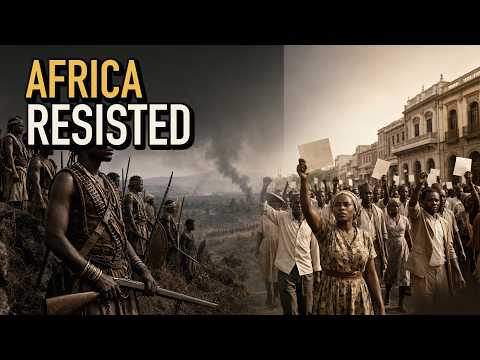
How Europe Drew Africa's Borders | The Scramble, Partition, and Lasting Legacy of Colonialism
On January 22, 1879, at Isandlwana in Southern Africa, thousands of Zulu warriors overwhelmed one of the most powerful imperial armies in the world. Yet the battle unfolding that day was only one chapter in a much larger story.
This documentary explores the Scramble and Partition of Africa — the dramatic period when European powers rushed into Africa, divided the continent among themselves, imposed colonial rule, redrew borders, and reshaped the political, economic, and social realities of millions of Africans.
From the Berlin Conference of 1884–1885 to the conquest of African territories, from the resistance movements led by figures such as King Cetshwayo, Muhammad Ahmad, Samori Touré, Menelik II, and Yaa Asantewaa, to the creation of artificial colonial states and borders, this documentary traces how Africa was transformed during one of the most consequential periods in world history.
The story does not end with colonial conquest. We follow the legacy of the Scramble and Partition of Africa into the modern era, examining the Biafran War, the Congo crises, the Ogaden conflicts, Rwanda, Pan-Africanism, the African Union, the East African Community, the African Continental Free Trade Area (AfCFTA), and the continuing debate over African unity, identity, borders, and self-determination. More than a century after the Berlin Conference, many of the borders drawn by European powers still remain. Their consequences continue to shape modern Africa.