
Did Africans Sell Other Africans? Power, Profit, and Political Advantage: Why African Rulers and Merchants Participated in the Slave Trade
Introduction
Why did powerful African rulers, merchants, and political elites continue to participate in the slave trade even as its human cost became increasingly visible? For generations, explanations have often focused on profit alone, portraying the trade as little more than a commercial exchange driven by greed and opportunity. Yet such interpretations overlook a more fundamental reality. Across much of West and Central Africa, participation in the Atlantic slave trade became closely intertwined with the pursuit of political power, military security, and regional influence. Wealth was certainly an important incentive, but wealth derived much of its value from the advantages it could provide in a highly competitive political environment.
Understanding these incentives is essential because the Atlantic slave trade operated within existing African power structures rather than outside them. The rulers who supplied captives, the merchants who organized their movement, and the coastal brokers who connected African markets to European ships did not act in a political vacuum. They operated within states competing for survival, influence, territory, and prestige. Firearms could strengthen armies, imported goods could reinforce political authority, and commercial wealth could expand networks of patronage and loyalty. This study therefore examines the relationship between power and participation, exploring how political ambition, commercial opportunity, military competition, and structural pressures combined to make the slave trade attractive to some while making withdrawal increasingly difficult for others.
1. Political Power and State Building
Although the Atlantic slave trade generated considerable wealth, profit alone does not adequately explain why many African rulers and political elites became involved in it. Across much of West and Central Africa, participation in the trade was closely connected to the pursuit and preservation of political power.[1] Rulers did not simply seek wealth for its own sake. They sought the advantages that wealth could provide, including stronger armies, expanded influence, greater control over trade routes, and the ability to reward loyal followers. As a result, the slave trade became deeply intertwined with broader processes of state formation, political competition, and regional dominance.
The relationship between slavery and political authority was not entirely new. Long before the arrival of European traders, many African societies used captives acquired through warfare, tribute, or judicial punishment as laborers, soldiers, administrators, or dependents.[2] In several regions, the control of people was itself an important measure of power. Wealth was often expressed not through ownership of land alone but through the ability to command labor, mobilize followers, and maintain networks of loyalty.[3] Consequently, when Atlantic demand transformed captives into highly valuable commodities, rulers found themselves in possession of a resource that could be converted into both economic and political advantage.
Few examples illustrate this connection more clearly than the Kingdom of Dahomey in present-day Benin. During the eighteenth century, Dahomey's rulers increasingly integrated the slave trade into the political and military structure of the state.[4] Military campaigns generated captives who could be sold to European traders along the coast, while the revenue obtained from those sales strengthened royal authority and expanded the kingdom's capacity to wage further campaigns.[5] Rather than functioning as a separate commercial activity, the trade became embedded within the kingdom's political system, helping to sustain the monarchy, finance military expansion, and reinforce Dahomey's position within the regional balance of power.
A similar relationship between political authority and the slave trade emerged within the Asante Empire of present-day Ghana. Asante's rulers governed an expanding state whose influence rested upon military strength, tribute relationships, and control of commercial networks.[6] Captives acquired through military campaigns formed part of the wider flow of resources that sustained imperial authority. While Asante's economy was not solely dependent upon slave exports, participation in Atlantic commerce provided opportunities to acquire goods that enhanced both military and political power.[7] The ability to distribute imported products among allies, military commanders, and subordinate leaders strengthened the cohesion of the empire and reinforced the authority of the Asantehene, the king and supreme ruler of the Asante Empire.
The Oyo Empire of present-day southwestern Nigeria and parts of Benin likewise demonstrates how political power and slave trading could become interconnected. Oyo's military success, particularly its use of cavalry, enabled the empire to exert influence across a large territory.[8] Victories over rival groups generated captives who could be incorporated into the state, exchanged through commercial networks, or sold to coastal traders. The resulting flow of resources helped sustain Oyo's political dominance and supported the institutions through which imperial authority was exercised.[9]
Beyond these well-known examples, similar dynamics appeared across many parts of Africa. Political leaders who controlled access to captives often gained access to wealth, while wealth in turn strengthened their ability to maintain armies, reward followers, and expand influence.[10] The relationship therefore operated in both directions. Political authority facilitated participation in the slave trade, while participation in the slave trade frequently reinforced political authority.
However, the significance of the trade extended beyond individual rulers. In many regions, Atlantic commerce contributed to broader processes of state centralization. Access to imported goods enabled governments to strengthen administrative structures, increase their control over regional commerce, and consolidate authority over subordinate populations.[11] States capable of controlling trade routes, regulating exchanges, and monopolizing access to European merchants frequently acquired advantages over rivals that lacked similar access. Consequently, the slave trade became embedded within wider struggles for political survival and regional supremacy.
Understanding this relationship is essential because it reveals that participation in the slave trade was often driven by considerations far more complex than personal greed. For many rulers and political elites, captives represented a source of power as much as a source of profit. The trade offered opportunities to strengthen states, expand influence, and secure political authority in a highly competitive environment. It is within this broader context that the economic incentives of the trade must be understood.
2. Wealth and Commercial Opportunity
If political power explains why many African rulers and elites became interested in the slave trade, wealth explains how that power could be acquired, expanded, and maintained. Yet the economic incentives of the trade extended far beyond the accumulation of money alone. In many African societies, wealth was valuable because it could be converted into military resources, political influence, commercial dominance, and social prestige.[12] Consequently, participation in the slave trade often represented access to a wider system of opportunity that connected African states to an expanding Atlantic economy.
European merchants arriving along the African coast brought a range of goods that many rulers and trading communities considered highly desirable. These included firearms, gunpowder, metal bars, copper and brass goods, textiles, alcohol, luxury items, and manufactured products that were difficult or impossible to produce locally.[13] While some of these goods served practical purposes, others carried significant political value. Imported cloth, weapons, and prestige goods could be distributed to military commanders, regional chiefs, court officials, and allies, strengthening networks of loyalty upon which political authority depended.[14]
The wealth-enhancing potential of these imported goods helps explain why participation in the slave trade became increasingly attractive to many African rulers and merchants. Historical records from the eighteenth century indicate that captives often passed through several commercial transactions before reaching the coast, with each intermediary taking a share of the value generated along the way.[15] By the time a captive reached a major Atlantic port, that individual represented a highly marketable commodity whose exchange could yield goods worth far more than those available through many traditional forms of commerce. This did not mean that every participant became wealthy, but it did create powerful incentives for rulers, merchants, and brokers positioned within the trade's commercial networks.[16]
In regions such as the Bight of Biafra, encompassing parts of present-day southeastern Nigeria and Cameroon, merchant groups developed extensive commercial systems that connected inland suppliers to Atlantic markets.[17] These networks allowed traders to profit from transportation, brokerage, taxation, warehousing, and exchange. Wealth generated through these activities strengthened merchant influence and, in some cases, enabled commercial elites to exercise political authority that rivaled or complemented that of traditional rulers.[18]
The scale of the profits involved helps explain why participation became so attractive. Although prices varied considerably across time and region, historians have shown that during the eighteenth century a healthy adult captive sold on the West African coast could be exchanged for a package of imported goods that often included firearms, gunpowder, textiles, alcohol, metal bars, and other valuable commodities.[19] Contemporary trading records from the Slave Coast and the Bight of Biafra indicate that captives ranked among the most valuable commodities in Atlantic commerce, frequently generating returns that exceeded those obtainable through many local exports.[20] The profitability of the trade therefore extended beyond individual transactions. It created opportunities for rulers, merchants, brokers, and coastal intermediaries to accumulate wealth on a scale capable of reshaping local economies and strengthening their political influence.[21]
The Kingdom of Dahomey again provides a revealing example. Revenues derived from the slave trade became an important source of royal income, helping to finance the court, support military institutions, and sustain the administrative machinery of the state.[22] By the mid-eighteenth century, slave exports had become so central to Dahomey's economy that customs duties and taxes associated with the trade formed a substantial portion of state revenue.[23] These revenues enabled the kingdom to maintain one of the most formidable military establishments in West Africa, including the standing army for which Dahomey became famous.[24] Similar patterns appeared elsewhere as rulers increasingly incorporated Atlantic commerce into their broader economic strategies.[25]
The attraction of the trade was further enhanced by the scale of demand generated across the Atlantic. Plantation economies in Brazil, the Caribbean, and the Americas required vast numbers of laborers, creating a market unlike anything previously encountered by many African societies.[26] Between the sixteenth and nineteenth centuries, more than twelve million Africans were embarked on slave ships bound for the Americas, generating an enormous and sustained demand for captives.[27] For African merchants and rulers positioned within these commercial networks, the rewards could be considerable. While precise modern equivalents are difficult to calculate, some historians estimate that the value of slave exports from major trading regions amounted to millions of pounds sterling over the course of the eighteenth century—a level of wealth capable of transforming regional political economies and concentrating power in the hands of those who controlled access to the trade.[28]
Yet the significance of these opportunities lay not simply in the goods acquired but in what those goods made possible. Wealth enabled rulers to maintain armies, finance political projects, reward supporters, and reinforce their authority. Firearms purchased through the trade could be used to acquire additional captives, creating a cycle in which economic gain translated directly into military and political advantage.[29] Commercial success strengthened merchant networks and expanded influence over regional trade. Economic gain therefore functioned as a means to larger political and social ends rather than an end in itself.[30]
This distinction is crucial because it reveals why the slave trade became so deeply embedded within existing power structures. Wealth was rarely pursued in isolation. Instead, it served as the foundation upon which political authority, military capability, and social influence could be built. The economic incentives of the trade were therefore inseparable from the broader pursuit of power that shaped participation across much of West and Central Africa.
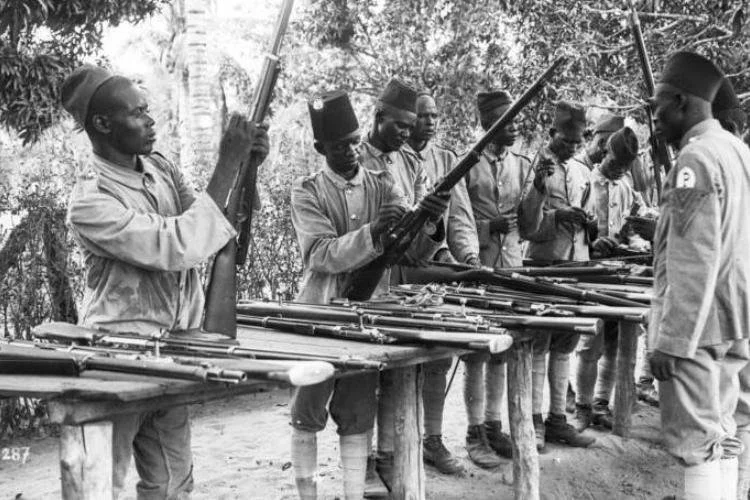
Police askaris clean their rifles in German East Africa, c. 1906–1914. Although this photograph postdates the transatlantic slave trade, it illustrates the continuing importance of imported firearms in the organisation of African military and political power.
Source: Walther Dobbertin, German Federal Archives, Bild 105-DOA6364. Licensed under CC BY-SA 3.0 Germany.
3. Firearms and Military Advantage
If wealth provided the means through which power could be accumulated, firearms often determined how that power was exercised. Across much of West and Central Africa, imported weapons became one of the most sought-after commodities exchanged through the Atlantic slave trade.[31] While firearms were not the sole reason for participation, they significantly increased the strategic value of the trade by offering rulers and military leaders access to technologies that could strengthen armies, deter rivals, and expand political influence.
The importance of firearms varied across regions. In some areas, traditional weapons remained highly effective and continued to dominate warfare for long periods.[32] Nevertheless, the growing availability of muskets, gunpowder, and ammunition gradually altered military balances across many parts of the continent. States capable of securing a steady supply of firearms frequently enjoyed advantages over neighboring rivals that lacked similar access.[33]
This relationship contributed to what historians have often described as the "gun-slave cycle." Captives were exchanged for firearms, while firearms strengthened military capabilities that could then be used to acquire additional captives.[34] The cycle did not operate uniformly across Africa, nor did firearms automatically guarantee victory. However, where access to imported weapons became strategically important, participation in the slave trade increasingly provided a pathway to military superiority.[35]
The Kingdom of Dahomey illustrates this dynamic particularly well. Revenues from slave exports enabled the kingdom to acquire weapons that strengthened its military forces and reinforced royal authority.[36] Military success then generated additional captives who could be sold through coastal markets, helping sustain the very system that financed the kingdom's armed expansion. Similar patterns appeared in portions of present-day Ghana, Nigeria, Angola, and elsewhere, where rulers sought to secure access to imported weapons in order to compete with neighboring states.[37]
The significance of firearms extended beyond warfare itself. Military strength enhanced a ruler's ability to collect tribute, secure trade routes, suppress internal opposition, and project authority over wider territories.[38] In this sense, firearms were valuable not simply as weapons but as instruments of governance and political control. The military advantages they provided often translated directly into political advantages.
Consequently, the slave trade offered something more than commercial profit. It provided access to resources that could reshape regional balances of power. For many rulers operating in competitive political environments, the acquisition of firearms became inseparable from questions of security, survival, and statecraft.
4. Prestige, Patronage, and Elite Power
Military strength alone could not sustain political authority. Rulers also depended upon networks of loyalty that linked courts, military commanders, provincial leaders, merchants, and local elites to the state.[39] Maintaining those networks required resources, and the slave trade supplied many rulers with the means to acquire and distribute them.
Across numerous African societies, political authority rested partly upon systems of patronage in which rulers rewarded supporters with wealth, positions, protection, and opportunities.[40] Imported goods acquired through Atlantic commerce became particularly valuable within these systems. Fine textiles, firearms, alcohol, metal goods, luxury items, and other imported commodities could be distributed to loyal followers, reinforcing bonds of obligation and strengthening political alliances.[41]
The ability to reward supporters often distinguished powerful rulers from weaker ones. Leaders who controlled access to Atlantic commerce could use imported goods to expand their influence, attract followers, and consolidate authority.[42] In some cases, wealth derived from the slave trade enabled rulers to build larger courts, support administrative officials, and maintain more elaborate political institutions than would otherwise have been possible.[43]
Prestige also played an important role. Imported goods frequently carried symbolic significance beyond their practical value. Possessing foreign commodities could signal status, success, and access to powerful commercial networks.[44] For rulers seeking to project authority, such displays reinforced perceptions of legitimacy and influence. Participation in Atlantic commerce therefore enhanced not only material wealth but also social standing and political prestige.
This relationship between wealth and patronage further strengthened the attraction of the slave trade. The benefits extended beyond individual enrichment and became embedded within the broader political structures through which authority was exercised. In many regions, commercial success translated directly into greater influence over people, institutions, and resources.
5. Atlantic Trade and Regional Competition
The incentives created by wealth, firearms, and patronage were further intensified by competition between neighboring states. As some rulers gained access to the advantages offered by Atlantic commerce, others faced increasing pressure to respond.[45]
Participation in the slave trade was rarely a decision made in isolation. African states existed within dynamic political environments characterized by alliances, rivalries, military competition, and shifting balances of power.[46] When one state acquired firearms, increased revenues, or strengthened its military through participation in the trade, neighboring states often confronted the risk of strategic disadvantage. Refusal to participate could therefore carry significant political costs.
This dynamic helps explain why the trade expanded so widely across certain regions. States that engaged successfully in Atlantic commerce frequently gained resources that enhanced their ability to defend territory, project power, and dominate regional trade networks.[47] Their growing strength could compel neighboring rulers to seek similar advantages simply to maintain their own security and independence.
The resulting competition created pressures that extended beyond individual motives. Even rulers who recognized the social disruptions associated with the trade could find it difficult to withdraw if rivals continued to profit from participation.[48] Access to firearms, imported goods, and commercial revenues increasingly became factors influencing regional power balances. In such circumstances, participation was often viewed not merely as an opportunity but as a strategic necessity.
The expansion of the slave trade therefore cannot be understood solely through the choices of individual rulers or merchants. It was also shaped by broader political environments in which competition encouraged continued engagement. As more states became connected to Atlantic commerce, the costs of remaining outside those networks often increased.
6. The Limits of Choice
Yet despite the powerful incentives associated with the trade, participation was never entirely predetermined. African rulers, merchants, and political elites retained varying degrees of agency, and their responses differed across regions and historical periods.[49] Some embraced the opportunities presented by Atlantic commerce. Others sought to limit their involvement, regulate the trade, or resist aspects of it altogether.
Recognizing this variation is important because it prevents us from reducing participation to either simple greed or complete coercion. The decisions made by African actors were shaped by a complex combination of political ambition, economic opportunity, military pressure, and regional competition.[50] These forces influenced choices without entirely eliminating them.
At the same time, the incentives examined throughout this discussion reveal why participation often proved so attractive and why withdrawal could become increasingly difficult. Wealth generated power. Power strengthened states. Stronger states acquired advantages over rivals. Those advantages encouraged further participation, reinforcing the structures that sustained the trade.[51]
The Atlantic slave trade therefore became embedded within existing African power systems not because every ruler shared the same objectives, but because the trade intersected with broader struggles over authority, security, influence, and survival. Understanding those dynamics helps explain why participation expanded across many regions despite its destructive consequences.
It also raises a further question. If the incentives were so powerful and the pressures so significant, what happened when individuals, communities, and states chose a different path? Exploring that question requires turning from participation to resistance and examining those African societies and leaders who opposed, restricted, or refused involvement in the trade.
End Notes.
[1] John K. Thornton, Africa and Africans in the Making of the Atlantic World, 1400–1800, 2nd ed. (Cambridge: Cambridge University Press, 1998), pp. 92–100.
[2] Paul E. Lovejoy, Transformations in Slavery: A History of Slavery in Africa, 3rd ed. (Cambridge: Cambridge University Press, 2012), pp. 1–25.
[3] Lovejoy, Transformations in Slavery, pp. 25–38.
[4] Robin Law, The Slave Coast of West Africa 1550–1750: The Impact of the Atlantic Slave Trade on an African Society (Oxford: Clarendon Press, 1991), pp. 68–76.
[5] Law, The Slave Coast of West Africa, pp. 76–83.
[6] Ivor Wilks, Asante in the Nineteenth Century: The Structure and Evolution of a Political Order (Cambridge: Cambridge University Press, 1975), pp. 180–188.
[7] Gareth Austin, Labour, Land, and Capital in Ghana: From Slavery to Free Labour in Asante, 1807–1956 (Rochester: University of Rochester Press, 2005), pp. 37–45.
[8] Robin Law, The Oyo Empire c.1600–1836: A West African Imperialism in the Era of the Atlantic Slave Trade (Oxford: Oxford University Press, 1977), pp. 144–151.
[9] Law, The Oyo Empire, pp. 151–158.
[10] Thornton, Africa and Africans in the Making of the Atlantic World, pp. 100–104.
[11] Thornton, Africa and Africans in the Making of the Atlantic World, pp. 100–104.
[12] Paul E. Lovejoy, Transformations in Slavery: A History of Slavery in Africa, 3rd ed. (Cambridge: Cambridge University Press, 2012), pp. 60–75.
[13] John K. Thornton, Africa and Africans in the Making of the Atlantic World, 1400–1800, 2nd ed. (Cambridge: Cambridge University Press, 1998), pp. 97–104.
[14] Gareth Austin, Labour, Land, and Capital in Ghana: From Slavery to Free Labour in Asante, 1807–1956 (Rochester: University of Rochester Press, 2005), pp. 37–45.
[15] Joseph C. Miller, Way of Death: Merchant Capitalism and the Angolan Slave Trade, 1730–1830 (Madison: University of Wisconsin Press, 1988), pp. 97–115.
[16] Thornton, Africa and Africans in the Making of the Atlantic World, pp. 100–104.
[17] G. Ugo Nwokeji, The Slave Trade and Culture in the Bight of Biafra: An African Society in the Atlantic World (Cambridge: Cambridge University Press, 2010), pp. 112–132.
[18] Nwokeji, The Slave Trade and Culture in the Bight of Biafra, pp. 132–145.
[19] Robin Law, The Slave Coast of West Africa 1550–1750: The Impact of the Atlantic Slave Trade on an African Society (Oxford: Clarendon Press, 1991), pp. 205–214.
[20] David Richardson, "The Slave Trade, Sugar, and British Economic Growth, 1748–1776," Journal of Interdisciplinary History 17, no. 4 (1987): pp. 739–769; Robin Law, The Slave Coast of West Africa 1550–1750, pp. 205–214.
[21] G. Ugo Nwokeji, The Slave Trade and Culture in the Bight of Biafra: An African Society in the Atlantic World (Cambridge: Cambridge University Press, 2010), pp. 112–132; Robin Law, The Slave Coast of West Africa 1550–1750, pp. 214–220.
[22] Robin Law, The Slave Coast of West Africa 1550–1750, pp. 76–83.
[23] Robin Law, The Slave Coast of West Africa 1550–1750, pp. 83–90.
[24] Stanley B. Alpern, Amazons of Black Sparta: The Women Warriors of Dahomey (New York: New York University Press, 1998), pp. 34–45; Robin Law, The Slave Coast of West Africa 1550–1750, pp. 88–90.
[25] John K. Thornton, Africa and Africans in the Making of the Atlantic World, 1400–1800, 2nd ed. (Cambridge: Cambridge University Press, 1998), pp. 100–104.
[26] David Eltis and David Richardson, Atlas of the Transatlantic Slave Trade (New Haven: Yale University Press, 2010), pp. 15–23.
[27] David Eltis and David Richardson, Atlas of the Transatlantic Slave Trade (New Haven: Yale University Press, 2010), pp. 20–23.
[28] Joseph E. Inikori, Africans and the Industrial Revolution in England: A Study in International Trade and Economic Development (Cambridge: Cambridge University Press, 2002), pp. 181–196; David Eltis, Economic Growth and the Ending of the Transatlantic Slave Trade (Oxford: Oxford University Press, 1987), pp. 42–48.
[29] Paul E. Lovejoy, Transformations in Slavery: A History of Slavery in Africa, 3rd ed. (Cambridge: Cambridge University Press, 2012), pp. 92–101; John K. Thornton, Africa and Africans in the Making of the Atlantic World, pp. 97–104.
[30] Paul E. Lovejoy, Transformations in Slavery, pp. 75–85.
[31] John K. Thornton, Africa and Africans in the Making of the Atlantic World, 1400–1800, 2nd ed. (Cambridge: Cambridge University Press, 1998), pp. 97–104.
[32] Thornton, Africa and Africans in the Making of the Atlantic World, pp. 126–130.
[33] Robin Law, The Slave Coast of West Africa 1550–1750 (Oxford: Clarendon Press, 1991), pp. 90–98.
[34] Walter Rodney, How Europe Underdeveloped Africa (London: Bogle-L'Ouverture Publications, 1972), pp. 108–112.
[35] Paul E. Lovejoy, Transformations in Slavery: A History of Slavery in Africa, 3rd ed. (Cambridge: Cambridge University Press, 2012), pp. 92–101.
[36] Robin Law, The Slave Coast of West Africa 1550–1750, pp. 83–98.
[37] Joseph C. Miller, Way of Death: Merchant Capitalism and the Angolan Slave Trade, 1730–1830 (Madison: University of Wisconsin Press, 1988), pp. 115–130.
[38] Ivor Wilks, Asante in the Nineteenth Century (Cambridge: Cambridge University Press, 1975), pp. 180–188.
[39] Wilks, Asante in the Nineteenth Century, pp. 188–195.
[40] Gareth Austin, Labour, Land, and Capital in Ghana (Rochester: University of Rochester Press, 2005), pp. 37–48.
[41] Thornton, Africa and Africans in the Making of the Atlantic World, pp. 100–104.
[42] Austin, Labour, Land, and Capital in Ghana, pp. 45–50.
[43] Wilks, Asante in the Nineteenth Century, pp. 190–200.
[44] Thornton, Africa and Africans in the Making of the Atlantic World, pp. 102–104.
[45] Lovejoy, Transformations in Slavery, pp. 92–101.
[46] Thornton, Africa and Africans in the Making of the Atlantic World, pp. 92–104.
[47] Law, The Oyo Empire c.1600–1836 (Oxford: Oxford University Press, 1977), pp. 144–158.
[48] Lovejoy, Transformations in Slavery, pp. 101–108.
[49] Thornton, Africa and Africans in the Making of the Atlantic World, pp. 110–116.
[50] Lovejoy, Transformations in Slavery, pp. 108–115.
[51] Rodney, How Europe Underdeveloped Africa, pp. 108–118.
Bibliography:
Alpern, Stanley B. Amazons of Black Sparta: The Women Warriors of Dahomey. New York: New York University Press, 1998.
Austin, Gareth. Labour, Land, and Capital in Ghana: From Slavery to Free Labour in Asante, 1807–1956. Rochester: University of Rochester Press, 2005.
Eltis, David. Economic Growth and the Ending of the Transatlantic Slave Trade. Oxford: Oxford University Press, 1987.
Eltis, David, and David Richardson. Atlas of the Transatlantic Slave Trade. New Haven: Yale University Press, 2010.
Inikori, Joseph E. Africans and the Industrial Revolution in England: A Study in International Trade and Economic Development. Cambridge: Cambridge University Press, 2002.
Law, Robin. The Oyo Empire c.1600–1836: A West African Imperialism in the Era of the Atlantic Slave Trade. Oxford: Oxford University Press, 1977.
Law, Robin. The Slave Coast of West Africa 1550–1750: The Impact of the Atlantic Slave Trade on an African Society. Oxford: Clarendon Press, 1991.
Lovejoy, Paul E. Transformations in Slavery: A History of Slavery in Africa. 3rd ed. Cambridge: Cambridge University Press, 2012.
Miller, Joseph C. Way of Death: Merchant Capitalism and the Angolan Slave Trade, 1730–1830. Madison: University of Wisconsin Press, 1988.
Nwokeji, G. Ugo. The Slave Trade and Culture in the Bight of Biafra: An African Society in the Atlantic World. Cambridge: Cambridge University Press, 2010.
Richardson, David. “The Slave Trade, Sugar, and British Economic Growth, 1748–1776.” Journal of Interdisciplinary History 17, no. 4 (1987): 739–769.
Rodney, Walter. How Europe Underdeveloped Africa. London: Bogle-L'Ouverture Publications, 1972.
Thornton, John K. Africa and Africans in the Making of the Atlantic World, 1400–1800. 2nd ed. Cambridge: Cambridge University Press, 1998.
Wilks, Ivor. Asante in the Nineteenth Century: The Structure and Evolution of a Political Order. Cambridge: Cambridge University Press, 1975.
Research by: Emmer Atwiine
Paper by: Ezron Kaijuka
