
How African societies resisted European conquest and how colonial rule reshaped the continent
Introduction
European conquest did not descend upon a silent or defenseless continent. From the deserts of Sudan to the forests of West Africa and the plains of Southern Africa, African kingdoms, military leaders, religious movements, and ordinary communities fought fiercely against foreign occupation as European empires pushed deeper into the continent during the Scramble for Africa. Some resisted through organized warfare, others through diplomacy, strategic alliances, economic disruption, spiritual mobilization, and prolonged acts of political defiance. Across the continent, colonial conquest became not simply a story of European expansion, but a violent struggle over sovereignty, land, identity, and survival itself.
Yet even where resistance was eventually crushed, colonial rule would leave consequences far beyond military defeat. European conquest dismantled older political systems, reorganized African economies around extraction and labor exploitation, disrupted social structures, and introduced new forms of racial hierarchy and cultural domination whose effects would continue long after colonial rule formally ended. At the same time, the experience of conquest and resistance helped generate new political consciousness across Africa, laying some of the intellectual and ideological foundations for nationalism, Pan-Africanism, and the later struggles for independence.
1. How African Societies Organized Resistance Against Colonial Rule
As European colonial powers expanded deeper into Africa during the late nineteenth century, resistance emerged across the continent in remarkably diverse and sophisticated forms. African societies did not respond uniformly to conquest. Instead, resistance movements adapted to local political systems, military traditions, religious beliefs, geography, and the growing realities of European technological superiority. Some societies organized large-scale military campaigns against colonial armies, while others relied upon guerrilla warfare, strategic retreat, diplomacy, spiritual mobilization, economic disruption, and symbolic resistance in attempts to slow, weaken, or reverse colonial occupation.[1]
1.1 Military Resistance and Defensive Warfare
Military resistance became one of the most immediate responses to European expansion. Across many regions, African societies already possessed long-established military institutions long before the arrival of European colonial armies.[2] Powerful kingdoms and empires such as the Zulu kingdom, the Sokoto Caliphate, the Ethiopian Empire, the Asante kingdom, and several Sahelian states maintained organized military systems composed of standing armies, age-grade regiments, cavalry divisions, royal guards, and professional warrior classes that had historically been used to defend territory, expand influence, secure trade routes, and suppress internal rebellions.[3]
In other regions where centralized standing armies were less developed, resistance often depended upon the rapid mobilization of local populations, clan networks, farming communities, religious followers, hunters, and regional militias who were assembled during moments of crisis to resist colonial intrusion.[4]
These resistance movements therefore varied considerably in organization and military structure across the continent. Some African rulers attempted to modernize and centralize their armies by importing firearms, reorganizing command systems, and strengthening military discipline in response to growing European threats.[5] Ethiopia under Emperor Menelik II and the military state built by Samori Touré both invested heavily in firearms acquisition, military logistics, and administrative coordination in attempts to strengthen resistance against European expansion.[6] In Southern Africa, the Zulu kingdom under King Cetshwayo relied upon highly disciplined regimental systems rooted in earlier military reforms introduced under Shaka Zulu, allowing the Zulu army to inflict one of the most devastating defeats ever suffered by the British Empire during the Battle of Isandlwana in 1879 despite Britain’s technological superiority.[7]
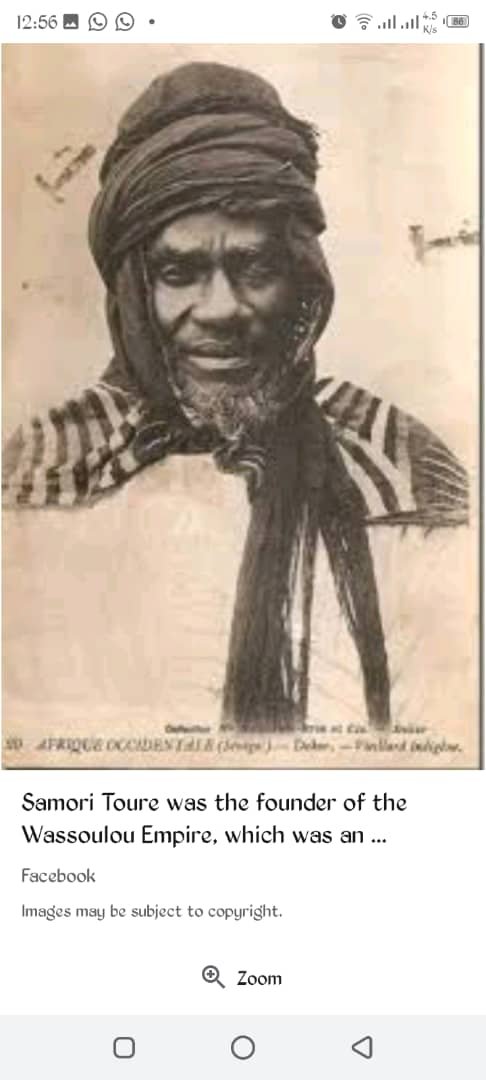
Samori Touré, the Mandinka resistance leader
Yet African resistance was rarely static. As European campaigns intensified and industrial weaponry increasingly altered the balance of power, many African societies increasingly abandoned reliance upon direct battlefield confrontation alone and began adapting older military traditions to the changing realities of colonial warfare.[8] In West Africa, for example, Samori Touré’s resistance against French expansion gradually evolved into a highly mobile military campaign that relied upon rapid troop movement, scorched-earth tactics, and the deliberate destruction of settlements and supplies in order to slow advancing French forces and deny them resources.[9] Similar defensive adaptations appeared in Southern Africa, where the Pedi under Sekhukhune and later the Ndebele under Lobengula increasingly relied upon fortified mountain strongholds, regional alliances, and tactical withdrawal to prolong resistance against both Boer and British expansion.[10]
Elsewhere, African rulers attempted to combine defensive adaptation with military modernization itself. During the Italo-Ethiopian conflict, Ethiopian forces under Menelik II combined imported modern firearms, fortified defensive preparation, strategic diplomacy, and the coordinated mobilization of regional armies drawn from across the empire before decisively defeating Italy at Adwa in 1896.[11] Across the continent, such strategies reflected a broader process of military adaptation through which African societies adjusted older systems of warfare, political organization, and regional cooperation in attempts to confront the growing realities of industrial colonial conquest.
Large-scale military confrontations therefore emerged not simply as spontaneous rebellions, but as organized political and military efforts to preserve sovereignty, defend economic systems, protect sacred authority, and resist the growing destruction of African political independence under colonial rule.
1.2 Guerrilla Warfare and Strategic Adaptation
As European firepower and military resources intensified, many African resistance movements increasingly shifted toward more flexible forms of warfare. Guerrilla tactics, mobile warfare, and strategic withdrawal became important methods through which African leaders attempted to prolong resistance and exhaust colonial armies operating far from their bases.[12]
In North Africa, Emir Abdelkader’s resistance against the French invasion of Algeria during the nineteenth century evolved into a highly mobile guerrilla campaign that combined rapid cavalry movement, tribal alliances, fortified encampments, and strategic retreat in attempts to frustrate French military advances across difficult terrain.[13] Rather than relying entirely upon direct confrontation, his forces frequently dispersed, regrouped, disrupted communication lines, and used their knowledge of local geography to weaken French control beyond major occupied centers.[14]
Similar strategies later emerged during the Chimurenga resistance in present-day Zimbabwe, where Ndebele and Shona fighters relied upon mobility, regional coordination, and attacks on isolated colonial positions in efforts to prolong resistance against British South Africa Company expansion.[15]
Across several regions of Africa, such adaptive methods proved capable of slowing colonial conquest, increasing the financial and military costs of occupation, and forcing European powers into prolonged campaigns of suppression rather than rapid territorial takeover.
1.3 Spiritual and Religious Mobilization
As military resistance and guerrilla adaptation increasingly struggled against the overwhelming industrial resources of European empires, many African societies also turned toward religion and spiritual belief as powerful instruments of anti-colonial mobilization. In several regions, resistance movements drew legitimacy and unity from religious leadership, spiritual rituals, sacred symbols, and prophetic traditions that encouraged collective resistance against foreign domination.[16]
In Sudan, the Mahdist movement united large populations against Egyptian and British control under the leadership of Muhammad Ahmad al-Mahdi, whose movement combined military resistance with Islamic revivalism and political transformation.[17] In German East Africa, the Maji Maji Rebellion mobilized diverse ethnic communities around spiritual beliefs that sacred water could protect fighters from German bullets, helping create a broader sense of unity against colonial oppression despite the devastating repression that followed.[18]
Spiritual authority therefore frequently operated not simply as religious expression, but as a mechanism for political organization, social cohesion, and mass mobilization during anti-colonial resistance.
1.4 Diplomacy, Alliances, and Political Strategy
Diplomacy and alliance-building similarly became important strategies through which African rulers attempted to navigate the expanding colonial threat. Some African leaders pursued treaties, military alliances, arms acquisition, and diplomatic engagement with rival European powers in efforts to preserve autonomy or delay conquest.[19]
Ethiopia under Emperor Menelik II combined military modernization with careful diplomacy, exploiting rivalries among European states while importing modern weaponry and reorganizing the Ethiopian army before defeating Italy at the Battle of Adwa in 1896.[20] The Ethiopian victory became one of the most significant defeats suffered by a European colonial power in Africa and later emerged as a powerful symbol of African sovereignty and resistance across the continent and the African diaspora.[21]
Beyond Ethiopia, diplomatic maneuvering and alliance-building frequently enabled African rulers to delay European occupation, strengthen military preparedness, secure access to firearms, and exploit tensions among competing imperial powers in ways that complicated and sometimes temporarily disrupted colonial expansion itself. Although diplomacy alone rarely prevented eventual conquest, it often prolonged African political autonomy and gave several societies valuable time to reorganize resistance against advancing colonial rule.
1.5 Cultural and Symbolic Resistance
As diplomacy, military adaptation, and spiritual mobilization increasingly became intertwined within anti-colonial struggles across the continent, many African societies also relied heavily upon cultural and symbolic forms of defiance that reinforced collective identity and political legitimacy during periods of colonial encroachment.
In West Africa, the Asante resistance against British expansion drew enormous strength from the symbolic importance of the Golden Stool, which represented political authority, spiritual continuity, and the collective identity of the Asante nation.[22] During the War of the Golden Stool in 1900, Queen Mother Yaa Asantewaa mobilized resistance not only around military defense, but around the protection of sacred political symbols viewed as inseparable from Asante sovereignty itself.[23] Across other parts of Africa, resistance similarly involved the defense of kingship institutions, sacred land, ancestral authority, and cultural systems threatened by colonial conquest and administrative restructuring.
Although many resistance movements were eventually suppressed through superior European weaponry, large military campaigns, famine policies, forced displacement, and collective punishment, colonial conquest across Africa remained far more violent and contested than imperial propaganda often portrayed.[24] European colonial powers frequently spent enormous financial and military resources suppressing rebellions, conducting punitive expeditions, and maintaining fragile control over conquered territories.[25] Resistance therefore remained a constant feature of colonial Africa from the earliest campaigns of conquest through the later rise of organized nationalist and anti-colonial movements during the twentieth century.
2. How Colonial Rule Politically, Economically, and Socially Reshaped African Societies
Although African resistance repeatedly challenged colonial conquest across the continent, European victory eventually allowed colonial powers to impose profound political, economic, social, and cultural transformations upon African societies. The defeat of many resistance movements did not simply result in territorial occupation alone. Colonial rule fundamentally reorganized systems of governance, patterns of economic production, land ownership, labor relations, education, religion, and social identity in ways that would continue shaping African societies long after formal colonial rule ended.[26] In many regions, the colonial state became one of the most intrusive political systems African societies had ever encountered, extending administrative authority into areas that had previously operated through decentralized political arrangements, kinship networks, religious structures, and autonomous local institutions.[27]
2.1 Political Restructuring and Colonial Governance
As military conquest consolidated colonial rule across Africa, European administrations systematically dismantled or subordinated many existing political institutions that had previously organized authority within African societies.
Kings, chiefs, religious leaders, and military rulers who resisted colonial expansion were frequently removed, exiled, imprisoned, or executed and replaced with figures willing to collaborate with colonial administrations.[28] Once many of these older political authorities had been weakened, subordinated, or removed altogether, colonial administrations increasingly reorganized governance itself according to European administrative priorities. In several regions, colonial powers imposed centralized bureaucratic systems that concentrated authority in ways that differed sharply from many precolonial political arrangements, particularly in societies where governance had traditionally operated through distributed authority, clan systems, councils of elders, or federated political structures.[29]
As colonial administrations consolidated these new centralized systems of authority, they also began transforming the relationship between African societies and political power itself. European governments introduced new systems of taxation, census-taking, pass laws, identity registration, policing, and territorial administration that extended colonial control deeply into everyday life.[30]
These expanding systems of colonial administration soon extended beyond political control alone and increasingly sought to reorganize African societies themselves according to categories and hierarchies that colonial governments considered easier to govern and monitor. Through indirect rule in British territories and assimilationist systems in French colonies, colonial administrations increasingly classified African populations into administrative and ethnic categories designed to simplify governance, regulate local authority, and strengthen colonial political control.[31] In places such as Nigeria and Rwanda, colonial policies institutionalized ethnic distinctions and political hierarchies that would later contribute to major postcolonial tensions and conflicts.[32]
These new systems of ethnic classification and administrative restructuring were further reinforced by the territorial boundaries that European powers imposed across the continent during the partition of Africa. As colonial rule expanded, European administrations increasingly divided African societies into separate colonies whose borders frequently cut across older kingdoms, ethnic communities, migration routes, and long-established commercial networks. Colonial borders therefore further fragmented many existing political and economic relationships by imposing artificially constructed territorial divisions established largely according to European imperial interests rather than African historical realities.[33]
2.2 Economic Exploitation and Dependency
As colonial administrations consolidated political authority across the continent, economic transformation quickly became one of the central objectives of imperial rule itself. Political conquest soon became inseparable from economic extraction because colonial control increasingly depended upon the ability of European powers to redirect African labor, land, and natural resources toward the needs of expanding European industries and international markets.[34] Rather than preserving existing economic systems or encouraging balanced local development, colonial administrations gradually reorganized African economies around the production of raw materials and agricultural commodities demanded abroad.
This restructuring profoundly altered patterns of production and labor across many African societies. In several regions, subsistence farming increasingly gave way to export-oriented cash-crop economies centered around cocoa, cotton, coffee, rubber, groundnuts, and palm oil, while mining industries expanded rapidly around gold, copper, diamonds, and other mineral resources required by industrial economies in Europe.[35] As colonial governments expanded commercial agriculture and mineral extraction, African communities were increasingly drawn into international economic systems over which they exercised little control. Colonial economies therefore became heavily structured around outward extraction, with African labor and resources directed primarily toward imperial centers rather than toward diversified internal economic development.
Such economic transformation could not be sustained through market incentives alone and increasingly relied upon systems of coercion and labor control imposed by colonial administrations. Across many colonies, European governments introduced hut taxes, labor taxes, forced cultivation policies, and compulsory labor systems that pressured or compelled African populations into colonial labor markets, plantations, mines, railway construction, and infrastructure projects.[36] In the Congo Free State, for example, rubber extraction under King Leopold II’s administration became associated with extreme violence, forced labor, hostage-taking, mutilation, and mass death as colonial authorities attempted to maximize production quotas and imperial profits.[37] Similar systems of coercive labor organization later expanded across settler economies in Southern and Central Africa where land alienation, pass laws, and migrant labor systems increasingly tied African survival to colonial wage economies controlled largely by European settlers and mining corporations.[38]
As these extractive economies expanded, colonial infrastructure increasingly developed around the needs of imperial commerce itself. Railways, roads, ports, and communication networks were therefore constructed primarily to connect mines, plantations, and resource-producing regions to coastal export centers rather than to facilitate balanced trade and integration among African societies themselves.[39] In British East Africa, French West Africa, the Congo, and Southern Africa, transport systems became deeply integrated into export production and imperial commercial networks that linked African colonies more closely to European markets than to neighboring African economies.[40] Colonial economic policy therefore did not simply extract wealth from Africa in the short term. It also produced long-term structural dependency by discouraging industrialization, limiting diversified local production, and integrating African territories into unequal positions within the global capitalist economy dominated by European powers.[41]
2.3 Social, Cultural, and Psychological Transformation
As colonial administrations expanded politically and economically across Africa, they increasingly sought not only to control territory and labor, but also to reshape the social and cultural foundations of African life itself. Colonial rule therefore extended beyond systems of taxation, labor extraction, and political administration into the regulation of education, religion, law, language, morality, and social identity across many parts of the continent.[42] Missionary education, Christianization, colonial legal systems, and European cultural institutions increasingly challenged older belief systems, social structures, languages, and intellectual traditions that had long organized everyday life within African societies.
Education soon became one of the most important instruments through which colonial governments and missionary organizations attempted to transform African societies socially and culturally. Colonial schools frequently promoted European historical narratives, languages, religious values, and cultural ideals while portraying African societies as backward, primitive, or uncivilized populations supposedly requiring European guidance and transformation.[43] In many colonies, therefore, African languages and knowledge systems were marginalized within formal education, while European models of religion, dress, administration, and social conduct increasingly became associated with power, literacy, modernity, and economic advancement.
As these cultural transformations expanded, they also contributed to the emergence of new social classes and forms of identity within colonial Africa. Urbanization, wage labor, mission education, and colonial administration gradually produced new African elites composed of clerks, teachers, interpreters, soldiers, civil servants, and professionals educated within colonial systems.[44] At the same time, colonial societies became increasingly structured around racial hierarchy and unequal access to political and economic opportunity. Racial segregation, discriminatory legal systems, and unequal access to land, education, and political representation reinforced rigid systems of racial inequality throughout many colonies, particularly within settler societies such as South Africa, Kenya, Algeria, and Rhodesia.[45]
These material and social transformations also carried profound psychological consequences. The repeated denigration of African languages, religions, institutions, and cultural practices contributed to forms of alienation and inferiority that affected both individual identity and collective historical consciousness.[46]
Colonial domination therefore frequently operated not only through military force and economic extraction, but also through cultural control and the gradual reshaping of how colonized populations understood themselves, their histories, and their place within the modern world.[47]
2.4 The Rise of Nationalism and Pan-African Consciousness
However, the very social, educational, and political transformations introduced under colonial rule would eventually help generate many of the forces that later challenged imperial domination itself. As mission schools, colonial cities, labor migration, newspapers, and Western education expanded across the continent, increasing numbers of Africans became exposed to global political ideas concerning liberty, nationalism, equality, socialism, constitutionalism, and self-determination.[48] At the same time, the inequalities and racial hierarchies embedded within colonial society increasingly encouraged educated Africans to use these same political languages to criticize colonial exploitation, forced labor, racial discrimination, and political exclusion.
As criticism of colonial rule deepened, anti-colonial thought also increasingly expanded beyond local grievances alone and began connecting African struggles across both the continent and the wider African diaspora. Intellectuals, activists, journalists, and political organizations gradually promoted broader ideas of African unity and liberation while arguing that colonial rule had fragmented African societies politically, economically, and psychologically even as it simultaneously created shared experiences of oppression that could form the basis for collective resistance movements.[49] The memory of earlier resistance movements; from the Mahdists and the Asante to Ethiopia’s victory at Adwa gradually became woven into emerging nationalist narratives that celebrated African sovereignty, dignity, historical achievement, and self-rule.[50]
As these nationalist and Pan-African ideas spread more widely, political and intellectual awakening increasingly evolved into organized activism across many parts of Africa during the twentieth century. Pan-African conferences, anti-colonial newspapers, labor unions, student movements, veterans’ organizations, and nationalist parties gradually emerged as important centers of political mobilization through which Africans began demanding independence, constitutional reform, political representation, and an end to colonial domination.[51]
Colonial conquest had therefore reshaped African societies profoundly, but it had also unintentionally helped generate many of the political, intellectual, and organizational foundations that would later contribute to the eventual collapse of European colonial rule across the continent.
In conclusion, European conquest of Africa therefore unfolded neither as a peaceful expansion nor as an uncontested triumph of imperial power. Across the continent, African societies resisted colonial rule through organized warfare, guerrilla campaigns, diplomacy, spiritual mobilization, symbolic resistance, and prolonged political defiance in attempts to defend sovereignty, preserve institutions, protect sacred authority, and resist the destruction of their political independence. Although European military technology and industrial resources eventually enabled colonial powers to impose control over much of the continent, conquest remained violent, expensive, and deeply contested from beginning to end.
Yet the consequences of colonial rule would ultimately extend far beyond military occupation itself. Colonial administrations reorganized African political systems, redirected economies toward extraction and dependency, transformed labor relations, reshaped education and cultural life, and institutionalized new racial and administrative hierarchies whose effects continued long after formal empire collapsed. At the same time, the experience of conquest, domination, and resistance also generated new political consciousness across Africa and the wider diaspora. The very colonial systems designed to secure imperial control unintentionally helped produce many of the nationalist, Pan-African, and anti-colonial movements that would later challenge European domination and contribute to the eventual dismantling of colonial rule across the continent. The history of resistance during the Scramble for Africa therefore remained not simply a struggle against conquest, but also part of the broader historical foundations upon which later movements for African liberation, sovereignty, and self-determination would emerge.
Endnotes
[1] Terence Ranger, ed., African Resistance to the Imposition of European Rule (London: Heinemann, 1985), 1–12.
[2] John Iliffe, Africans: The History of a Continent (Cambridge: Cambridge University Press, 1995), 198–203.
[3] Richard Reid, Warfare in African History (Cambridge: Cambridge University Press, 2012), 52–71.
[4] John Thornton, Africa and Africans in the Making of the Atlantic World, 1400–1800 (Cambridge: Cambridge University Press, 1998), 103–109.
[5] Richard Reid, Warfare in African History (Cambridge: Cambridge University Press, 2012), 87–95.
[6] Bruce Vandervort, Wars of Imperial Conquest in Africa, 1830–1914 (Bloomington: Indiana University Press, 1998), 142–148.
[7] Timothy Stapleton, A Military History of Africa, Volume II: Colonial Africa and the Cold War, 1850–1977 (Santa Barbara: Praeger, 2013), 14–22.
[8] Richard Reid, A History of Modern Africa: 1800 to the Present (Oxford: Wiley-Blackwell, 2012), 119–123.
[9] Yves Person, Samori: Une Révolution Dyula, Vol. 3 (Dakar: IFAN, 1975), 1334–1341.
[10] Timothy Stapleton, A Military History of Africa, Volume II: Colonial Africa and the Cold War, 1850–1977 (Santa Barbara: Praeger, 2013), 26–31.
[11] Raymond Jonas, The Battle of Adwa: African Victory in the Age of Empire (Cambridge, MA: Harvard University Press, 2011), 241–252.
[12] Bruce Vandervort, Wars of Imperial Conquest in Africa, 1830–1914 (Bloomington: Indiana University Press, 1998), 188–194.
[13] John Ruedy, Modern Algeria: The Origins and Development of a Nation (Bloomington: Indiana University Press, 2005), 48–56.
[14] John Ruedy, Modern Algeria: The Origins and Development of a Nation (Bloomington: Indiana University Press, 2005), 57–63.
[15] Terence Ranger, Revolt in Southern Rhodesia, 1896–97: A Study in African Resistance (London: Heinemann, 1967), 112–124.
[16] Terence Ranger, “Religious Movements and Politics in Sub-Saharan Africa,” African Studies Review 29, no. 2 (1986): 1–17.
[17] P.M. Holt, The Mahdist State in the Sudan, 1881–1898 (Oxford: Clarendon Press, 1958), 96–103.
[18] John Iliffe, A Modern History of Tanganyika (Cambridge: Cambridge University Press, 1979), 168–181.
[19] Richard Reid, A History of Modern Africa: 1800 to the Present (Oxford: Wiley-Blackwell, 2012), 114–118.
[20] Raymond Jonas, The Battle of Adwa: African Victory in the Age of Empire (Cambridge, MA: Harvard University Press, 2011), 241–248.
[21] Harold G. Marcus, The Life and Times of Menelik II: Ethiopia 1844–1913 (Lawrenceville: Red Sea Press, 1995), 187–192.
[22] T.C. McCaskie, State and Society in Pre-Colonial Asante (Cambridge: Cambridge University Press, 1995), 293–301.
[23] A.A. Boahen, Yaa Asantewaa and the Asante-British War of 1900–1 (Accra: Sub-Saharan Publishers, 2003), 74–81.
[24] Thomas Pakenham, The Scramble for Africa: The White Man’s Conquest of the Dark Continent from 1876 to 1912 (New York: Random House, 1991), 575–583.
[25] H.L. Wesseling, Divide and Rule: The Partition of Africa, 1880–1914 (Westport, CT: Praeger, 1996), 358–366.
[26] Crawford Young, The African Colonial State in Comparative Perspective (New Haven: Yale University Press, 1994), 95–108.
[27] Mahmood Mamdani, Citizen and Subject: Contemporary Africa and the Legacy of Late Colonialism (Princeton: Princeton University Press, 1996), 16–27.
[28] Terence Ranger, ed., African Resistance to the Imposition of European Rule (London: Heinemann, 1985), 23–31.
[29] Crawford Young, The African Colonial State in Comparative Perspective (New Haven: Yale University Press, 1994), 132–146.
[30] Mahmood Mamdani, Citizen and Subject: Contemporary Africa and the Legacy of Late Colonialism (Princeton: Princeton University Press, 1996), 37–52.
[31] Martin Chanock, Law, Custom and Social Order: The Colonial Experience in Malawi and Zambia (Cambridge: Cambridge University Press, 1985), 62–74.
[32] Mahmood Mamdani, When Victims Become Killers: Colonialism, Nativism, and the Genocide in Rwanda (Princeton: Princeton University Press, 2001), 41–59.
[33] A.I. Asiwaju, Partitioned Africans: Ethnic Relations Across Africa’s International Boundaries, 1884–1984 (London: C. Hurst & Company, 1985), 1–18.
[34] Walter Rodney, How Europe Underdeveloped Africa (Washington, DC: Howard University Press, 1982), 149–161.
[35] Frederick Cooper, Africa Since 1940: The Past of the Present (Cambridge: Cambridge University Press, 2002), 19–33.
[36] Samir Amin, Accumulation on a World Scale: A Critique of the Theory of Underdevelopment, Vol. 2 (New York: Monthly Review Press, 1974), 498–506.
[37] Adam Hochschild, King Leopold’s Ghost: A Story of Greed, Terror, and Heroism in Colonial Africa (Boston: Houghton Mifflin, 1998), 115–139.
[38] Colin Bundy, The Rise and Fall of the South African Peasantry (Berkeley: University of California Press, 1979), 85–103.
[39] Walter Rodney, How Europe Underdeveloped Africa (Washington, DC: Howard University Press, 1982), 205–214.
[40] Frederick Cooper, Africa Since 1940: The Past of the Present (Cambridge: Cambridge University Press, 2002), 27–39.
[41] Samir Amin, Unequal Development: An Essay on the Social Formations of Peripheral Capitalism (New York: Monthly Review Press, 1976), 179–191.
[42] Jean Comaroff and John Comaroff, Of Revelation and Revolution: Christianity, Colonialism, and Consciousness in South Africa, Vol. 1 (Chicago: University of Chicago Press, 1991), 218–236.
[43] Ngũgĩ wa Thiong’o, Decolonising the Mind: The Politics of Language in African Literature (London: James Currey, 1986), 11–28.
[44] Frederick Cooper, Colonialism in Question: Theory, Knowledge, History (Berkeley: University of California Press, 2005), 153–172.
[45] Achille Mbembe, On the Postcolony (Berkeley: University of California Press, 2001), 24–38.
[46] Frantz Fanon, Black Skin, White Masks (New York: Grove Press, 1967), 9–27.
[47] Ngũgĩ wa Thiong’o, Decolonising the Mind: The Politics of Language in African Literature (London: James Currey, 1986), 28–33.
[48] Ali A. Mazrui and Michael Tidy, Nationalism and New States in Africa (London: Heinemann, 1984), 54–67.
[49] Hakim Adi and Marika Sherwood, Pan-African History: Political Figures from Africa and the Diaspora Since 1787 (London: Routledge, 2003), 21–43.
[50] Kevin Shillington, History of Africa, 4th ed. (New York: Palgrave Macmillan, 2012), 327–334.
[51] George Padmore, Pan-Africanism or Communism? The Coming Struggle for Africa (London: Dennis Dobson, 1956), 112–129.
Bibliography
Adi, Hakim, and Marika Sherwood. Pan-African History: Political Figures from Africa and the Diaspora Since 1787. London: Routledge, 2003.
Amin, Samir. Accumulation on a World Scale: A Critique of the Theory of Underdevelopment. Vol. 2. New York: Monthly Review Press, 1974.
Amin, Samir. Unequal Development: An Essay on the Social Formations of Peripheral Capitalism. New York: Monthly Review Press, 1976.
Asiwaju, A.I. Partitioned Africans: Ethnic Relations Across Africa’s International Boundaries, 1884–1984. London: C. Hurst & Company, 1985.
Boahen, A. Adu. African Perspectives on Colonialism. Baltimore: Johns Hopkins University Press, 1987.
Boahen, A.A. Yaa Asantewaa and the Asante-British War of 1900–1. Accra: Sub-Saharan Publishers, 2003.
Bundy, Colin. The Rise and Fall of the South African Peasantry. Berkeley: University of California Press, 1979.
Chanock, Martin. Law, Custom and Social Order: The Colonial Experience in Malawi and Zambia. Cambridge: Cambridge University Press, 1985.
Comaroff, Jean, and John Comaroff. Of Revelation and Revolution: Christianity, Colonialism, and Consciousness in South Africa. Vol. 1. Chicago: University of Chicago Press, 1991.
Cooper, Frederick. Africa Since 1940: The Past of the Present. Cambridge: Cambridge University Press, 2002.
Cooper, Frederick. Colonialism in Question: Theory, Knowledge, History. Berkeley: University of California Press, 2005.
Fanon, Frantz. Black Skin, White Masks. New York: Grove Press, 1967.
Hochschild, Adam. King Leopold’s Ghost: A Story of Greed, Terror, and Heroism in Colonial Africa. Boston: Houghton Mifflin, 1998.
Holt, P.M. The Mahdist State in the Sudan, 1881–1898. Oxford: Clarendon Press, 1958.
Iliffe, John. Africans: The History of a Continent. Cambridge: Cambridge University Press, 1995.
Iliffe, John. A Modern History of Tanganyika. Cambridge: Cambridge University Press, 1979.
Jonas, Raymond. The Battle of Adwa: African Victory in the Age of Empire. Cambridge, MA: Harvard University Press, 2011.
Mamdani, Mahmood. Citizen and Subject: Contemporary Africa and the Legacy of Late Colonialism. Princeton: Princeton University Press, 1996.
Mamdani, Mahmood. When Victims Become Killers: Colonialism, Nativism, and the Genocide in Rwanda. Princeton: Princeton University Press, 2001.
Marcus, Harold G. The Life and Times of Menelik II: Ethiopia 1844–1913. Lawrenceville: Red Sea Press, 1995.
Mazrui, Ali A., and Michael Tidy. Nationalism and New States in Africa. London: Heinemann, 1984.
Mbembe, Achille. On the Postcolony. Berkeley: University of California Press, 2001.
McCaskie, T.C. State and Society in Pre-Colonial Asante. Cambridge: Cambridge University Press, 1995.
Ngũgĩ wa Thiong’o. Decolonising the Mind: The Politics of Language in African Literature. London: James Currey, 1986.
Padmore, George. Pan-Africanism or Communism? The Coming Struggle for Africa. London: Dennis Dobson, 1956.
Pakenham, Thomas. The Scramble for Africa: The White Man’s Conquest of the Dark Continent from 1876 to 1912. New York: Random House, 1991.
Person, Yves. Samori: Une Révolution Dyula. Vol. 3. Dakar: IFAN, 1975.
Ranger, Terence, ed. African Resistance to the Imposition of European Rule. London: Heinemann, 1985.
Ranger, Terence. Revolt in Southern Rhodesia, 1896–97: A Study in African Resistance. London: Heinemann, 1967.
Ranger, Terence. “Religious Movements and Politics in Sub-Saharan Africa.” African Studies Review 29, no. 2 (1986): 1–17.
Reid, Richard. A History of Modern Africa: 1800 to the Present. Oxford: Wiley-Blackwell, 2012.
Reid, Richard. Warfare in African History. Cambridge: Cambridge University Press, 2012.
Rodney, Walter. How Europe Underdeveloped Africa. Washington, DC: Howard University Press, 1982.
Ruedy, John. Modern Algeria: The Origins and Development of a Nation. Bloomington: Indiana University Press, 2005.
Shillington, Kevin. History of Africa. 4th ed. New York: Palgrave Macmillan, 2012.
Stapleton, Timothy. A Military History of Africa, Volume II: Colonial Africa and the Cold War, 1850–1977. Santa Barbara: Praeger, 2013.
Thornton, John. Africa and Africans in the Making of the Atlantic World, 1400–1800. Cambridge: Cambridge University Press, 1998.
Vandervort, Bruce. Wars of Imperial Conquest in Africa, 1830–1914. Bloomington: Indiana University Press, 1998.
Wesseling, H.L. Divide and Rule: The Partition of Africa, 1880–1914. Westport, CT: Praeger, 1996.
Young, Crawford. The African Colonial State in Comparative Perspective. New Haven: Yale University Press, 1994.
Research by Emmer Atwiine
Paper written by Ezron Kaijuka
