
How European Colonial Powers Suddenly Began the Scramble for Africa in the Late 19th Century.
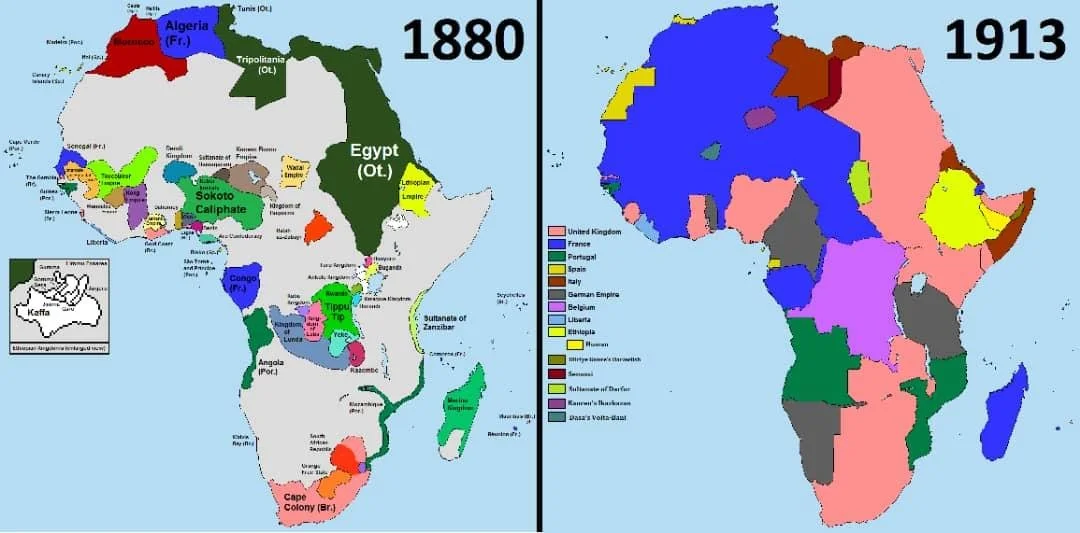
Map Africa in 1880 vs. Africa in 1913
In the late 19th century, something changed in Europe. For centuries, European powers had lingered cautiously along Africa’s coastlines, trading through fortified ports while the vast interior of the continent remained beyond their control. Powerful African kingdoms governed themselves, commanded trade routes, fought wars, and shaped regional politics on their own terms. Then, within the span of just a few decades, that balance collapsed. European colonial powers suddenly turned inward with extraordinary speed, launching one of the most aggressive territorial races in modern history. By 1914, in little more than a single generation, nearly the entire African continent had been divided among foreign empires.
Historians would later call this transformation the Scramble for Africa—a violent contest driven by imperial ambition, political rivalry, commercial greed, and the growing belief that global power depended on colonial expansion. As historian Thomas Pakenham described it, the Scramble became “a gigantic, fateful lottery,” whose winning tickets were drawn in European capitals while its consequences reshaped millions of African lives.[1] Yet the speed of this sudden rush raises a deeper historical question: why did European powers, after centuries of limited inland presence, abruptly begin racing to conquer Africa in the late 19th century? The answer lies in a chain of escalating events, rivalries, fears, and ambitions that transformed imperial competition into a continental land grab and permanently altered the course of African history.
The Immediate Triggers Behind Europe’s Rush Into Africa
Between 1881 and 1914, Europe carved up Africa with extraordinary speed and aggression. Within little more than a generation, nearly the entire continent had been claimed, occupied, or brought under the political control of European empires. Yet this sudden rush did not emerge spontaneously. For centuries, most European powers had largely confined themselves to Africa’s coastlines, establishing forts and trading posts for gold, ivory, and enslaved Africans while leaving the vast interior beyond their direct control. African kingdoms and commercial states continued to dominate inland political and economic life with limited European interference.[2]
The sudden transition from coastal influence to territorial conquest was triggered by a series of escalating crises, rivalries, and imperial maneuvers during the late nineteenth century. Each development intensified fears among European powers that delay could result in strategic exclusion, economic disadvantage, or loss of international prestige. Together, these events transformed imperial competition into a full continental scramble.
1. The Franco-Prussian War and the Transformation of European Rivalry
One of the deeper political foundations of the Scramble for Africa emerged from the Franco-Prussian War of 1870–71. The conflict began after growing tensions between the expanding Kingdom of Prussia and the French Empire under Napoleon III. Prussia’s victory not only defeated France militarily but also led to the unification of Germany into a powerful new European state under Chancellor Otto von Bismarck.[3]
The consequences of the war reshaped European politics profoundly. France suffered humiliation and lost the territories of Alsace-Lorraine to the newly unified German Empire, intensifying French fears of declining international influence.[4] Germany’s sudden rise meanwhile disrupted the traditional European balance of power and increased diplomatic tensions among Europe’s major states.
As rivalries intensified, colonial expansion increasingly became an alternative arena through which European powers could compete for prestige, influence, and strategic advantage without risking immediate continental war.[5] France increasingly turned toward overseas empire-building as a means of restoring national pride, while Germany’s emergence as a major industrial and military power generated growing pressure for imperial expansion abroad.
Imperial competition therefore became closely tied to broader European geopolitics. Colonial possessions increasingly symbolized national greatness, military strength, and economic power. As tensions mounted across Europe, Africa gradually became one of the principal arenas through which these rivalries unfolded.
2. King Leopold II and the Congo Crisis
Another decisive trigger emerged through the activities of King Leopold II of Belgium in Central Africa. Frustrated that Belgium possessed no major overseas empire, Leopold sought to establish personal control over territory in the Congo Basin under the language of humanitarianism, scientific exploration, and anti-slavery campaigns.[6]
To achieve this goal, Leopold employed the explorer Henry Morton Stanley to negotiate treaties with African leaders along the Congo River. Many of these agreements were secured through coercion, misunderstanding, or deliberate deception, while simultaneously giving Leopold enormous territorial claims within Central Africa.[7]
Leopold’s success had consequences far beyond Belgium itself. His rapid acquisition of territory demonstrated to rival European powers that enormous wealth, strategic influence, and imperial prestige could be secured within Africa’s interior. The Congo suddenly appeared not merely as a distant region of exploration but as a source of immense commercial and geopolitical opportunity.
The Congo crisis therefore intensified fears among European powers that hesitation could lead to exclusion from the growing imperial race. Leopold’s activities helped accelerate demands for formal territorial claims and increased pressure for European governments to secure colonial possessions before their rivals did so first.[8]
3. Britain’s Occupation of Egypt and the Strategic Importance of the Suez Canal
Britain’s occupation of Egypt in 1882 became another major turning point in the escalation of the Scramble for Africa. The occupation emerged from growing instability within Egypt alongside Britain’s determination to protect the Suez Canal, which had become one of the most strategically important routes in the British Empire after its opening in 1869.[9]
The canal dramatically shortened the sea route between Britain and India, the most valuable territory within Britain’s imperial system. British policymakers increasingly viewed control over Egypt and the canal as essential to protecting imperial trade, military communication, and access to Asian markets.
When nationalist unrest threatened European financial interests in Egypt, Britain intervened militarily and established effective control over the country. France, which had previously shared influence within Egypt and had heavily invested in the Suez Canal project, viewed the British occupation as both a diplomatic humiliation and a strategic threat.[10]
The occupation intensified Anglo-French rivalry and convinced many European governments that informal influence in Africa could rapidly become formal territorial control. The crisis also demonstrated that African territories had become central to wider imperial competition among European powers.
Britain’s successful occupation of Egypt and effective control over the Suez Canal alarmed rival European states, particularly France, which increasingly turned toward expanding its influence deeper into the rest of Africa in search of imperial prestige, strategic compensation, and territorial advantage.[11] The occupation therefore acted as a major turning point, encouraging other European powers to accelerate their own territorial claims across the continent before strategic regions and economic opportunities were monopolized by their rivals.
4. Germany’s Entry into Colonial Competition
Germany’s formal entry into colonial expansion further accelerated the Scramble. Although Bismarck had initially shown skepticism toward colonialism, growing commercial pressures, nationalist demands, and fears of exclusion from overseas influence increasingly pushed Germany toward imperial expansion.[12]
By the early 1880s, Germany had emerged as one of Europe’s fastest-growing industrial powers. German businessmen, commercial groups, and nationalist organizations increasingly demanded overseas territories that could provide markets, raw materials, and strategic prestige comparable to those possessed by Britain and France.
In 1884, Germany declared protectorates over territories including Togo, Cameroon, and South-West Africa. These declarations formalized Germany’s entry into the imperial race and intensified fears among rival powers that Africa was rapidly being divided among competing European states.[13]
Germany’s actions helped transform imperial rivalry into an accelerating cycle of territorial acquisition. Once one European state established claims over an African territory, others increasingly felt compelled to follow in order to avoid diplomatic isolation, economic exclusion, or strategic disadvantage.
In conclusion, by the mid-1880s, rivalry had evolved into a full continental scramble. What had once been centuries of cautious coastal trade and limited European presence was rapidly transforming into a fierce imperial contest for territorial occupation and control. No major European power could now afford to remain behind while its rivals expanded deeper into the African interior.
However, these immediate triggers alone do not fully explain the intensity of the Scramble for Africa. Beneath the diplomatic crises and territorial rivalries lay deeper economic ambitions, industrial pressures, nationalist competition, and imperial ideologies that had been steadily pushing Europe toward colonial conquest for decades.
End Notes.
[1] [Pakenham, Thomas, “The Scramble for Africa: 1876-1912”, 1991, Page xxi.]
[2] Iliffe, John, “Africans: The History of a Continent”, Cambridge University Press, 1995, Page 193.
[3] Taylor, A.J.P., “The Struggle for Mastery in Europe 1848–1918”, Oxford University Press, 1954, Page 166.
[4] Hobsbawm, Eric, “The Age of Empire: 1875–1914”, Vintage Books, 1989, Page 67.
[5] Wesseling, H.L., “Divide and Rule: The Partition of Africa, 1880–1914”, Praeger, 1996, Page 110.
[6] Hochschild, Adam, “King Leopold’s Ghost: A Story of Greed, Terror, and Heroism in Colonial Africa”, Houghton Mifflin, 1998, Page 44.
[7] Hochschild, Adam, “King Leopold’s Ghost: A Story of Greed, Terror, and Heroism in Colonial Africa”, Houghton Mifflin, 1998, Page 58.
[8] Pakenham, Thomas, “The Scramble for Africa: 1876–1912”, Random House, 1991, Page 72.
[9] Darwin, John, “The Empire Project: The Rise and Fall of the British World-System, 1830–1970”, Cambridge University Press, 2009, Page 95.
[10] Cain, P.J. and Hopkins, A.G., “British Imperialism: Innovation and Expansion 1688–1914”, Longman, 1993, Page 334.
[11] Robinson, Ronald and Gallagher, John, “Africa and the Victorians: The Official Mind of Imperialism”, Macmillan, 1961, Page 465.
[12] Darwin, John, “After Tamerlane: The Rise and Fall of Global Empires, 1400–2000”, Bloomsbury Press, 2008, Page 292.
[13] Wesseling, H.L., “Divide and Rule: The Partition of Africa, 1880–1914”, Praeger, 1996, Page 142.
Bibliography:
Cain, P.J., and A.G. Hopkins. British Imperialism: Innovation and Expansion 1688–1914. London: Longman, 1993.
Darwin, John. After Tamerlane: The Rise and Fall of Global Empires, 1400–2000. New York: Bloomsbury Press, 2008.
Darwin, John. The Empire Project: The Rise and Fall of the British World-System, 1830–1970. Cambridge: Cambridge University Press, 2009.
Hobsbawm, Eric. The Age of Empire: 1875–1914. New York: Vintage Books, 1989.
Hochschild, Adam. King Leopold’s Ghost: A Story of Greed, Terror, and Heroism in Colonial Africa. Boston: Houghton Mifflin, 1998.
Iliffe, John. Africans: The History of a Continent. Cambridge: Cambridge University Press, 1995.
Pakenham, Thomas. The Scramble for Africa: 1876–1912. New York: Random House, 1991.
Robinson, Ronald, and John Gallagher. Africa and the Victorians: The Official Mind of Imperialism. London: Macmillan, 1961.
Taylor, A.J.P. The Struggle for Mastery in Europe 1848–1918. Oxford: Oxford University Press, 1954.
Wesseling, H.L. Divide and Rule: The Partition of Africa, 1880–1914. Westport, CT: Praeger, 1996.
Research by; Emmer Atwiine
Paper Written by: Ezron Kaijuka
