
How Europe’s Hunger for Power and Wealth Fueled the Scramble and Partition of Africa in the Late 19th Century.
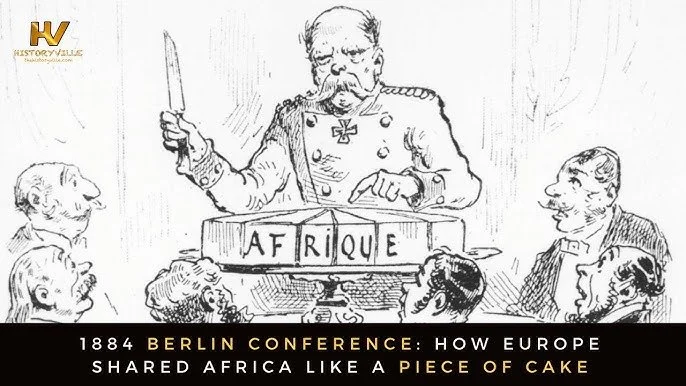
Cartoon image, adapted from a late 19th-century European imperial cartoon originally depicting the partition of China (Le Petit Journal, 1898), widely reproduced in modern educational contexts to illustrate imperial competition.
Long before European soldiers marched into the African interior or diplomats gathered to divide the continent on maps, a different transformation was already reshaping Europe itself. Across Britain, France, Germany, and other rising industrial powers, factories multiplied, cities expanded, and economies consumed resources at an unprecedented scale. Smoke rose endlessly above industrial skylines as new machines demanded rubber, copper, palm oil, gold, and other raw materials to sustain Europe’s accelerating industrial growth, while expanding industries simultaneously searched for new overseas markets for manufactured goods.
At the same time, rival empires competed fiercely for prestige, influence, and global dominance, each fearing that falling behind in the imperial race could threaten its future power. As these pressures intensified, Africa increasingly came to be viewed not as a distant frontier, but as the solution to Europe’s mounting ambitions. The Scramble for Africa was therefore not simply the product of sudden political events in the late 19th century; it was the culmination of deeper economic hunger, imperial rivalry, industrial expansion, and ideological beliefs that had been steadily pushing Europe toward colonial conquest for decades.
1. How the Industrial Revolution Turned Africa into an Imperial Target
The Industrial Revolution fundamentally transformed European economies and accelerated industrial production on an unprecedented scale. As factories expanded and manufacturing intensified, European powers increasingly sought new sources of raw materials and overseas markets to sustain continued economic growth.[1]
The Industrial Revolution, which began in Britain in the late 18th century, fundamentally altered Europe's relationship with the wider world. Factories demanded a constant supply of raw materials, while expanding industries required access to new overseas markets for manufactured goods. Initially, palm oil became important for industrial lubrication, while later industrial expansion sharply increased European demand for rubber, copper, gold, and diamonds.[2]
Across many European political and commercial circles, Africa increasingly came to be viewed as a major source of strategic raw materials and economic opportunity. According to economic historians P.J. Cain and A.G. Hopkins, British expansion was heavily driven by “gentlemanly capitalists”—financial elites in the City of London who sought new and secure fields for overseas investment.[3]
Colonies therefore offered European powers both access to raw materials and protected markets for manufactured goods, strengthening the growing economic logic behind imperial expansion into Africa.
2. How Political Rivalries Among European Powers Intensified the Scramble for Africa
As industrial expansion intensified Europe’s demand for markets, resources, and global influence, economic competition increasingly merged with political rivalry among the major European powers.
The political landscape of Europe after the Franco-Prussian War (1870–71) was deeply tense and increasingly competitive. Germany’s unification under Otto von Bismarck had dramatically altered the balance of power in Europe, unsettling older imperial powers such as France and Britain while intensifying fears of diplomatic and military isolation across the continent.[4] As historian H.L. Wesseling observes, colonial expansion increasingly became an alternative arena through which European states could project prestige, demonstrate strength, and compete for international influence without provoking direct continental war.[5]
For France, the humiliation of defeat by Prussia and the loss of Alsace-Lorraine intensified the desire for national recovery and imperial prestige abroad.[6] Meanwhile, the newly unified states of Germany and Italy increasingly viewed colonial possessions as symbols of modern great-power status. Although Bismarck of Germany had initially shown limited enthusiasm for colonies, growing commercial pressure and fears that Germany would be excluded from global influence gradually pushed the German state toward overseas expansion.[7]
These rivalries soon extended directly into Africa itself. British policymakers increasingly feared that rival European powers might threaten strategic trade routes linking Britain to India and other imperial possessions.[8] France simultaneously expanded aggressively across West and Central Africa, while Germany moved into East Africa and the southwest of the continent. The competition became increasingly visible during confrontations such as the Fashoda Incident of 1898, when British and French imperial ambitions nearly brought the two powers into direct military conflict in Sudan.[9] Italian ambitions in the Horn of Africa further reflected how colonial expansion had become tied to national prestige and geopolitical rivalry among European states.
Imperial competition therefore evolved into an escalating cycle of territorial acquisition. When one European power moved to occupy or claim territory in Africa, rival states increasingly felt compelled to follow in order to avoid strategic disadvantage, economic exclusion, or diplomatic isolation. Colonial expansion had become deeply intertwined with the wider struggle for power and influence within Europe itself.
3. How Explorers, Missionaries, and Imperial Ideologies Intensified Europe’s Hunger for Africa
As competition among European powers intensified, explorers and missionaries increasingly became important instruments through which imperial influence penetrated deeper into the African interior. Exploration narratives, missionary networks, and imperial ideologies did not simply accompany European expansion; they helped generate the public enthusiasm, political justification, and geographic knowledge that made territorial conquest increasingly imaginable and desirable.
Explorers such as David Livingstone and Henry Morton Stanley captured the European imagination through widely circulated accounts of African rivers, trade routes, and inland societies.[10] Their writings, maps, and public lectures transformed large parts of Africa from unfamiliar spaces on European maps into regions increasingly viewed as economically accessible and strategically significant. Exploration literature increasingly framed Africa not merely as a distant continent, but as a region filled with commercial opportunity, navigable routes, and territories open to imperial expansion.[11]
The role of Henry Morton Stanley became particularly significant in Central Africa. Stanley’s expeditions in the Congo Basin not only expanded European geographical knowledge but directly facilitated King Leopold II’s imperial ambitions in the region.[12] Through treaties, river mapping, and logistical groundwork, exploration increasingly merged with imperial acquisition itself. Stanley’s activities in the Congo helped transform European curiosity into formal territorial occupation and commercial exploitation.[13]
Missionaries similarly played an important role in expanding European influence inland. Many missionaries were genuinely motivated by religious conviction and campaigns against slavery; however, missionary activity also helped widen European cultural and political presence across African societies.[14] Mission stations often became some of the earliest semi-permanent European footholds in the interior, while missionary reports and appeals increasingly shaped public opinion in Europe regarding Africa.[15] In some instances, missionary calls for protection during periods of conflict or instability provided European governments with additional moral and political justification for intervention and eventual annexation. Missionary activity therefore frequently helped familiarize European audiences and political elites with African regions that later became targets of imperial expansion.
This expanding imperial presence was reinforced by powerful ideological frameworks that increasingly normalized colonial domination within European political thought. The so‑called civilizing mission portrayed imperial expansion as a moral obligation to spread Christianity, commerce, and “civilization” to supposedly inferior societies. Popular ideas such as the “White Man’s Burden,” alongside Social Darwinism and pseudo-scientific racial theories, presented European rule as both natural and beneficial.[16] These ideological systems increasingly framed imperial conquest as a legitimate and even necessary extension of European progress and global influence.[17]
Beneath the rhetoric of civilization, however, lay the realities of economic extraction, territorial ambition, and political domination. Imperial ideology provided a “veneer of morality” that concealed the violence and exploitation underlying European expansion into Africa.[18] These ideologies therefore did not merely justify colonial conquest after it occurred; they actively helped generate the public support, political legitimacy, and imperial confidence that intensified Europe’s growing hunger for Africa.
In conclusion, the Scramble for Africa did not emerge suddenly from a single political crisis or diplomatic decision. It was the result of mounting pressures that had been building across Europe for decades. Industrial expansion created an increasing demand for raw materials, overseas markets, and profitable fields for investment. At the same time, political rivalries among European powers transformed colonial expansion into a contest for prestige, strategic influence, and global dominance. As these pressures intensified, Africa increasingly came to be viewed not simply as a neighboring continent, but as a solution to Europe’s growing economic ambitions and geopolitical anxieties.
Explorers, missionaries, and imperial ideologies further accelerated this transformation. Exploration opened the African interior to European commercial and political imagination, missionary networks expanded European cultural influence inland, and imperial ideologies normalized conquest by presenting domination as civilization and expansion as moral duty. Together, these forces helped generate the public support, political confidence, and imperial momentum that pushed European powers toward territorial occupation on an unprecedented scale.
By the late nineteenth century, Europe’s hunger for power, wealth, influence, and imperial prestige had converged into a full continental scramble. Africa was no longer viewed merely as a region of trade and coastal interaction, but increasingly as territory to be occupied, controlled, and exploited within the wider struggle for European global supremacy. The immediate rush into Africa had therefore been fueled by far deeper economic, political, and ideological forces that would soon reshape the entire continent through conquest, partition, and colonial rule.
End Notes.
[1] Cain, P.J., and A.G. Hopkins. British Imperialism: Innovation and Expansion 1688–1914. London: Longman, 1993, Page 321.
[2] Pakenham, Thomas. The Scramble for Africa: 1876–1912. New York: Random House, 1991, Page 22.
[3] Cain, P.J., and A.G. Hopkins. British Imperialism: Innovation and Expansion 1688–1914. London: Longman, 1993, Page 365.
[4] A.J.P. Taylor, “The Struggle for Mastery in Europe 1848–1918”, Oxford University Press, 1954, Page 326.
[5] Wesseling, H.L., “Divide and Rule: The Partition of Africa, 1880–1914”, Praeger, 1996, Page 110.
[6] John Darwin, “The Empire Project: The Rise and Fall of the British World-System, 1830–1970”, Cambridge University Press, 2009, Page 92.
[7] Robinson, Ronald and John Gallagher, “Africa and the Victorians: The Official Mind of Imperialism”, Macmillan, 1961, Page 437.
[8] Pakenham, Thomas, “The Scramble for Africa: 1876–1912”, Random House, 1991, Page 254.
[9] Wesseling, H.L., “Divide and Rule: The Partition of Africa, 1880–1914”, Praeger, 1996, Page 358.
[10] Pakenham, Thomas, “The Scramble for Africa: 1876–1912”, Random House, 1991, Page 41.
[11] Pratt, Mary Louise, “Imperial Eyes: Travel Writing and Transculturation”, Routledge, 1992, Page 7.
[12] Hochschild, Adam, “King Leopold’s Ghost: A Story of Greed, Terror, and Heroism in Colonial Africa”, Houghton Mifflin, 1998, Page 58.
[13] Jeal, Tim, “Stanley: The Impossible Life of Africa’s Greatest Explorer”, Yale University Press, 2007, Page 389.
[14] Porter, Andrew, “Religion Versus Empire? British Protestant Missionaries and Overseas Expansion, 1700–1914”, Manchester University Press, 2004, Page 214.
[15] Comaroff, Jean and John Comaroff, “Of Revelation and Revolution, Volume One: Christianity, Colonialism, and Consciousness in South Africa”, University of Chicago Press, 1991, Page 236.
[16] Kipling, Rudyard, “The White Man’s Burden”, McClure’s Magazine, 1899, Page 290.
[17] Said, Edward, “Culture and Imperialism”, Vintage Books, 1993, Page 9; Arendt, Hannah, “The Origins of Totalitarianism”, Harcourt Brace, 1951, Page 185.
[18] Chinweizu, “The West and the Rest of Us: White Predators, Black Slavers and the African Elite”, Nok Publishers, 1975, Page 45.
Bibliography.
Arendt, Hannah. The Origins of Totalitarianism. New York: Harcourt Brace, 1951.
Cain, P.J., and A.G. Hopkins. British Imperialism: Innovation and Expansion, 1688–1914. London: Longman, 1993.
Chinweizu. The West and the Rest of Us: White Predators, Black Slavers and the African Elite. Enugu: Nok Publishers, 1975.
Comaroff, Jean, and John Comaroff. Of Revelation and Revolution, Volume One: Christianity, Colonialism, and Consciousness in South Africa. Chicago: University of Chicago Press, 1991.
Darwin, John. The Empire Project: The Rise and Fall of the British World-System, 1830–1970. Cambridge: Cambridge University Press, 2009.
Hochschild, Adam. King Leopold’s Ghost: A Story of Greed, Terror, and Heroism in Colonial Africa. Boston: Houghton Mifflin, 1998.
Jeal, Tim. Stanley: The Impossible Life of Africa’s Greatest Explorer. New Haven: Yale University Press, 2007.
Kipling, Rudyard. “The White Man’s Burden.” McClure’s Magazine, 1899.
Pakenham, Thomas. The Scramble for Africa: 1876–1912. New York: Random House, 1991.
Porter, Andrew. Religion Versus Empire? British Protestant Missionaries and Overseas Expansion, 1700–1914. Manchester: Manchester University Press, 2004.
Pratt, Mary Louise. Imperial Eyes: Travel Writing and Transculturation. London: Routledge, 1992.
Robinson, Ronald, and John Gallagher. Africa and the Victorians: The Official Mind of Imperialism. London: Macmillan, 1961.
Said, Edward. Culture and Imperialism. New York: Vintage Books, 1993.
Taylor, A.J.P. The Struggle for Mastery in Europe 1848–1918. Oxford: Oxford University Press, 1954.
Wesseling, H.L. Divide and Rule: The Partition of Africa, 1880–1914. Westport, CT: Praeger, 1996.
Research by: Emmer Atwiine
Paper written by; Ezron Kaijuka.
