
How Missionary Systems Took Root in Africa: Expansion and Institutional Formation Before Colonial Rule (18th–19th Century)
How Missionary Systems Took Root in Africa: Expansion and Institutional Formation Before Colonial Rule (18th–19th Century)
By the late eighteenth century, missionary activity in Africa was no longer confined to isolated preaching or dependent on the favor of individual rulers. What had been episodic and fragile began to assume a more durable form. Across multiple regions, missions increasingly operated through organized bodies capable of sustaining presence over time, coordinating personnel, and extending influence beyond single courts or coastal enclaves. Christianity’s expansion in this period was thus shaped not only by belief, but by the emergence of systems; networks of institutions, resources, and strategies that enabled continuity, scale, and reach.
Across the eighteenth and nineteenth centuries, this transformation altered the character of missionary enterprise. Mission societies recruited and trained African agents for long-term deployment; denominational traditions introduced competing models of conversion and community; and evangelization moved alongside exploration, commerce, and anti-slavery campaigns. From these convergences emerged the mission station, not merely as a site of worship, but as a center of education, translation, production, and mediation. Through these expanding systems, missionary influence took root more deeply within African societies, establishing structures whose effects extended far beyond religion and endured well beyond the era in which they were first created.
1. The Expansion and Organization of Missionary Enterprise
The reorganization of missionary activity in the late eighteenth and early nineteenth centuries emerged directly from the limitations observed in earlier encounters, where reliance on royal patronage and sporadic evangelization restricted both reach and durability. In response, missionary work was restructured into sustained, transnational enterprise, driven first by the Evangelical Revival in Britain and parallel renewal movements within Protestant Europe, and later reinforced by renewed Catholic missionary energy.[1]
This transformation was institutionalized through the formation of mission societies, which replaced earlier ad hoc clerical initiatives with coordinated systems of recruitment, training, finance, and deployment. Formation of missionary organizations in Europe such as the London Missionary Society (1795), the Church Missionary Society (1799), the Wesleyan Methodist Missionary Society (1813), and later Catholic bodies including the Society of the Holy Ghost and the White Fathers (1868), created enduring administrative frameworks capable of maintaining continuous missionary presence across multiple regions.[2] These societies operated through committees, training colleges, and fundraising networks, enabling missions to be planned, staffed, and sustained over extended periods rather than dependent on individual initiative.[3]
Through these institutional mechanisms, missionary work became professionalized. This meant that missionaries were no longer exclusively clergy but included teachers, artisans, printers, and medical assistants, all of whom contributed to establishing self-sustaining mission communities. This diversification of personnel allowed missions to extend beyond preaching into education, translation, agriculture, and basic healthcare, thereby embedding themselves more deeply within local societies.[4]
From this organizational base, missionary activity expanded geographically beyond its earlier concentration in coastal enclaves and royal courts. Central to this expansion was the establishment of durable mission centers; permanent settlements such as Freetown in Sierra Leone and inland stations like Kuruman (in present-day Northern Cape, South Africa, among the Tswana) which functioned as bases for training, coordination, and further outreach into surrounding regions.[5] In West Africa, the centers in Sierra Leone became focal points from which missions later extended into Yoruba regions through networks connected to liberated Africans. In Southern Africa, stations such as Kuruman similarly became bases for further inland expansion. In East Africa, coastal entry points provided the foundation for gradual penetration into interior regions. This expansion followed identifiable routes, often linked to existing trade corridors, and resulted in the establishment of interconnected mission networks rather than isolated points of contact.[6]
A central factor in this expansion was the role of African intermediaries. Catechists, interpreters, teachers, and clergy drawn from local communities, as well as from populations of liberated Africans (captives freed from intercepted slave ships and resettled, especially in Sierra Leone), became the principal agents through whom missionary activity extended beyond initial centers.[7] These actors translated teachings, mediated cultural exchange, and carried Christianity into regions beyond the immediate reach of European missionaries, thereby transforming missions from externally driven initiatives into locally sustained systems.
Building on the role of these African intermediaries, missionary expansion required tools that could standardize teaching and extend influence beyond immediate contact zones. The translation of scripture and the development of vernacular literacy therefore became central to this process. By reducing African languages to written form and producing translated religious texts, missionaries created replicable systems of instruction that could be transmitted across regions through these same intermediaries.[8] Schools established alongside mission stations trained local populations in reading and writing, producing a literate base capable of sustaining religious and administrative structures independently of continuous European oversight.
These developments culminated in the establishment of permanent mission stations, which replaced earlier itinerant patterns of evangelization. Stations functioned as fixed centers of religious instruction, education, and economic activity, and were linked to one another through communication and supply networks maintained by mission societies. Through these networks, missionary presence became regionally durable, capable of withstanding local fluctuations in political support and extending influence over wider territories.[9]
Despite this expansion, missionary growth remained uneven. It was often concentrated along accessible routes and depended heavily on local alliances and African participation. Nevertheless, the shift from sporadic contact to organized, institutionally sustained networks marked a decisive transformation in missionary activity, establishing the structural foundations for the broader intersections with commerce, exploration, and anti-slavery movements that would define the subsequent phase of expansion.
2. Denominational Expansion and Divergent Missionary Traditions
Having established how missionary activity expanded in scale and organization, it becomes necessary to examine the internal diversity of this expansion. Missionary enterprise in the late eighteenth and nineteenth centuries was not a uniform movement but a composite of distinct Christian traditions, each shaped by its own theological priorities, institutional structures, and methods of engagement. These differences were not incidental; they influenced how missions were established, how African societies encountered Christianity, and how durable missionary presence became across regions.
The earliest phase of this expanded missionary activity was dominated by Protestant mission societies emerging from the Evangelical Revival in Britain and related movements in Europe. Organizations such as the London Missionary Society (LMS), the Church Missionary Society (CMS), the Wesleyan Methodist Missionary Society, and later Presbyterian bodies including the Church of Scotland and the Basel Mission were among the most active during the early nineteenth century.[10] These societies operated with a shared emphasis on scriptural authority, individual conversion, and the dissemination of Christianity through vernacular engagement, reflecting broader Protestant theological commitments.[11]
A defining feature of Protestant missionary strategy was the prioritization of translation and literacy. Protestant missionaries sought to translate the Bible into local languages by reducing those languages to written form, and establishing schools to facilitate reading and interpretation among local populations. This model was first clearly observed among the Krio communities of Sierra Leone and later among Yoruba societies in West Africa and the Tswana in Southern Africa, where vernacular literacy and mission schooling became the primary vehicles of Christian expansion.[12] This approach not only enabled wider dissemination of Christian teaching but also elevated African languages into written and instructional use, thereby embedding missionary influence within local cultural and intellectual frameworks.[13] In this model, education functioned as both a religious and institutional tool, allowing missions to extend beyond immediate contact points through trained local intermediaries.
Closely linked to this emphasis on literacy was the reliance on African agents within Protestant missions. Africans trained as catechists, teachers, and interpreters played a central role in transmitting Christian teachings across regions, often operating with a degree of autonomy that reflected the decentralized structure of the Protestant mission societies.[14] This approach facilitated broader geographic diffusion, as missionary activity could continue through locally embedded actors even in the absence of direct European supervision.
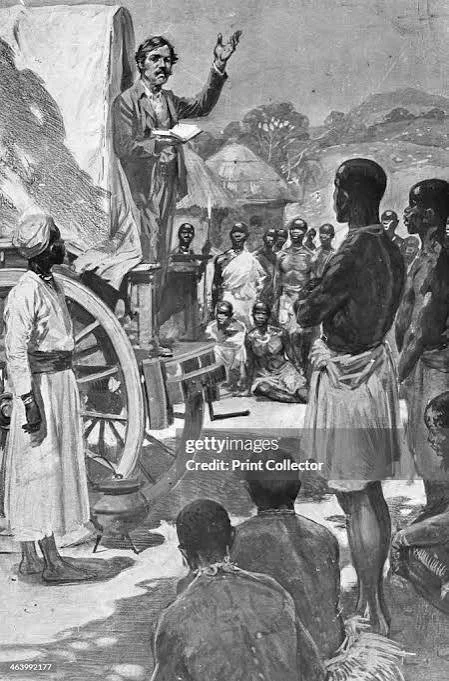
A 19th-century engraving of a missionary preaching in precolonial Africa. Image Credit: Print Collector
By contrast, Catholic missionary expansion in the nineteenth century, particularly from the mid-century onward, followed a different trajectory shaped by centralized ecclesiastical authority and sacramental theology. Authority was vested in a hierarchical clerical structure (ultimately under papal jurisdiction) that regulated doctrine, discipline, and mission organization, while sacramental theology emphasized the mediation of grace through institutional rites such as baptism, Eucharist, and confession. These features prioritized controlled community formation and clerical oversight over the diffusion of scripture-centered, lay-led instruction characteristic of Protestant missions.[15] Catholic missionary orders such as the Society of the Holy Ghost (Spiritans) and the White Fathers emerged as leading actors, often entering regions where Protestant missions had already established an initial presence.[16] These missions operated under direct ecclesiastical oversight and emphasized the construction of stable, institutionally controlled communities.
Catholic missionary strategy prioritized the establishment of structured mission settlements, sometimes referred to as Christian villages, in which converts were incorporated into regulated social and religious environments. This model was first observed in North Africa and parts of French-controlled West Africa, where Catholic missions established exclusive Christian communities around mission compounds in societies such as the Kabyle region of Algeria and later in Senegambia, seeking to separate converts from surrounding social and religious influences.[17] Within these settings, religious instruction was closely tied to sacramental life, and authority remained concentrated within the missionary clergy.[18] This approach differed from Protestant models by emphasizing communal transformation and institutional discipline over the diffusion of literacy as the primary mechanism of expansion.
These differences between Protestant and Catholic missionary traditions produced distinct patterns of engagement across the continent. Protestant missions, with their emphasis on translation, literacy, and decentralized structures, often achieved broader but more diffuse regional spread. Catholic missions, by contrast, tended to establish more concentrated but tightly controlled centers of influence, where religious, social, and economic life was organized within clearly defined institutional frameworks.[19]
Regionally, these denominational differences were reflected in patterns of missionary presence. Protestant missions were particularly prominent in parts of West Africa and Southern Africa, where early access and reliance on African intermediaries facilitated expansion. Catholic missions gained stronger footholds in Central and East Africa during the later nineteenth century, often building upon or competing with earlier Protestant initiatives.[20] These overlapping presences sometimes produced zones of competition, but also contributed to the broader entrenchment of Christianity through varied institutional forms.
African societies engaged these differing missionary traditions selectively. Among the Yoruba, Protestant missions often gained stronger acceptance because their emphasis on literacy, Bible translation, and schooling offered practical advantages in communication, education, and access to new forms of political and commercial engagement. In parts of the Kongo and later in mission fields of Central and East Africa, Catholic approaches could prove more attractive where rulers and local elites found value in the more hierarchical, communal, and ceremonially structured model of religious organization that resonated more closely with established patterns of authority.[21] These examples reinforce the broader pattern established in earlier encounters, in which African actors assessed and adapted missionary influence according to local priorities rather than receiving it uniformly.
In a nutshell, these denominational distinctions demonstrate that missionary expansion in the nineteenth century was not a singular process but a layered and internally differentiated movement. The coexistence of competing missionary traditions, each with distinct strategies and priorities, shaped the character of Christian expansion in Africa and laid the groundwork for the subsequent phase of missionary activity.
3. Missionaries, Exploration, Commerce, and Anti‑Slavery Campaigns: Expanding the Frontiers of Influence
Having examined the expansion of missionary organizations and the differing denominational strategies that shaped their methods, the next phase of missionary development unfolded through a growing intersection between missionary activity, geographical exploration, commercial expansion, and anti‑slavery campaigns, all led by European powers. By the early nineteenth century, missionary enterprise increasingly moved alongside exploration routes, commercial initiatives, and humanitarian campaigns, creating a multifaceted expansion in which religious, economic, and European political interests often overlapped, reinforced one another, and at times produced tensions and contradictions.[22]
The earliest stage of this intersection emerged through the role of exploration. As European explorers ventured into previously unfamiliar interior regions of Africa during the early nineteenth century, missionary societies increasingly followed these routes, using explorers' geographical knowledge, travel networks, and diplomatic contacts already established. Exploration thus opened pathways that transformed missionary activity from coastal and court‑centered encounters into sustained inland expansion.
In West Africa, the expeditions of the Scottish explorer Mungo Park, commissioned by the British‑based African Association to investigate the course of the Niger River, and the later journeys of the German scholar Heinrich Barth, commissioned by the British government to explore the central Sudan, provided geographical knowledge that missionary societies later utilized to establish missions in inland regions including the Upper Niger valley, Hausaland, the Sokoto Caliphate, and areas toward the Lake Chad basin and Timbuktu.[23] Similarly, in East Africa, the travels of the German missionaries Johann Rebmann and Johann Ludwig Krapf of the Church Missionary Society, operating from British‑sponsored mission bases along the East African coast and supported through British missionary and exploratory initiatives, helped identify routes into the interior including areas toward Kilimanjaro, the Kenyan highlands, and the regions surrounding Lake Victoria that later became important missionary corridors.[24]
This relationship between missionaries and exploration was not merely sequential but often collaborative. Missionaries frequently travelled with explorers, relied on their logistical networks, and contributed their own observations of geography, language, and political structures.[25] In this way, missionaries themselves increasingly became agents of exploration. Figures such as David Livingstone exemplified this convergence. Livingstone’s journeys across Southern and Central Africa combined evangelization with geographical exploration, producing maps, travel narratives, and intelligence about inland societies that significantly expanded European knowledge of the continent[26] His travels along the Zambezi River and his journey to Lake Nyasa, for instance, were simultaneously missionary endeavors and exploratory expeditions that encouraged further European involvement in the region.[27]
Beyond geographical knowledge, missionaries also produced linguistic and ethnographic information that proved crucial to subsequent European engagement.[28] Through translation work and interaction with local communities, missionaries documented languages, customs, and political structures. These observations circulated within missionary societies and European audiences, creating a growing body of knowledge about African interior societies. Such information facilitated later missionary expansion and, in many cases, informed subsequent commercial and diplomatic initiatives.[29]
Closely linked to exploration was the rise of anti‑slavery campaigns, which became a central moral framework for missionary expansion during the nineteenth century. Following the abolition of the transatlantic slave trade by Britain in 1807, missionary societies increasingly aligned their activities with humanitarian efforts aimed at suppressing slave trading and promoting alternative economic systems.[30] Missionaries portrayed Christianity as a moral force capable of transforming societies and reducing participation in slave trading networks. This alignment gave missionary expansion a humanitarian dimension that attracted support from European audiences and governments.[31]
Missionary settlements for liberated Africans became one of the earliest expressions of this intersection. Sierra Leone, established as a settlement for freed slaves, became an important missionary base from which evangelization spread into West Africa.[32] Liberated Africans trained as teachers, catechists, and clergy, later carried Christianity into the Yoruba regions of present‑day southwestern Nigeria, as well as the Gold Coast, Sierra Leone hinterland, Dahomey, and the Niger Delta in other parts of West Africa.[33] This development illustrates how anti‑slavery initiatives and missionary expansion became mutually reinforcing, as humanitarian settlements evolved into centers for religious outreach.
At the same time, missionaries promoted what became known as “legitimate commerce” as an alternative to slave trading.[34] This approach was observed most clearly in West Africa, where Protestant missionaries, especially within the Church Missionary Society and the Wesleyan Methodist Missionary Society, advocated agricultural production, craft training, and trade in commodities such as palm oil and cotton as alternatives to slave trading.[35] In the Niger missions and among Yoruba communities in present-day southwestern Nigeria, CMS figures such as Samuel Ajayi Crowther and other Protestant agents linked Christian expansion with the promotion of lawful trade and productive labor[36]
Similar assumptions also informed mission thinking in Sierra Leone, where liberated African communities were encouraged toward agriculture, artisanal work, and commerce under Protestant missionary supervision.[37] This approach reflected the belief that commercial transformation could weaken slave trading networks while encouraging social stability and Christian conversion. In this context, commerce, evangelization, and humanitarian objectives became intertwined. Mission stations frequently served as centers of agricultural production and trade, linking missionary activity to broader commercial networks.[38]
These overlapping agendas often reinforced one another. Exploration opened routes for missionary expansion; missionary expansion encouraged trade and settlement; anti‑slavery campaigns provided moral justification for inland expansion; and commercial activity sustained mission stations economically.[39] Together, these forces contributed to a gradual but sustained extension of missionary influence across multiple regions of Africa during the nineteenth century.
However, these relationships were not always harmonious. Tensions frequently emerged between missionary ideals and commercial interests.[40] Traders sometimes introduced firearms, alcohol, and exploitative trade practices that missionaries condemned as morally destructive and incompatible with Christian teaching. Missionaries also criticized commercial actors who prioritized profit over humanitarian objectives, creating friction between religious and economic agendas. Similarly, exploration routes opened by missionaries and explorers could be used not only for missionary expansion but also by slave traders and commercial interests, undermining humanitarian goals.[41]
These contradictions revealed the complex nature of missionary expansion. Missionaries sought to promote Christianity and humanitarian reform, yet their activities simultaneously contributed to expanding European knowledge, commercial engagement, and political interest in African societies[42] Thus, missionary enterprise in the nineteenth century operated within a broader network of exploration, commerce, and anti‑slavery campaigns that both reinforced and complicated one another.
This intersection marked a decisive transition in missionary activity. No longer confined to isolated evangelization efforts, missionary expansion became embedded within wider systems of movement, commerce, and humanitarian reform.[43] These developments laid the groundwork for the next phase of missionary influence, in which permanent mission stations emerged as enduring footholds of religious, social, and political transformation across the African continent.
4. Mission Stations as Institutional Footholds Before Colonial Rule: Influence, Mediation, and Dependency
As missionary expansion moved inland along exploration routes, humanitarian settlements, and emerging commercial networks, missionary activity gradually shifted from itinerant evangelization toward the establishment of permanent mission stations that marked a new phase of institutional presence. These mission stations soon developed into long‑term footholds across various regions of Africa, embedding missionary influence within local societies before the establishment of formal European colonial rule.[44] The established stations became enduring centers of religious instruction, education, commerce, and social transformation, building missionary foundations within African local societies over extended periods.
The earliest examples of such mission stations emerged in settlements linked to anti‑slavery initiatives and coastal expansion during the late eighteenth and early nineteenth centuries. In Sierra Leone, missionary settlements initially established to accommodate liberated Africans gradually developed into structured communities containing churches, schools, farms, and training institutions.[45] These settlements became stable missionary bases from which evangelization extended into the Sierra Leone hinterland and neighboring regions. Similar developments occurred in the Cape Colony, where mission stations established by Protestant missionary societies created agricultural communities that combined evangelization with education and economic activity.[46] These developments marked a transition from itinerant missionary work toward permanent institutional presence.
As these mission stations expanded, they increasingly functioned as administrative and cultural centers. Missionaries established schools, translation projects, and printing operations designed to promote literacy and Christian teaching.[47] Through these missionary institutions, missionaries trained Africans as teachers, clergy, and interpreters who became central figures in the spread of Christianity and Western education. In Sierra Leone, institutions such as Fourah Bay College later emerged from this missionary educational infrastructure, producing an educated African elite that contributed to missionary expansion into West Africa.[48] Similar educational initiatives appeared in Yoruba regions of southwestern Nigeria, where Church Missionary Society stations became centers for literacy, translation, and religious training.[49] These mission stations thus shaped new forms of cultural influence that extended beyond religious conversion.
Mission stations also began to exert political influence within African societies prior to formal colonial rule. Missionaries frequently mediated disputes, advised African rulers, and served as intermediaries between African communities and European governments.[50] In parts of West Africa and Southern Africa, missionaries established relationships with local authorities that allowed them to negotiate land, establish schools, and influence political decisions.[51] These relationships created informal channels of European influence that operated independently of formal colonial administration. Over time, European governments increasingly relied on missionary knowledge of local geography, politics, and languages when expanding diplomatic or commercial engagement.[52]
Beyond political influence, mission stations also contributed to new forms of economic dependency. Many mission stations promoted agriculture, craft production, and wage labor, encouraging local populations to adopt new economic practices linked to mission communities.[53] Mission farms in Southern Africa and agricultural settlements in West Africa became centers of economic activity where local populations depended on mission employment, trade opportunities, and access to new crops.[54] In West Africa, this was observed most clearly along the Niger and in the Yoruba country of present-day southwestern Nigeria, where Church Missionary Society stations encouraged the production and exchange of palm oil, cotton, and other lawful commodities within commercial networks linked to Lagos, Abeokuta, and the Niger trade.[55]
These networks were significant as they tied mission communities to expanding export commerce that contributed to the growth of regional markets and the wider nineteenth-century palm oil economy of West Africa.[56] Missionary leaders such as Samuel Ajayi Crowther and other CMS agents advocated these alternatives not simply as moral substitutes for slave trading but as practical foundations for stable Christian communities, productive labor, and lawful economic growth.[57] These developments created economic relationships in which local communities increasingly relied on mission infrastructure.
Mission stations also became gateways for further European involvement in African societies. Missionaries produced maps, linguistic studies, and ethnographic accounts that circulated within European missionary societies and governments.[58] This growing body of knowledge facilitated further missionary expansion and, in many cases, informed later colonial administrative planning. In Central and East Africa, missionary routes and stations later served as logistical bases for European expeditions and administrative expansion.[59] In this way, mission stations functioned as early institutional footholds that preceded formal colonial authority.
However, despite the missionary developments in various African societies, mission stations also generated tensions within these societies. In the Xhosa frontier region of Southern Africa, missionary influence became entangled with struggles over land, authority, and social change, as some converts attached themselves to mission communities while others and many local leaders viewed missionary teaching as disruptive to established political and cultural life.[60] In the Yoruba country of present-day southwestern Nigeria, conversion to Christianity and attachment to Church Missionary Society stations sometimes divided families and communities, especially where missionaries condemned polygyny, certain ritual practices, and forms of chiefly authority that remained central to local society.[61]
In Buganda (present day Central Ugandan region in East Africa) during the later nineteenth century, the arrival of Protestant and Catholic missions generated factional conflict at the royal court, where religious affiliation increasingly overlapped with political rivalry and competing foreign connections.[62] In the Kingdom of Kongo, located in parts of present‑day northern Angola and the Republic of Congo, missionary intervention in royal succession disputes, criticism of indigenous religious practices, and support for rival Christian factions contributed to political fragmentation and instability, particularly during periods of conflict between competing rulers who aligned themselves with different missionary influences.[63] These tensions weakened central authority and created prolonged internal divisions, illustrating how missionary presence could unintentionally reshape political structures and intensify instability within Central African societies.
These examples of tensions caused by missionaries demonstrate that mission stations did not merely expand religious influence; they also introduced new loyalties, new moral hierarchies, and new struggles over authority that reshaped political and cultural dynamics within African societies.
Despite the tensions, by the mid‑nineteenth century, mission stations had evolved into enduring centers of influence across multiple regions of Africa. They provided religious instruction, education, economic opportunities, and political mediation, while simultaneously creating new forms of dependency and influence that extended European presence inland.[64] These developments reinforced the role of missionaries as institutional actors whose long‑term presence shaped African societies prior to the establishment of formal colonial rule.
These developments reveal that missionary activity in the eighteenth and nineteenth centuries was transformed from a series of isolated encounters into a structured and enduring presence across African societies. Through the formation of mission societies, the expansion of denominational traditions, and the integration of evangelization with exploration, commerce, and anti-slavery efforts, missionary enterprise acquired the scale and organization necessary to sustain long-term influence. Mission stations, in particular, became focal points through which religion, education, economic practice, and political mediation were institutionalized, embedding missionary systems within the everyday life of many African communities.
The significance of this transformation extended far beyond the immediate spread of Christianity. These systems introduced new forms of literacy, economic activity, and social organization, while simultaneously generating new dependencies, tensions, and reconfigurations of authority within African societies. By the mid-nineteenth century, missionaries were no longer operating at the margins but had established networks that connected regions, shaped local structures, and informed wider European engagement with the continent. These foundations would prove decisive in the period that followed, as the institutional presence created by missionary expansion became deeply intertwined with the political and administrative transformations that accompanied the advance of colonial rule.
Footnotes.
[1] Hastings, Adrian. The Church in Africa, 1450–1950. Oxford University Press, 1994, pp. 120–145.
[2] Isichei, Elizabeth. A History of Christianity in Africa. Wm. B. Eerdmans Publishing, 1995, pp. 90–130.
[3] Latourette, Kenneth Scott. A History of the Expansion of Christianity. Harper & Row, 1945, Vol. IV, pp. 300–340.
[4] Etherington, Norman. “Missionaries and the Intellectual History of Africa.” Itinerario, vol. 7, no. 2, 1983, pp. 116–135.
[5] Groves, C. P. The Planting of Christianity in Africa. Lutterworth Press, 1954, Vol. II, pp. 1–80.
[6] Ajayi, J. F. A. Christian Missions in Nigeria 1841–1891. Longman, 1965, pp. 25–70.
[7] Walls, Andrew F. The Missionary Movement in Christian History. Orbis Books, 1996, pp. 200–230.
[8] Sanneh, Lamin. Translating the Message. Orbis Books, 2009, pp. 120–160.
[9] Groves, C. P. The Planting of Christianity in Africa. Lutterworth Press, 1954, Vol. II, pp. 1–80.
[10] Hastings, Adrian. The Church in Africa, 1450–1950. Oxford University Press, 1994, pp. 180–210.
[11] Isichei, Elizabeth. A History of Christianity in Africa. Wm. B. Eerdmans Publishing, 1995, pp. 130–170.
[12] Ajayi, J. F. A. Christian Missions in Nigeria 1841–1891. Longman, 1965, pp. 40–90; Sanneh, Lamin. Translating the Message. Orbis Books, 2009, pp. 170–200; Comaroff, Jean, and John Comaroff. Of Revelation and Revolution. University of Chicago Press, 1991, pp. 140–180.
[13] Sanneh, Lamin. Translating the Message. Orbis Books, 2009, pp. 160–200.
[14] Walls, Andrew F. The Missionary Movement in Christian History. Orbis Books, 1996, pp. 230–260.
[15] Hastings, Adrian. The Church in Africa, 1450–1950. Oxford University Press, 1994, pp. 200–230; Comaroff, Jean, and John Comaroff. Of Revelation and Revolution. University of Chicago Press, 1991, pp. 120–150.
[16] Groves, C. P. The Planting of Christianity in Africa. Lutterworth Press, 1954, Vol. II, pp. 80–120.
[17] Hastings, Adrian. The Church in Africa, 1450–1950. Oxford University Press, 1994, pp. 220–245; Isichei, Elizabeth. A History of Christianity in Africa. Wm. B. Eerdmans Publishing, 1995, pp. 150–175.
[18] Hastings, Adrian. The Church in Africa, 1450–1950. Oxford University Press, 1994, pp. 210–240.
[19] Comaroff, Jean, and John Comaroff. Of Revelation and Revolution. University of Chicago Press, 1991, pp. 100–140.
[20] Ajayi, J. F. A. Christian Missions in Nigeria 1841–1891. Longman, 1965, pp. 70–110.
[21] Ajayi, J. F. A. Christian Missions in Nigeria 1841–1891. Longman, 1965, pp. 85–110; Hastings, Adrian. The Church in Africa, 1450–1950. Oxford University Press, 1994, pp. 95–120, 230–250; Isichei, Elizabeth. A History of Christianity in Africa. Wm. B. Eerdmans Publishing, 1995, pp. 165–190.
[22] Etherington, Norman. “Missionaries and the Intellectual History of Africa.” Itinerario, 1983, pp. 118‑122.
[23] Iliffe, John. Africans: The History of a Continent. Cambridge University Press, 2017, pp. 217‑223.
[24] Iliffe, John. Africans: The History of a Continent. Cambridge University Press, 2017, pp. 217‑223.
[25] Livingstone, David. Missionary Travels and Researches in South Africa. John Murray, 1857, pp. 45‑78.
[26] Livingstone, David. Missionary Travels and Researches in South Africa. John Murray, 1857, pp. 45‑78.
[27] Livingstone, David. Missionary Travels and Researches in South Africa. John Murray, 1857, pp. 45‑78.
[28] Porter, Andrew. Religion Versus Empire? Manchester University Press, 2004, pp. 92‑110.
[29] Porter, Andrew. Religion Versus Empire? Manchester University Press, 2004, pp. 92‑110.
[30] Isichei, Elizabeth. A History of Christianity in Africa. Eerdmans, 1995, pp. 98‑105.
[31] Isichei, Elizabeth. A History of Christianity in Africa. Eerdmans, 1995, pp. 98‑105.
[32] Sanneh, Lamin. Translating the Message. Orbis Books, 2009, pp. 120‑132.
[33] Sanneh, Lamin. Translating the Message. Orbis Books, 2009, pp. 120‑132.
[34] Hopkins, A.G. An Economic History of West Africa. Longman, 1973, pp. 135‑150.
[35] Hopkins, A.G. An Economic History of West Africa. Longman, 1973, pp. 135‑150.
[36] Ajayi, J. F. Ade. Christian Missions in Nigeria, 1841–1891: The Making of a New Elite. Longmans, 1965, pp. 74‑92.
[37] Sanneh, Lamin. Translating the Message: The Missionary Impact on Culture. Orbis Books, 2009, pp. 126‑132.
[38] Hopkins, A.G. An Economic History of West Africa. Longman, 1973, pp. 135‑150.
[39] Etherington, Norman. Missions and Empire. Oxford University Press, 2005, pp. 67‑83.
[40] Porter, Andrew. Religion Versus Empire? Manchester University Press, 2004, pp. 130‑145.
[41] Porter, Andrew. Religion Versus Empire? Manchester University Press, 2004, pp. 130‑145.
[42] Etherington, Norman. Missions and Empire. Oxford University Press, 2005, pp. 67‑83.
[43] Etherington, Norman. Missions and Empire. Oxford University Press, 2005, pp. 67‑83.
[44] Etherington, Norman. Missions and Empire. Oxford University Press, 2005, pp. 67‑92.
[45] Isichei, Elizabeth. A History of Christianity in Africa. Eerdmans, 1995, pp. 104‑120.
[46] Etherington, Norman. Missions and Empire. Oxford University Press, 2005, pp. 67‑92.
[47] Sanneh, Lamin. Translating the Message. Orbis Books, 2009, pp. 132‑148.
[48] Sanneh, Lamin. Translating the Message. Orbis Books, 2009, pp. 132‑148.
[49] Ajayi, J. F. Ade. Christian Missions in Nigeria, 1841–1891. Longmans, 1965, pp. 88‑105.
[50] Porter, Andrew. Religion Versus Empire? Manchester University Press, 2004, pp. 145‑165.
[51] Porter, Andrew. Religion Versus Empire? Manchester University Press, 2004, pp. 145‑165.
[52] Etherington, Norman. Missions and Empire. Oxford University Press, 2005, pp. 67‑92.
[53] Hopkins, A. G. An Economic History of West Africa. Longman, 1973, pp. 150‑168.
[54] Hopkins, A. G. An Economic History of West Africa. Longman, 1973, pp. 150‑168.
[55] Iliffe, John. Africans: The History of a Continent. Cambridge University Press, 2017, pp. 223‑235.
[56] Hopkins, A. G. An Economic History of West Africa. Longman, 1973, pp. 150‑168.
[57] Ajayi, J. F. Ade. Christian Missions in Nigeria, 1841–1891. Longmans, 1965, pp. 88‑105.
[58] Etherington, Norman. Missions and Empire. Oxford University Press, 2005, pp. 67‑92.
[59] Porter, Andrew. Religion Versus Empire? Manchester University Press, 2004, pp. 145‑165.
[60] Comaroff, Jean, and John Comaroff. Of Revelation and Revolution, Volume 1: Christianity, Colonialism, and Consciousness in South Africa. University of Chicago Press, 1991, pp. 197‑224.
[61] Ajayi, J. F. Ade. Christian Missions in Nigeria, 1841–1891: The Making of a New Elite. Longmans, 1965, pp. 156‑176.
[62] Pirouet, M. Louise. Black Evangelists: The Spread of Christianity in Uganda, 1891‑1914. Rex Collings, 1978, pp. 12‑28.
[63] Isichei, Elizabeth. A History of Christianity in Africa. Eerdmans, 1995, pp. 104‑120.
[64] Etherington, Norman. Missions and Empire. Oxford University Press, 2005, pp. 67‑92.
Bibliography
Ajayi, J. F. A. Christian Missions in Nigeria 1841–1891. London: Longman, 1965.
Ajayi, J. F. Ade. Christian Missions in Nigeria, 1841–1891: The Making of a New Elite. London: Longmans, 1965.
Comaroff, Jean, and John Comaroff. Of Revelation and Revolution: Christianity, Colonialism, and Consciousness in South Africa. Chicago: University of Chicago Press, 1991.
Etherington, Norman. Missions and Empire. Oxford: Oxford University Press, 2005.
Etherington, Norman. “Missionaries and the Intellectual History of Africa.” Itinerario 7, no. 2 (1983): 116–135.
Groves, C. P. The Planting of Christianity in Africa. Vol. II. London: Lutterworth Press, 1954.
Hastings, Adrian. The Church in Africa, 1450–1950. Oxford: Oxford University Press, 1994.
Hopkins, A. G. An Economic History of West Africa. London: Longman, 1973.
Iliffe, John. Africans: The History of a Continent. 3rd ed. Cambridge: Cambridge University Press, 2017.
Isichei, Elizabeth. A History of Christianity in Africa. Grand Rapids: Wm. B. Eerdmans Publishing, 1995.
Latourette, Kenneth Scott. A History of the Expansion of Christianity. Vol. IV. New York: Harper & Row, 1945.
Livingstone, David. Missionary Travels and Researches in South Africa. London: John Murray, 1857.
Pirouet, M. Louise. Black Evangelists: The Spread of Christianity in Uganda, 1891–1914. London: Rex Collings, 1978.
Porter, Andrew. Religion Versus Empire? British Protestant Missionaries and Overseas Expansion, 1700–1914. Manchester: Manchester University Press, 2004.
Sanneh, Lamin. Translating the Message: The Missionary Impact on Culture. Maryknoll: Orbis Books, 2009.
Walls, Andrew F. The Missionary Movement in Christian History. Maryknoll: Orbis Books, 1996.
Research By: Emmer Atwiine
Paper drafted by: Ezron Kaijuka
