
How European Colonial Powers Divided Africa Among Themselves at the Berlin Conference and Drew the Borders That Still Shape the Continent Today.
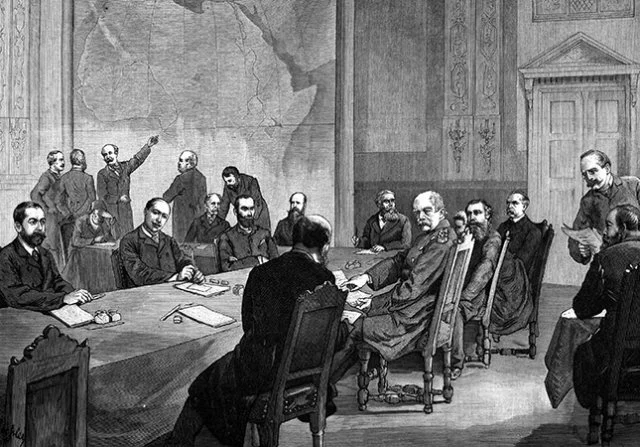
Illustration showing European diplomats discussing the partitioning of Africa at the Berlin Conference. Image Source unknown.
By the late nineteenth century, Europe’s scramble for Africa had evolved into an increasingly dangerous imperial contest. Britain, France, Germany, Belgium, Portugal, and other European powers were racing to secure territories across the continent, each fearing that delay could result in strategic exclusion, economic disadvantage, or the loss of international prestige. As rival claims expanded deeper into Central Africa, particularly around the Congo Basin, tensions among the European powers intensified rapidly. What had begun as commercial competition was steadily transforming into a wider geopolitical crisis capable of destabilizing relations within Europe itself.
It was within this atmosphere of imperial rivalry and growing diplomatic anxiety that German Chancellor Otto von Bismarck convened the Berlin Conference between November 1884 and February 1885. Representatives from the major European powers gathered in Berlin to negotiate the future of Africa and establish rules that would regulate European expansion across the continent, yet no African kingdom, ruler, or society was invited to participate.
Behind the language of diplomacy and international order lay a far deeper objective. As recorded in the General Act of the Berlin Conference[1], the meeting sought to regulate colonization and trade in Africa primarily to prevent conflict among European powers themselves. The conference was therefore not organized to preserve African sovereignty or protect African societies, but to manage imperial rivalry and create an internationally recognized framework through which European powers could expand, occupy, and divide the African continent among themselves.
1. The Major Outcomes of the Berlin Conference and Their Immediate Consequences
The Berlin Conference did far more than simply gather European powers around a diplomatic table. The agreements reached in Berlin fundamentally transformed the nature of European involvement in Africa and accelerated the continent’s rapid colonization. Before the conference, much of European influence in Africa had remained concentrated around coastal trade, commercial treaties, and isolated territorial claims. After Berlin, imperial expansion became increasingly formalized, legalized, and militarized through internationally recognized agreements among European powers themselves.
The outcomes of the conference therefore carried immediate and far-reaching consequences for African societies. The agreements reached in Berlin legitimized foreign occupation, intensified territorial competition, accelerated military conquest, and laid the foundations for the arbitrary borders that would later divide African communities and reshape the continent’s political future. The Berlin Conference transformed imperial rivalry into an organized system of territorial acquisition that rapidly pushed European powers deeper into the African interior.[2]
1.1 The General Act and the Legalization of Imperial Expansion
The most important outcome of the Berlin Conference was the signing of the General Act of Berlin in February 1885, a diplomatic framework that attempted to regulate European expansion across Africa while reducing the risk of war among the competing imperial powers. The conference did not divide every African territory immediately, but it established the legal and political principles that accelerated the final partition of the continent.[3] Through the General Act, European powers effectively transformed imperial conquest into an internationally recognized system governed by European agreements rather than African sovereignty.
1.2 Recognition of the Congo Free State and the Expansion of Imperial Claims
As the conference moved toward regulating European expansion across Africa, one of the most urgent questions facing the delegates concerned the Congo Basin. By the early 1880s, King Leopold II of Belgium had already secured numerous treaties through agents and explorers operating in Central Africa, particularly through the activities of Henry Morton Stanley.[4] However, Leopold’s claims remained diplomatically fragile because rival European powers, especially France and Portugal, also sought influence within the Congo region. Without broader international recognition, competing territorial ambitions in Central Africa risked escalating into direct confrontation among the European powers themselves.
It was within this atmosphere of growing imperial rivalry that the Berlin Conference formally recognized Leopold’s control over the Congo Free State, granting him authority over an enormous territory in Central Africa under the language of humanitarianism, anti-slavery campaigns, and free trade.[5] This recognition proved historically significant because it demonstrated that vast African territories could now be internationally allocated through European diplomatic agreements without African participation or consent. The decision also intensified imperial competition by signaling to rival powers that formal international recognition could rapidly transform commercial influence into sovereign territorial control.
The consequences were immediate and far-reaching. The recognition of the Congo Free State opened the way for one of the most exploitative colonial systems in African history, built upon forced labor, violent extraction, and systematic terror directed against Congolese communities.[6]
At the same time, the decision accelerated European urgency to secure territorial claims elsewhere across Africa before rival powers consolidated similar internationally recognized possessions. The Berlin Conference therefore did not simply acknowledge Leopold’s ambitions in Central Africa; it legitimized the broader principle that European powers could claim, occupy, and govern African territories through agreements reached entirely among themselves.
1.3 The Principle of Effective Occupation and the Race Inland
Among the most consequential principles established at Berlin was the doctrine of “effective occupation.” Prior to the conference, European powers often claimed territories through coastal presence, symbolic ceremonies, or vague treaty arrangements with local rulers. The Berlin Conference fundamentally changed this system. Under the new rules, European states could no longer rely on symbolic claims alone; they were now required to demonstrate actual administrative control over territories if their claims were to be internationally recognized.[7]
This principle immediately transformed imperial rivalry into a frantic race for military occupation and territorial control. European governments, commercial companies, soldiers, and explorers rapidly pushed inland to establish forts, sign treaties, impose administrations, and suppress resistance before rival powers could secure competing claims. The principle of effective occupation accelerated the militarization of the Scramble for Africa because territorial possession now depended upon visible occupation and enforcement rather than abstract declarations.[8]
The consequences were immediate and profound. Regions that had previously experienced limited European interference suddenly became targets of military expeditions, treaty coercion, and violent conquest. Across West, Central, East, and Southern Africa, African rulers increasingly faced diplomatic pressure, territorial encroachment, and armed invasion as European powers rushed to convert paper claims into physical domination. The Berlin Conference therefore transformed imperial ambition into direct territorial occupation and dramatically intensified the speed of Africa’s colonization.
1.4 Internationalization of African Rivers and the Expansion of European Commercial Access
As European territorial expansion accelerated after the Berlin Conference, access to Africa’s major river systems became increasingly important to imperial powers seeking commercial penetration and administrative control deep within the continent. Rivers such as the Congo and Niger were strategically significant because they provided direct transportation routes into the African interior at a time when European powers still faced enormous geographical and logistical challenges inland.
One of the major economic outcomes of the Berlin Conference was therefore the agreement that the Congo and Niger rivers would remain open to international trade and navigation for all European powers.[9] The General Act established principles of free navigation along these waterways in order to reduce conflict among rival European states and prevent any single power from monopolizing access to the economic opportunities of the interior.[10]
This outcome carried enormous geopolitical and commercial significance. The Congo and Niger rivers were not merely natural waterways; they were major strategic corridors capable of transporting goods, soldiers, missionaries, administrators, and commercial agents deep into regions that Europeans had previously struggled to reach.[11] By guaranteeing international access to these river systems, the Berlin Conference accelerated European commercial expansion inland while simultaneously weakening African control over important trade routes and economic networks.
The consequences quickly became visible across Central and West Africa. European trading companies expanded rapidly along navigable waterways, military expeditions increasingly followed river systems into the interior, and colonial administrations established stronger territorial control around river basins and commercial centers. The internationalization of African rivers therefore reinforced one of the broader principles emerging from Berlin: that Africa’s strategic geography, commercial infrastructure, and transportation routes could now be regulated and internationally controlled through agreements reached among European powers themselves.
2.How European Colonial Powers Drew Africa’s Borders After Claiming Territories
As European powers rapidly expanded into the African interior after the Berlin Conference, territorial claims that had initially existed only on maps or through loosely defined treaties now had to be transformed into fixed colonial possessions. Once a European power established what it considered effective occupation through military presence, treaties, trading posts, forts, or administrative control, negotiations with rival European states would often follow in order to define the precise limits of each colonial territory.[12]
The drawing of African borders therefore emerged gradually through a combination of diplomatic bargaining, military competition, bilateral agreements, exploratory expeditions, and strategic compromise among European powers rather than through any consultation with African societies themselves.[13] In many cases, European officials sitting in European capitals used incomplete maps, limited geographical knowledge, and arbitrary geometric lines to separate territories claimed by rival empires.[14]
Natural features such as rivers, lakes, and mountain ranges were sometimes used as boundary markers where geographical knowledge existed. However, in vast regions where Europeans possessed limited understanding of local political and ethnic realities, borders were frequently drawn using lines of latitude and longitude or through simple ruler-straight demarcations across maps.[15] The Anglo-French Convention, the Anglo-German agreements, and various Franco-Portuguese and Belgian negotiations throughout the late nineteenth century became central mechanisms through which European powers adjusted and finalized competing territorial claims across Africa.[16]
This process carried profound consequences because the boundaries being negotiated rarely reflected existing African political structures, patterns of migration, commercial systems, or cultural realities. Powerful kingdoms, long-established trade networks, and ethnolinguistic communities were divided or merged according to European strategic calculations rather than indigenous historical relationships.[17] In many cases, European negotiators possessed little understanding of the societies they were partitioning, yet the borders they established would later become the foundations of modern African states.
The drawing of Africa’s borders was therefore not a single event completed at Berlin itself, but an extended process of imperial negotiation and territorial adjustment that accelerated after the conference and continued into the early twentieth century.[18] The Berlin Conference provided the diplomatic framework and legitimacy for this process, while subsequent occupations, treaties, and interstate agreements among European powers transformed abstract imperial claims into fixed colonial frontiers across the continent.
3. The Lasting Impact of the Arbitrary Borders
The borders that emerged from the Scramble for Africa became some of the most enduring and consequential legacies of European colonialism on the continent. Although many of these frontiers were initially designed to manage imperial competition among European powers, they later evolved into the territorial foundations of modern African states after independence.[23] Because these boundaries were primarily shaped by European strategic interests rather than African historical realities, they produced political, social, economic, and security consequences that extended far beyond the colonial period itself.
3.1. Division of Ethnic and Linguistic Communities
One of the most immediate consequences of colonial boundary-making was the fragmentation of long-established ethnic, linguistic, and cultural communities across multiple colonial territories.[19] Communities that had historically shared political systems, migration routes, religious traditions, trade networks, and social institutions suddenly found themselves separated by international borders imposed by colonial administrations.
The Somali people, for example, were divided among British Somaliland, Italian Somaliland, French Somaliland (Djibouti), the Ethiopian Empire, and northern Kenya.[20] Similarly, the Ewe people were partitioned between British and German colonial territories in West Africa, while the Maasai were divided between British East Africa and German East Africa.[21] These divisions disrupted older patterns of mobility, weakened precolonial political cohesion, and later contributed to cross-border tensions and irredentist movements after independence.
The fragmentation of ethnic communities also complicated state-building processes across postcolonial Africa. Colonial borders frequently prevented newly independent governments from fully consolidating political legitimacy around unified national identities because many populations maintained stronger historical, cultural, or linguistic ties with communities located across neighboring borders.[22]
3.2. Forced Political Unions and Internal Instability
While some societies were divided, many others were forcibly merged into single colonial territories despite possessing deeply different historical experiences, political systems, religions, and social structures.[23] Colonial administrations often grouped diverse populations together primarily for administrative convenience, strategic calculation, or economic extraction rather than long-term political stability.
Nigeria became one of the clearest examples of this process. British colonial rule amalgamated hundreds of distinct societies into a single colony, including the Hausa-Fulani emirates in the north, Yoruba kingdoms in the southwest, and Igbo communities in the southeast.[24] These societies had developed under different political systems, economic structures, and religious traditions long before colonial rule. Similar forced unions emerged elsewhere across Africa, including in Sudan, the Congo, and Rwanda-Burundi, where colonial boundaries and administrative systems intensified tensions among communities that had previously existed under different political arrangements.[25]
These artificial political unions created major governance challenges after independence. Newly independent African states inherited colonial borders that enclosed highly diverse populations within centralized political systems often lacking shared historical identities or institutions of national integration.[26] In many cases, colonial administrative practices further deepened ethnic divisions by favoring particular groups within systems of indirect rule, uneven development, taxation, military recruitment, and access to education.[27]
3.3. Economic Distortion and Colonial Dependency
The arbitrary colonial borders also reshaped African economies in ways that primarily served European imperial interests rather than regional African development.[28] Colonial infrastructure, including railways, ports, and roads, was often constructed to move raw materials from the interior toward coastal export centers linked to European markets rather than to integrate African economies internally.[29]
As a result, many colonial territories developed highly uneven economic structures dependent upon the export of a narrow range of commodities such as cocoa, cotton, copper, rubber, or minerals.[30] Border arrangements frequently disrupted older regional trade systems that had historically connected African societies across deserts, savannahs, forests, and river systems long before European colonization.
These colonial economic patterns continued to shape postcolonial Africa after independence. Many African states inherited economies heavily dependent upon commodity exports, externally oriented trade networks, and infrastructure systems designed for extraction rather than regional integration.[31] The persistence of these economic structures contributed to long-term patterns of dependency, uneven development, and vulnerability within the global economy.
3.4. Border Conflicts and Postcolonial Wars
The colonial borders established during and after the Berlin Conference also became major sources of interstate disputes and internal conflict after African independence.[32] Because many borders had been negotiated rapidly among European powers with limited geographical knowledge, disputes over territorial ownership frequently emerged once colonial rule ended.
Postcolonial Africa witnessed numerous border-related conflicts linked directly or indirectly to colonial demarcations, including disputes between Somalia and Ethiopia over the Ogaden region, tensions between Nigeria and Cameroon over the Bakassi Peninsula, and conflicts involving Eritrea, Sudan, Chad, and other territories.[33] In many regions, colonial borders also trapped rival political groups within fragile states, contributing to civil wars, secessionist movements, and prolonged instability.
Despite these tensions, many newly independent African leaders ultimately chose to preserve the inherited colonial boundaries through the Organization of African Unity in 1964 because redrawing borders threatened to produce even wider conflict across the continent.[34] The colonial borders therefore survived into the postcolonial era largely intact, continuing to shape African politics, governance, security, and regional relations long after the end of formal European rule.
In a nutshell, the Berlin Conference transformed European imperial rivalry into an internationally recognized system through which European powers could claim, occupy, negotiate, and divide African territories among themselves.[35] Although the conference did not itself complete the partition of Africa, it established the legal principles and diplomatic framework that accelerated military occupation, territorial expansion, and the drawing of colonial borders across the continent. Once these territories were claimed, European powers proceeded to negotiate and formalize boundaries that rarely reflected Africa’s existing political systems, commercial networks, migration patterns, or ethnolinguistic realities.[36] Powerful kingdoms were fragmented, rival societies were merged into artificial political units, and strategic economic regions were reorganized primarily to serve imperial interests rather than African integration.
The consequences of these colonial borders extended far beyond the nineteenth century. Politically, they complicated state-building by enclosing highly diverse populations within centralized colonial territories lacking shared historical identities or institutions of cohesion.[37] Economically, they redirected African trade systems outward toward European markets and entrenched long-term patterns of extraction and dependency.[38] Socially and culturally, they divided long-established communities while forcing historically distinct societies into single colonial administrations, tensions that would continue to shape governance, identity, conflict, and interstate relations across modern Africa.[39] More than a century later, many of the borders established during the Scramble for Africa remain largely intact, continuing to shape the continent politically, economically, and socially to this day.[40]
End Notes:
[1] General Act of the Berlin Conference (1885), Article VI; Signed 26 February 1885.
[2] Thomas Pakenham, The Scramble for Africa: The White Man’s Conquest of the Dark Continent from 1876 to 1912 (New York: Random House, 1991), 254–258.
[3] H.L. Wesseling, Divide and Rule: The Partition of Africa, 1880–1914 (Westport, CT: Praeger, 1996), 127–131.
[4] Adam Hochschild, King Leopold’s Ghost: A Story of Greed, Terror, and Heroism in Colonial Africa (Boston: Houghton Mifflin, 1998), 58–61.
[5] General Act of the Conference of Berlin, signed 26 February 1885, Articles 34–35.
[6] Adam Hochschild, King Leopold’s Ghost: A Story of Greed, Terror, and Heroism in Colonial Africa (Boston: Houghton Mifflin, 1998), 225–230.
[7] General Act of the Conference of Berlin, signed 26 February 1885, Article 35.
[8] John Darwin, The Empire Project: The Rise and Fall of the British World-System, 1830–1970 (Cambridge: Cambridge University Press, 2009), 118–120.
[9] General Act of the Conference of Berlin, signed 26 February 1885, Articles 13–15.
[10] H.L. Wesseling, Divide and Rule: The Partition of Africa, 1880–1914 (Westport, CT: Praeger, 1996), 144–147.
[11] Thomas Pakenham, The Scramble for Africa: The White Man’s Conquest of the Dark Continent from 1876 to 1912 (New York: Random House, 1991), 239–242.
[12] H.L. Wesseling, Divide and Rule: The Partition of Africa, 1880–1914 (Westport, CT: Praeger, 1996), 165–170.
[13] Thomas Pakenham, The Scramble for Africa: The White Man’s Conquest of the Dark Continent from 1876 to 1912 (New York: Random House, 1991), 315–320.
[14] A. Adu Boahen, African Perspectives on Colonialism (Baltimore: Johns Hopkins University Press, 1987), 42–49.
[15] Basil Davidson, The Black Man’s Burden: Africa and the Curse of the Nation-State (New York: Times Books, 1992), 88–91.
[16] Robert O. Collins and James M. Burns, A History of Sub-Saharan Africa (Cambridge: Cambridge University Press, 2013), 287–292.
[17] Mahmood Mamdani, Citizen and Subject: Contemporary Africa and the Legacy of Late Colonialism (Princeton: Princeton University Press, 1996), 16–24.
[18] Martin Meredith, The Fortunes of Africa: A 5,000-Year History of Wealth, Greed, and Endeavour (New York: PublicAffairs, 2014), 426–431.
[19] A. Adu Boahen, African Perspectives on Colonialism (Baltimore: Johns Hopkins University Press, 1987), 47–52.
[20] Saadia Touval, Somali Nationalism: International Politics and the Drive for Unity in the Horn of Africa (Cambridge, MA: Harvard University Press, 1963), 34–41.
[21] John Iliffe, Africans: The History of a Continent (Cambridge: Cambridge University Press, 2007), 193–197.
[22] Jeffrey Herbst, States and Power in Africa: Comparative Lessons in Authority and Control (Princeton: Princeton University Press, 2000), 35–41.
[23] Mahmood Mamdani, Citizen and Subject: Contemporary Africa and the Legacy of Late Colonialism (Princeton: Princeton University Press, 1996), 16–28.
[24] Toyin Falola, A History of Nigeria (Cambridge: Cambridge University Press, 2008), 85–92.
[25] Martin Meredith, The State of Africa: A History of the Continent Since Independence (London: Simon & Schuster, 2005), 56–68.
[26] Crawford Young, The African Colonial State in Comparative Perspective (New Haven: Yale University Press, 1994), 271–279.
[27] Mahmood Mamdani, Citizen and Subject: Contemporary Africa and the Legacy of Late Colonialism (Princeton: Princeton University Press, 1996), 52–61.
[28] Walter Rodney, How Europe Underdeveloped Africa (London: Bogle-L’Ouverture Publications, 1972), 205–215.
[29] Frederick Cooper, Africa Since 1940: The Past of the Present (Cambridge: Cambridge University Press, 2002), 18–24.
[30] Walter Rodney, How Europe Underdeveloped Africa (London: Bogle-L’Ouverture Publications, 1972), 223–229.
[31] Patrick Chabal and Jean-Pascal Daloz, Africa Works: Disorder as Political Instrument (Bloomington: Indiana University Press, 1999), 9–16.
[32] Jeffrey Herbst, States and Power in Africa: Comparative Lessons in Authority and Control (Princeton: Princeton University Press, 2000), 145–152.
[33] Paul Nugent, Africa Since Independence: A Comparative History (New York: Palgrave Macmillan, 2004), 414–422.
[34] Organization of African Unity, Resolution on Border Disputes Among African States, Cairo Resolution AHG/Res. 16(I), July 1964.
[35] Basil Davidson, The Black Man’s Burden: Africa and the Curse of the Nation-State (New York: Times Books, 1992), 101–107.
[36] Martin Meredith, The Fortunes of Africa: A 5,000-Year History of Wealth, Greed, and Endeavour (New York: PublicAffairs, 2014), 426–433.
[37] Crawford Young, The African Colonial State in Comparative Perspective (New Haven: Yale University Press, 1994), 271–279.
[38] Walter Rodney, How Europe Underdeveloped Africa (London: Bogle-L’Ouverture Publications, 1972), 223–235.
[39] Mahmood Mamdani, Citizen and Subject: Contemporary Africa and the Legacy of Late Colonialism (Princeton: Princeton University Press, 1996), 16–28.
[40] Basil Davidson, The Black Man’s Burden: Africa and the Curse of the Nation-State (New York: Times Books, 1992), 101–107.
Bibliography:
Boahen, A. Adu. African Perspectives on Colonialism. Baltimore: Johns Hopkins University Press, 1987.
Chabal, Patrick, and Jean-Pascal Daloz. Africa Works: Disorder as Political Instrument. Bloomington: Indiana University Press, 1999.
Collins, Robert O., and James M. Burns. A History of Sub-Saharan Africa. Cambridge: Cambridge University Press, 2013.
Cooper, Frederick. Africa Since 1940: The Past of the Present. Cambridge: Cambridge University Press, 2002.
Davidson, Basil. The Black Man’s Burden: Africa and the Curse of the Nation-State. New York: Times Books, 1992.
Darwin, John. The Empire Project: The Rise and Fall of the British World-System, 1830–1970. Cambridge: Cambridge University Press, 2009.
Falola, Toyin. A History of Nigeria. Cambridge: Cambridge University Press, 2008.
General Act of the Conference of Berlin. Signed 26 February 1885.
Herbst, Jeffrey. States and Power in Africa: Comparative Lessons in Authority and Control. Princeton: Princeton University Press, 2000.
Hochschild, Adam. King Leopold’s Ghost: A Story of Greed, Terror, and Heroism in Colonial Africa. Boston: Houghton Mifflin, 1998.
Iliffe, John. Africans: The History of a Continent. Cambridge: Cambridge University Press, 2007.
Mamdani, Mahmood. Citizen and Subject: Contemporary Africa and the Legacy of Late Colonialism. Princeton: Princeton University Press, 1996.
Meredith, Martin. The Fortunes of Africa: A 5,000-Year History of Wealth, Greed, and Endeavour. New York: PublicAffairs, 2014.
Meredith, Martin. The State of Africa: A History of the Continent Since Independence. London: Simon & Schuster, 2005.
Nugent, Paul. Africa Since Independence: A Comparative History. New York: Palgrave Macmillan, 2004.
Organization of African Unity. Resolution on Border Disputes Among African States. Cairo Resolution AHG/Res. 16(I), July 1964.
Pakenham, Thomas. The Scramble for Africa: The White Man’s Conquest of the Dark Continent from 1876 to 1912. New York: Random House, 1991.
Rodney, Walter. How Europe Underdeveloped Africa. London: Bogle-L’Ouverture Publications, 1972.
Touval, Saadia. Somali Nationalism: International Politics and the Drive for Unity in the Horn of Africa. Cambridge, MA: Harvard University Press, 1963.
Wesseling, H.L. Divide and Rule: The Partition of Africa, 1880–1914. Westport, CT: Praeger, 1996.
Young, Crawford. The African Colonial State in Comparative Perspective. New Haven: Yale University Press, 1994.
Research by: Emmer Atwiine
Paper written by: Ezron Kaijuka
