
How Missionary Networks Helped Shape Colonial Rule in Africa (1870s–1914)
How Missionary Networks Helped Shape Colonial Rule in Africa (1870s–1914)
By the final decades of the nineteenth century, Christianity in Africa was no longer confined to scattered missions or isolated spheres of influence. Across the continent, dense webs of mission stations, schools, converts, and communication routes had taken shape, linking inland societies to coastal settlements and, beyond them, to Europe. These networks carried more than religious teaching. They transmitted information, shaped alliances, and opened pathways through which outsiders could read, interpret, and increasingly act within African political landscapes.
In this environment of intensifying imperial rivalry, these missionary networks acquired a significance that extended beyond their original purpose. They became conduits through which European interests advanced, sometimes deliberately, often indirectly, but with far‑reaching consequences. The lines between evangelization and expansion grew increasingly difficult to separate, as missionaries found themselves positioned between African authorities and European powers—translating, advising, negotiating, and, at times, drawing both sides into closer and more consequential engagement. What emerged from this convergence was not a simple fusion of religion and empire, but a complex and often uneasy relationship in which missionary presence became woven into the processes through which colonial power took form across the continent.
1. Missionary Networks and the Scramble for Africa
As the missionary footholds established during the preceding decades matured into enduring institutions across African societies, they increasingly intersected with European strategic ambitions during the accelerating territorial rivalries of the late nineteenth century.[1] Mission stations, African converts, schools, and communication routes formed networks that offered European governments and commercial interests ready‑made infrastructures of knowledge, influence, and access, transforming missionary presence into an important factor in the unfolding Scramble for Africa.
By the 1870s, missionary societies had established inland networks across West, Central, and East Africa.[2] These networks functioned as centers of communication linking African rulers, European societies, and commercial interests. Missionaries frequently travelled between African courts and coastal settlements, translating languages, documenting political conditions, and relaying this information through missionary reports, society correspondence, published journals, and direct communication with European missionary boards and government officials.[3] This was helpful in shaping European perceptions of African political conditions with missionary correspondence being a vital source of geographical and political intelligence for European expansion.
As missionary networks expanded their political and social influence across African societies, they increasingly became entangled in emerging regional conflicts during the 1870s and 1880s, prompting missionaries to appeal to European governments for protection. Conflicts such as Boer expansion into Tswana territories in present‑day Botswana and parts of northern South Africa, alongside growing German ambitions in what later became German South‑West Africa (present‑day Namibia) during the early 1880s, threatened African political authority and missionary operations and contributed to the British declaration of the Bechuanaland Protectorate (covering most of present‑day Botswana and parts of northern South Africa) in 1885.[4]
At the Buganda court in present‑day central Uganda between the late 1870s and 1890s, rivalry among Protestant, Catholic, and Muslim factions partly shaped by competing missionary alliances became intertwined with struggles over succession, foreign alliances, and royal authority, culminating in a series of religious civil wars in the 1880s and early 1890s.[5] Around Lake Nyasa (present‑day Lake Malawi, spanning Malawi, Tanzania, and Mozambique) during the 1870s–1880s, insecurity linked to slave raiding and warfare associated with the East African trade threatened mission settlements and encouraged missionary appeals for British intervention, which later contributed to the establishment of the British Central Africa Protectorate in 1891.[6] While these conflicts emerged from broader political and commercial pressures, missionary presence frequently transformed local instability into grounds for imperial intervention, and such interventions increasingly culminated in the formal establishment of protectorates and eventual colonial rule across the affected territories.
Similar developments unfolded in Central Africa. Scottish Presbyterian missionaries in the Lake Nyasa region advocated for British intervention to suppress slave trading and stabilize missionary operations, contributing to the establishment of the British Central Africa Protectorate (Nyasaland, present‑day Malawi) in 1891.[7]
Missionary networks also intersected with chartered companies during early colonial expansion. Chartered companies were private commercial enterprises granted royal charters by European governments, giving them authority to administer territories, negotiate treaties, maintain armed forces, and manage trade on behalf of imperial powers before formal colonial administration was established.[8] These companies became significant instruments of early imperial expansion, often operating in regions where missionary networks had already created political contacts and geographical knowledge. The Imperial British East Africa Company, for example, benefited from routes and contacts established by the Church Missionary Society between the East African coast and the interior, particularly in present‑day Kenya and Uganda, while the Royal Niger Company expanded British influence along the Niger River in present‑day Nigeria, and the British South Africa Company advanced into territories that later became Zimbabwe and Zambia, frequently following areas already influenced by missionary activity.[9]
Within this expanding system of chartered company rule and imperial advance, missionaries frequently served as intermediaries in treaty‑making processes. This intermediary role was observed at the Buganda court in present‑day central Uganda as Church Missionary Society representatives such as Alexander Mackay and later Anglican missionaries became influential advisers to royal authorities, assisting in diplomatic communication and shaping political alliances during the late nineteenth century.[10]
Comparable patterns emerged around Lake Nyasa in present‑day Malawi, Tanzania, and Mozambique, where Scottish missionaries communicated with British officials and African leaders, advocating treaties and protection arrangements that later informed British territorial claims.[11] Similar roles also developed along the Niger River in present‑day Nigeria, where missionaries and mission‑educated intermediaries facilitated negotiations between African rulers and British representatives associated with the Royal Niger Company, contributing to agreements later used to justify colonial authority.[12] These examples illustrate how missionary familiarity with local languages and political structures positioned them as intermediaries whose involvement in negotiations was later invoked to legitimize colonial occupation.
As these treaty negotiations and chartered company expansions increasingly relied on missionary knowledge and personnel, missionary networks by the 1890s had begun to function as colonial infrastructure, with mission stations serving as logistical bases and mission‑educated African elites working as intermediaries between colonial governments and African communities. In Buganda (present‑day Uganda), figures such as Apolo Kagwa, educated through Protestant missionary networks, later served as Katikkiro (Prime Minister) and played a central role in negotiating agreements and shaping the administrative structures that accompanied British colonial rule.[13]
In Sierra Leone and along the Niger, Samuel Ajayi Crowther, a mission‑educated African bishop, facilitated communication between British authorities and African rulers while also supporting expanding British commercial and political influence in the nineteenth century.[14] This was also observed, in Nyasaland (present‑day Malawi) as mission‑educated Africans such as John Chilembwe emerged within missionary institutions and later interacted directly with colonial administrative structures, illustrating how missionary education produced intermediaries operating within colonial systems.[15] These figures demonstrate how mission‑educated African elites increasingly became part of the administrative and diplomatic frameworks accompanying colonial expansion.
Taken together, these developments reveal a continental pattern in the late nineteenth century in which missionary networks intersected with protectorates, chartered companies, and expanding imperial authority, gradually transforming informal influence into formal political control. By the early twentieth century, these intersections had contributed significantly to the consolidation of European colonial rule, with missionary institutions increasingly embedded within colonial systems of governance, diplomacy, and administration across much of the African continent.
2. Missionary Influence in Treaties, Diplomacy, and Early Colonial Administration
As missionary networks became increasingly embedded within the structures that facilitated imperial expansion, their influence extended beyond providing access and intelligence to shaping treaties, diplomacy, and the early frameworks of colonial administration. The same networks that had intersected with the Scramble for Africa now positioned missionaries as political intermediaries whose involvement increasingly influenced the formation of colonial authority across African societies.
During the late 1870s and 1880s, missionaries frequently served as diplomatic intermediaries between African rulers and European representatives, using their linguistic familiarity and political access to facilitate negotiations and agreements. At the Buganda court in present-day Central Uganda, Church Missionary Society missionaries such as Alexander Mackay and his successors became influential advisers to Kabaka Mutesa and later Mwanga, assisting in diplomatic correspondence and shaping alliances with European powers during the period of growing imperial rivalry, developments that contributed to British political influence and later the establishment of formal colonial administration in Uganda during the 1890s.[16] Comparable diplomatic influence emerged in Bechuanaland (present-day Botswana), where London Missionary Society missionary John Mackenzie advised Tswana rulers, particularly Khama III, encouraging appeals for British protection against Boer expansion, a process that culminated in British diplomatic intervention and the declaration of the Bechuanaland Protectorate in 1885.[17]
Such developments were also observed along the Niger River in present-day Nigeria, missionaries and mission-educated intermediaries facilitated diplomatic communication between African rulers and representatives of the Royal Niger Company during the 1880s and early 1890s. These negotiations contributed to treaty arrangements that later formed the basis of British political control in the region.[18] Around Lake Nyasa in present-day Malawi, Tanzania, and Mozambique, Scottish Presbyterian missionaries similarly communicated with British authorities and African leaders, advocating protection treaties designed to stabilize missionary operations and suppress slave trading, these developments too as in other cases later influenced the creation of British colonial authority in Central Africa.[19]
By the late nineteenth century, missionary involvement extended from diplomacy into treaty formation itself. In this era of treaty making, missionaries often drafted, translated, or interpreted treaty terms, shaping agreements between African rulers and European powers. This sort of arrangement was observed in Buganda (present day, central Uganda), Church Missionary Society missionaries, including Bishop Alfred Tucker and earlier advisers such as Alexander Mackay, participated in negotiations leading to the 1890 and 1900 Buganda Agreements, which structured British authority and administrative organization and formalized colonial governance in the region.[20] Comparable treaty influence was observed in Central Africa where Scottish Presbyterian missionaries associated with the Livingstonia and Blantyre missions advocated diplomatic arrangements with local rulers, developments that preceded the proclamation of the British Central Africa Protectorate (later Nyasaland, present‑day Malawi) in 1891 and facilitated the transition to formal colonial administration.[21]
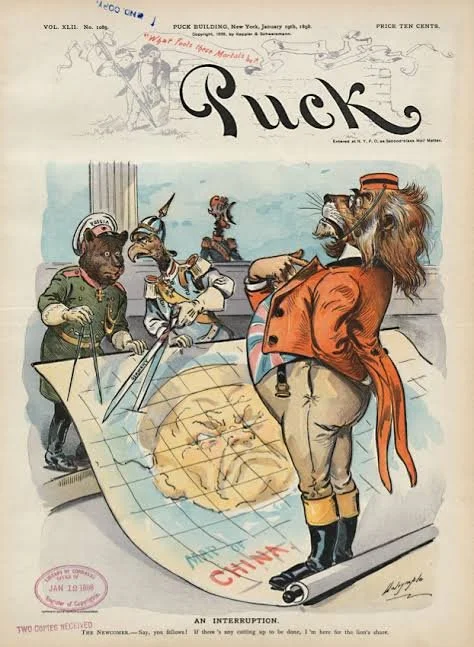
A political cartoon from Punch magazine (c. 1890) depicting missionaries carving up a map of Africa. Source: British Library.
As colonial authority emerged and expanded in Africa during the 1890s and early twentieth century, missionaries also became influential within early colonial administration. Mission stations served as logistical centers, while missionaries acted as advisers, translators, and intermediaries between colonial officials and African communities. In Buganda, mission-educated native leaders such as Apolo Kagwa worked alongside missionary advisers and British officials in shaping early administrative systems under colonial rule.[22] Similar patterns emerged also in Nyasaland, where Scottish missionaries advised early colonial administrators on governance, labor organization, and local political structures.[23] Along the Niger, mission-educated native elites likewise assisted colonial authorities in communication and governance.[24] These reflect a broader continental pattern in which missionary networks influenced early colonial administration.
While missionaries played significant roles in shaping treaties, diplomacy, and early colonial administration, these processes were shaped by pronounced power imbalances. African rulers often relied on missionaries for interpretation, diplomatic communication, and understanding of European political systems, placing missionaries in positions of disproportionate influence over negotiations and agreements.[25] These imbalances were further reinforced by differences in military power, access to information, and legal knowledge, which enabled treaties and diplomatic arrangements to favor European interests while appearing as mutual agreements.[26] In a nutshell, missionary participation in diplomacy and governance contributed to the establishment of colonial authority and that participation also demonstrates the unequal political relationships that characterized European colonial rule across Africa.
3. Missionaries and Colonial Authority: Collaboration, Conflict, and Contradiction
The consolidation of colonial rule following treaty making, diplomatic engagement, and early administrative arrangements transformed the position missionaries occupied within emerging colonial states. Having helped legitimize imperial expansion, missionaries now confronted the practical realities of colonial governance. In this new phase, missionaries sometimes reinforced colonial authority and, at other times, came into direct conflict with colonial officials when imperial policies threatened African communities or missionary objectives. This evolving relationship emerged as colonial governance became more firmly established. Missionaries’ earlier influence in diplomacy and political alignment increasingly translated into direct engagement with colonial authority, including administrative collaboration and mediation.
3.1 Missionaries as Partners of Colonial Authority: Administrative and Ideological Support
In the early phase of colonial consolidation during the late nineteenth century, missionaries frequently supported colonial authority, particularly where European rule promised stability and expanded opportunities for evangelization. Missionaries often encouraged African rulers to accept European protection, viewing colonial rule as a means to end warfare and suppress the slave trade, which missionaries had long identified as major obstacles to Christian expansion.[27] In Buganda (present day Central Uganda), Protestant missionaries played an influential role in shaping political alignments that ultimately favored British intervention during the religious wars of the late nineteenth century, helping legitimize imperial authority amid internal religious and political rivalries.[28]
Similarly, Catholic missionaries in French West Africa often worked alongside colonial administrators, supporting French expansion under the ideological framework of the civilizing mission. Mission stations frequently became early centers of cultural transformation and administrative influence, as missionaries encouraged African communities to adopt European education, Christianity, and governance structures aligned with colonial objectives. In Senegal, for example, Catholic mission schools in Saint‑Louis and Gorée worked closely with French administrators, promoting French language education and administrative practices that prepared African converts for roles within colonial governance.[29]
In German East Africa, missionaries also cooperated with colonial authorities during the establishment of administrative control. Missionaries would provide linguistic skills and knowledge of local societies that colonial officials lacked, allowing colonial administrations to communicate, negotiate, and extend authority more effectively in newly conquered territories.[30]
As colonial administrations expanded in the 1890s and early twentieth century, missionaries increasingly contributed to governance structures through education and administrative support. Mission schools trained Africans who later served as clerks, interpreters, and intermediaries within colonial administrations, creating a new class of mission‑educated African elites who were integrated into colonial governance.[31] In the Uganda Protectorate, mission‑educated Africans became essential intermediaries between colonial officials and local populations, reinforcing both missionary influence and colonial administration.[32]
Missionaries also supported colonial authority through the promotion of the civilizing ideology that justified imperial expansion. Many missionaries viewed European rule as a necessary stage in transforming African societies, arguing that colonial authority would facilitate Christianization, education, and social reform.[33] The legacy of missionary figures such as David Livingstone further reinforced the idea that Christianity, commerce, and colonial rule were interconnected forces for African transformation.[34]
In French colonial territories, Catholic missions reinforced assimilation policies by encouraging the adoption of French language, education, and social practices.[35] In Senegal’s Four Communes of Saint‑Louis, Gorée, Rufisque, and Dakar, Catholic mission schools promoted French curricula and civic education that prepared African elites for participation in French colonial administration.[36] Similarly, in French Dahomey (present‑day Benin), mission schools trained African converts in French language and administrative practices, creating intermediaries who would later serve within colonial bureaucracies.[37] Mission schools therefore functioned as institutions not only of conversion but also of cultural transformation aligned with colonial objectives.
3.2 Missionaries and Colonial Disagreements: Conflict, Criticism, and Resistance
However, as colonial rule matured, tensions between missionaries and colonial officials began to emerge. Missionaries increasingly came into conflict with colonial authorities over labor exploitation, land alienation, and administrative brutality that disrupted African communities and undermined missionary work.[38] In the Congo Free State, missionaries documented abuses associated with rubber extraction, including forced labor and violence, and became among the earliest critics of colonial practices under King Leopold’s administration.[39]
Similar tensions emerged in Southern Rhodesia, where missionaries objected to settler land alienation policies that displaced African communities. Missionaries feared that land dispossession destabilized African societies and weakened Christian communities they had worked to establish.[40]
Same kind of tensions were observed in German East Africa as missionary criticism intensified following the Maji‑Maji rebellion, where harsh colonial repression and forced labor policies disrupted African societies and hindered missionary activities among affected populations.[41]
By the early twentieth century, conflicts between missionaries and European settler communities became particularly pronounced. Unlike colonial administrators, who represented imperial governments and were primarily concerned with political control and administrative governance, settlers were European immigrants who acquired land for farming and commercial enterprise, often seeking permanent residence and economic dominance within African territories. These differing priorities frequently placed settlers in direct opposition to missionaries, whose work depended on stable African communities and access to land for mission stations and converts.
In Kenya, European settlers in the fertile Kikuyu highlands pushed for extensive land alienation to establish large‑scale agricultural estates. Missionaries working among the Kikuyu, however, opposed these land seizures, arguing that displacement disrupted African societies, weakened Christian communities, and undermined missionary progress. This disagreement generated sustained friction, as settlers demanded further land acquisition while missionaries warned that dispossession would fuel instability and resistance among African populations.[42]
This growing friction between missionaries and colonial authorities also extended beyond land and labor disputes, as missionaries increasingly found themselves aligned with African grievances and resistance movements where colonial policies threatened African converts and Christian communities. In Nyasaland (present‑day Malawi), missionary engagement with African concerns led to the 1915 Chilembwe uprising, illustrating how missionary‑educated African elites increasingly interpreted colonial injustices through Christian teachings on equality and justice. The uprising was led by John Chilembwe, an African Baptist pastor educated through missionary networks, he mobilized resistance partly in response to harsh labor practices and racial discrimination on European estates, particularly the exploitative thangata labor system, which had drawn criticism from missionary circles concerned about the moral legitimacy of colonial labor regimes.[43]
Although missionaries in Nyasaland did not uniformly support the rebellion themselves, several mission‑educated Africans participated, and missionary institutions became associated with African political consciousness and protest. Colonial authorities subsequently grew suspicious of missionary influence, fearing that mission education and Christian teachings about equality and justice encouraged African resistance. These developments intensified tensions between colonial administrators and missionaries, particularly where African converts increasingly sought missionary protection against colonial abuses and discriminatory policies.[44]
These conflicts revealed a growing divide within the colonial project. While missionaries often supported imperial expansion and administrative consolidation, they also resisted colonial policies that threatened African stability or missionary objectives.[45] Missionaries thus emerged as both collaborators and critics within the colonial system, reinforcing imperial rule while simultaneously shaping the limits of colonial authority.[46]
By the early twentieth century, missionaries occupied a dual position within colonial Africa. Their educational institutions, administrative influence, and cultural transformation reinforced colonial authority, yet their advocacy for African communities occasionally challenged colonial policies. This complex relationship reflected the broader contradictions of empire, where religious, humanitarian, and imperial ambitions intersected and sometimes collided.[47]
4. Rival Christian Denominations: Competition, Territory, and Colonial Influence
As missionary expansion accelerated and their influence grew alongside colonial consolidation, rival Christian denominations increasingly competed for converts, territorial access, and influence within emerging colonial administrations, creating conflicts driven primarily by competing institutional interests. Protestant and Catholic missions increasingly competed for converts, territorial influence, and access to colonial administrations. This denominational rivalry shaped African political alignments, influenced colonial decision‑making, and contributed to the fragmentation of Christian communities across the continent.[48]
This denominational competition emerged even before colonial rule was firmly established, as missionaries sought influence among African rulers, strategic settlement locations, and early converts who would strengthen their institutional presence. In Buganda (present‑day Central Uganda) during the late nineteenth century, Anglican missionaries from the Church Missionary Society and Catholic White Fathers competed intensely for royal patronage and political influence, contributing to religious divisions within the kingdom as competing Christian factions aligned with political elites and participated in the religious wars of the 1880s and 1890s.[49]
These religious rivalries quickly assumed political dimensions. Protestant missionaries increasingly gained support from British officials, while Catholic missionaries were often perceived as aligned with French interests. This alignment became decisive during the conflicts of 1888–1892, when Protestant missionaries of the Church Missionary Society, working closely with British representatives such as Captain Frederick Lugard of the Imperial British East Africa Company, encouraged British intervention to stabilize Buganda under Protestant leadership. This intervention strengthened Protestant factions and contributed to the consolidation of British authority, culminating in the declaration of the Uganda Protectorate in 1894 and the establishment of Protestant political dominance within the emerging colonial administration.[50]
Similar denominational competition emerged in West Africa. In Sierra Leone and the Gold Coast (present‑day Ghana), Wesleyan Methodist missionaries, Anglican missions of the Church Missionary Society, and the Basel Mission originating from Swiss and German Protestant traditions competed for converts, school enrollment, and mission territory, with these missions establishing rival networks of schools and congregations that expanded into overlapping regions of influence.[51]
This rivalry extended beyond evangelization into education, literacy, and political influence, as mission schools became instruments for attracting African elites and shaping emerging Christian communities. In the Gold Coast, for instance, Wesleyan missions expanded along coastal trading towns, while the Basel Mission moved inland into Akan and other interior regions, creating overlapping spheres of influence and denominational competition for converts and institutional presence. These developments in turn led to intensified rivalry over school establishment, access to local chiefs, and the consolidation of denominational loyalties that shaped emerging Christian communities and local political alignments.[52]
As European powers formalized colonial control during the Scramble for Africa, denominational rivalry increasingly intersected with imperial politics. Missionaries often relied on colonial administrations for protection, funding, and territorial access, leading denominations to cultivate relationships with particular colonial powers. In Uganda, Anglican missionaries benefited from British colonial support, which reinforced Protestant influence within the emerging colonial administration. Catholic missions, by contrast, struggled to maintain influence in areas where British officials favored Protestant institutions.[53]
In German East Africa, Lutheran missions often received support from German colonial authorities, while Catholic missions competed for converts and territorial presence. This rivalry shaped mission expansion patterns and influenced colonial administrative decisions regarding mission land allocation and education policy.[54]
As rivalry intensified, denominations increasingly divided territories to reduce conflict. These informal arrangements created denominational spheres of influence that shaped Christian expansion across Africa. In Nigeria, Anglican missions concentrated in Yoruba regions, while Catholic missions expanded more strongly into eastern territories. These denominational zones reflected strategic decisions to avoid direct confrontation while maintaining institutional growth.[55]
In Central Africa, Catholic and Protestant missions similarly established territorial boundaries. These arrangements formalized denominational influence and reinforced competition for converts within defined regions.[56]
Education became one of the most significant arenas of denominational competition. Mission schools attracted converts, trained African elites, and expanded denominational loyalty. In Sierra Leone, competing mission schools sought to attract African students, producing denominational competition that extended into church leadership and colonial administration.[57]
In Nigeria, denominational education systems produced African elites aligned with specific missions, as Anglican, Catholic, and Methodist institutions trained competing groups of educated Africans who later assumed roles in local administration, church leadership, and emerging political movements. These educational rivalries reinforced denominational identities, shaped political leadership within colonial societies, and contributed to regional and institutional divisions that persisted into the late colonial and early post‑colonial periods, demonstrating how denominational competition extended beyond religious influence into broader political and social structures.[58]
Colonial administrations often favored certain denominations, intensifying competition. In British territories, Protestant missions frequently received administrative backing in education and governance, while Catholic missions sometimes faced institutional disadvantages, whereas in French territories Catholic missions benefited from policies aligned with French assimilation and cultural expansion. These preferences influenced access to land, education funding, and administrative cooperation, creating uneven denominational growth and reinforcing rivalry across colonial Africa, as missionary expansion increasingly became tied to colonial patronage and political influence.[59]
African converts also played a role in denominational rivalry. As African Christians moved between denominations, missionary competition intensified. In southern Africa and West Africa, African Independent Churches emerged partly in response to denominational tensions and missionary control.[60]
These movements reflected African agency within missionary rivalry and contributed to the diversification of Christian communities across colonial Africa.
These rivalries reinforced missionary expansion but also fragmented Christian communities, demonstrating that denominational competition became an integral feature of missionary activity within colonial Africa.[61]
In conclusion, missionary activity in the late nineteenth and early twentieth centuries extended well beyond a parallel religious enterprise. Expanding networks of mission stations, schools, converts, and communications supplied routes, intelligence, intermediaries, and institutions that enabled European powers to move from influence to occupation. Missionaries participated in diplomacy, treaty-making, and early administration, even as their proximity to power exposed them to the moral tensions of empire. The same presence that facilitated imperial advance could also document abuses, resist settler excess, and challenge policies that threatened African communities.
The result was a sustained fusion of mission and power across African societies. Denominational rivalry, educational systems, political mediation, and the rise of mission-educated intermediaries all fed into the formation of colonial authority, while African actors continued to negotiate, redirect, and contest these processes. By the eve of the twentieth century, missionary Christianity had become intertwined with the institutional and political reordering of the continent shaping not only the spread of belief, but the very structures through which colonial rule was organized, experienced, and, at times, resisted.
Endnotes.
[1] Hastings, Adrian. The Church in Africa 1450–1950. Oxford University Press, 1994, pp. 394–401.
[2] Porter, Andrew. Religion versus Empire? Manchester University Press, 2004, pp. 260–268.
[3] Porter, Andrew. Religion versus Empire? British Protestant Missionaries and Overseas Expansion, 1700–1914. Manchester University Press, 2004, pp. 254–262; Hastings, Adrian. The Church in Africa 1450–1950. Oxford University Press, 1994, pp. 396–400.
[4] Parsons, Neil. King Khama, Emperor Joe, and the Great White Queen. University of Chicago Press, 1998, pp. 176–189; Porter, Andrew. Religion versus Empire? British Protestant Missionaries and Overseas Expansion, 1700–1914. Manchester University Press, 2004, pp. 266–271.
[5] Pirouet, M. Louise. Black Evangelists: The Spread of Christianity in Uganda, 1891–1914. Rex Collings, 1978, pp. 23–31; Ward, Kevin. A History of Global Anglicanism. Cambridge University Press, 2006, pp. 111–114.
[6] Ross, Andrew C. Blantyre Mission and the Making of Modern Malawi. Montfort Press, 1996, pp. 84–96; Ranger, Terence. “African Reactions to the Imposition of Colonial Rule in East and Central Africa.” In The Cambridge History of Africa, Volume 6, edited by J. D. Fage and Roland Oliver, Cambridge University Press, 1985, pp. 289–292.
[7] Ross, Andrew. Blantyre Mission and the Making of Modern Malawi. Montfort Press, 1996, pp. 84–96.
[8] Crowder, Michael. The Story of Nigeria. 4th ed., Faber and Faber, 1978, pp. 156–159; Iliffe, John. Africans: The History of a Continent. 3rd ed., Cambridge University Press, 2017, pp. 193–196.
[9] Ajayi, J.F.A. Christian Missions in Nigeria. Northwestern University Press, 2010, pp. 196–205; Iliffe, John. Africans: The History of a Continent. Cambridge University Press, 2017, pp. 218–224.
[10] Ross, Andrew. Blantyre Mission and the Making of Modern Malawi. Montfort Press, 1996, pp. 84–96.
[11] Ross, Andrew C. Blantyre Mission and the Making of Modern Malawi. Montfort Press, 1996, pp. 72–86; Porter, Andrew. Religion versus Empire? Manchester University Press, 2004, pp. 269–272.
[12] Ajayi, J.F.A. Christian Missions in Nigeria 1841–1891. Longman, 1965, pp. 210–219; Crowder, Michael. West Africa Under Colonial Rule. Northwestern University Press, 1968, pp. 88–94.
[13] Reid, Richard. Political Power in Pre‑Colonial Buganda. James Currey, 2002, pp. 256–263; Ward, Kevin. A History of Global Anglicanism. Cambridge University Press, 2006, pp. 120–125.
[14] Ajayi, J.F.A. Christian Missions in Nigeria 1841–1891. Longman, 1965, pp. 131–148; Hastings, Adrian. The Church in Africa 1450–1950. Oxford University Press, 1994, pp. 310–315.
[15] McCracken, John. A History of Malawi, 1859–1966. James Currey, 2012, pp. 58–66; Ross, Andrew. Blantyre Mission and the Making of Modern Malawi. Montfort Press, 1996, pp. 120–127.
[16] Ward, Kevin. A History of Global Anglicanism. Cambridge University Press, 2006, pp. 109–118; Pirouet, M. Louise. Black Evangelists. Rex Collings, 1978, pp. 18–28.
[17] Parsons, Neil. King Khama, Emperor Joe and the Great White Queen. University of Chicago Press, 1998, pp. 176–193.
[18] Ajayi, J.F.A. Christian Missions in Nigeria 1841–1891. Longman, 1965, pp. 210–225; Crowder, Michael. West Africa Under Colonial Rule. Northwestern University Press, 1968, pp. 88–98.
[19] Ross, Andrew C. Blantyre Mission and the Making of Modern Malawi. Montfort Press, 1996, pp. 72–95; Porter, Andrew. Religion versus Empire? Manchester University Press, 2004, pp. 269–275.
[20] Reid, Richard. Political Power in Pre-Colonial Buganda. James Currey, 2002, pp. 256–272.
[21] McCracken, John. A History of Malawi, 1859–1966. James Currey, 2012, pp. 45–66.
[22] Reid, Richard. Political Power in Pre-Colonial Buganda. James Currey, 2002, pp. 273–281; Ward, Kevin. A History of Global Anglicanism. Cambridge University Press, 2006, pp. 120–126.
[23] McCracken, John. A History of Malawi, 1859–1966. James Currey, 2012, pp. 66–82.
[24] Hastings, Adrian. The Church in Africa 1450–1950. Oxford University Press, 1994, pp. 401–410.
[25] Porter, Andrew. Religion versus Empire? Manchester University Press, 2004, pp. 275–281.
[26] Iliffe, John. Africans: The History of a Continent. Cambridge University Press, 2017, pp. 222–231.
[27] Hastings, Adrian. The Church in Africa 1450–1950. Oxford University Press, 1994, pp. 380–382.
[28] Rowe, John. Buganda and the British Overrule, 1900–1955. Oxford University Press, 1969, pp. 14–19.
[29] Hastings, Adrian. The Church in Africa 1450–1950. Oxford University Press, 1994, pp. 382–385.
[30] Iliffe, John. A Modern History of Tanganyika. Cambridge University Press, 1979, pp. 102–105.
[31] Mamdani, Mahmood. Citizen and Subject: Contemporary Africa and the Legacy of Late Colonialism. Princeton University Press, 1996, pp. 37–41.
[32] Iliffe, John. Africans: The History of a Continent. Cambridge University Press, 2007, pp. 213–216.
[33] Porter, Andrew. Religion versus Empire?. Manchester University Press, 2004, pp. 265–270.
[34] Oliver, Roland & Atmore, Anthony. Africa Since 1800. Cambridge University Press, 2005, pp. 149–152.
[35] Sanneh, Lamin. West African Christianity. Orbis Books, 1983, pp. 120–124.
[36] Conklin, Alice L. A Mission to Civilize: The Republican Idea of Empire in France and West Africa, 1895–1930. Stanford University Press, 1997, pp. 66–72.
[37] Sanneh, Lamin. West African Christianity: The Religious Impact. Orbis Books, 1983, pp. 145–150.
[38] Hastings, Adrian. The Church in Africa 1450–1950. Oxford University Press, 1994, pp. 390–392.
[39] Hochschild, Adam. King Leopold's Ghost. Houghton Mifflin, 1998, pp. 186–195.
[40] Ranger, Terence. The African Voice in Southern Rhodesia. Northwestern University Press, 1970, pp. 52–56.
[41] Iliffe, John. A Modern History of Tanganyika. Cambridge University Press, 1979, pp. 173–178.
[42] Sandgren, David P. Christianity and the Kikuyu. Peter Lang, 1989, pp. 110–115.
[43] McCracken, John. Politics and Christianity in Malawi 1875–1940. Cambridge University Press, 1977, pp. 178–184.
[44] McCracken, John. A History of Malawi, 1859–1966. Boydell & Brewer, 2012, pp. 75–79.
[45] Porter, Andrew. Religion versus Empire?. Manchester University Press, 2004, pp. 271–275.
[46] Hastings, Adrian. The Church in Africa 1450–1950. Oxford University Press, 1994, pp. 395–398.
[47] Iliffe, John. Africans: The History of a Continent. Cambridge University Press, 2007, pp. 220–223.
[48] Hastings, Adrian. The Church in Africa 1450–1950. Oxford University Press, 1994, pp. 402–405.
[49] Rowe, John. Buganda and the British Overrule, 1900–1955. Oxford University Press, 1969, pp. 20–27.
[50] Porter, Andrew. Religion versus Empire?. Manchester University Press, 2004, pp. 280–284.
[51] Ajayi, J.F.A. Christian Missions in Nigeria 1841–1891. Longman, 1965, pp. 98–104; Sanneh, Lamin. West African Christianity. Orbis Books, 1983, pp. 155–160.
[52] Sanneh, Lamin. West African Christianity. Orbis Books, 1983, pp. 160–165.
[53] Hastings, Adrian. The Church in Africa 1450–1950. Oxford University Press, 1994, pp. 410–415.
[54] Iliffe, John. A Modern History of Tanganyika. Cambridge University Press, 1979, pp. 190–196.
[55] Ajayi, J.F.A. Christian Missions in Nigeria 1841–1891. Longman, 1965, pp. 230–236.
[56] Oliver, Roland & Atmore, Anthony. Africa Since 1800. Cambridge University Press, 2005, pp. 180–185.
[57] Sanneh, Lamin. West African Christianity. Orbis Books, 1983, pp. 170–175.
[58] Ajayi, J.F.A. Christian Missions in Nigeria 1841–1891. Longman, 1965, pp. 240–244.
[59] Porter, Andrew. Religion versus Empire? British Protestant Missionaries and Overseas Expansion, 1700–1914. Manchester University Press, 2004, pp. 296–301; Hastings, Adrian. The Church in Africa 1450–1950. Oxford University Press, 1994, pp. 430–434.
[60] Ranger, Terence. African Voice in Southern Rhodesia. Northwestern University Press, 1970, pp. 75–80.
[61] Walls, Andrew. The Missionary Movement in Christian History. Orbis Books, 1996, pp. 102–108.
Bibliography
Ajayi, J. F. A. Christian Missions in Nigeria 1841–1891. London: Longman, 1965.
Ajayi, J. F. A. Christian Missions in Nigeria. Evanston: Northwestern University Press, 2010.
Conklin, Alice L. A Mission to Civilize. Stanford: Stanford University Press, 1997.
Crowder, Michael. The Story of Nigeria. London: Faber and Faber, 1978.
Crowder, Michael. West Africa Under Colonial Rule. Evanston: Northwestern University Press, 1968.
Hastings, Adrian. The Church in Africa 1450–1950. Oxford: Oxford University Press, 1994.
Hochschild, Adam. King Leopold’s Ghost. Boston: Houghton Mifflin, 1998.
Iliffe, John. Africans: The History of a Continent. Cambridge: Cambridge University Press, 2017.
Iliffe, John. A Modern History of Tanganyika. Cambridge: Cambridge University Press, 1979.
Mamdani, Mahmood. Citizen and Subject. Princeton: Princeton University Press, 1996.
McCracken, John. A History of Malawi. Woodbridge: James Currey, 2012.
McCracken, John. Politics and Christianity in Malawi. Cambridge: Cambridge University Press, 1977.
Oliver, Roland, and Anthony Atmore. Africa Since 1800. Cambridge: Cambridge University Press, 2005.
Parsons, Neil. King Khama, Emperor Joe, and the Great White Queen. Chicago: University of Chicago Press, 1998.
Pirouet, M. Louise. Black Evangelists. London: Rex Collings, 1978.
Porter, Andrew. Religion versus Empire? Manchester: Manchester University Press, 2004.
Ranger, Terence. The African Voice in Southern Rhodesia. Evanston: Northwestern University Press, 1970.
Reid, Richard. Political Power in Pre‑Colonial Buganda. Woodbridge: James Currey, 2002.
Ross, Andrew C. Blantyre Mission and the Making of Modern Malawi. Limbe: Montfort Press, 1996.
Rowe, John. Buganda and the British Overrule. Oxford: Oxford University Press, 1969.
Sanneh, Lamin. West African Christianity. Maryknoll: Orbis Books, 1983.
Sandgren, David P. Christianity and the Kikuyu. New York: Peter Lang, 1989.
Ward, Kevin. A History of Global Anglicanism. Cambridge: Cambridge University Press, 2006.
Walls, Andrew. The Missionary Movement in Christian History. Maryknoll: Orbis Books, 1996.
Research by: Atwiine Emmer
Paper written by: Ezron Kaijuka
